 Add to Chrome
 Add to Firefox
 Add to Edge
StreamSplat: Streaming Feed-Forward 3D Gaussian Splatting
Aug 03, 2026
Feed-forward 3D Gaussian Splatting enables efficient novel-view synthesis without per-scene optimization, but most existing methods assume a fixed set of context views and process them jointly. This limits their applicability to online scenarios where calibrated views arrive sequentially and the scene must be updated causally. We present \emph{StreamSplat}, a streaming feed-forward 3DGS framework that incrementally maintains a persistent geometry-grounded scene state and decodes it into renderable 3D Gaussians after each input chunk. StreamSplat centers on a \textbf{Voxel-Aligned Causal Cache (VACC)}, which stores historical 3D tokens in a memory-bounded voxel structure so that memory grows with explored scene geometry rather than stream length. To better reuse history during causal prediction, we introduce \textbf{History-Projected Depth Anchoring (HPDA)} to project cached geometry as depth guidance for current cost-volume estimation, and \textbf{Cache-Guided Feature Injection (CGFI)} to inject cached latent evidence into Gaussian-token regression. Experiments on DL3DV, RealEstate10K, and ScanNet show that StreamSplat remains competitive with state-of-the-art feed-forward 3DGS methods under sparse causal inputs, despite not using future views or full-scene context. More importantly, it scales to long input streams with 256, 512, and 1024 views where fixed-view baselines run out of memory, yielding sustained improvements in novel-view synthesis quality as more observations arrive. The code will be made publicly available upon acceptance.

Large Emotional World Model
Dec 30, 2025World Models serve as tools for understanding the current state of the world and predicting its future dynamics, with broad application potential across numerous fields. As a key component of world knowledge, emotion significantly influences human decision-making. While existing Large Language Models (LLMs) have shown preliminary capability in capturing world knowledge, they primarily focus on modeling physical-world regularities and lack systematic exploration of emotional factors. In this paper, we first demonstrate the importance of emotion in understanding the world by showing that removing emotionally relevant information degrades reasoning performance. Inspired by theory of mind, we further propose a Large Emotional World Model (LEWM). Specifically, we construct the Emotion-Why-How (EWH) dataset, which integrates emotion into causal relationships and enables reasoning about why actions occur and how emotions drive future world states. Based on this dataset, LEWM explicitly models emotional states alongside visual observations and actions, allowing the world model to predict both future states and emotional transitions. Experimental results show that LEWM more accurately predicts emotion-driven social behaviors while maintaining comparable performance to general world models on basic tasks.
Large Language Models for Subjective Language Understanding: A Survey
Aug 11, 2025Subjective language understanding refers to a broad set of natural language processing tasks where the goal is to interpret or generate content that conveys personal feelings, opinions, or figurative meanings rather than objective facts. With the advent of large language models (LLMs) such as ChatGPT, LLaMA, and others, there has been a paradigm shift in how we approach these inherently nuanced tasks. In this survey, we provide a comprehensive review of recent advances in applying LLMs to subjective language tasks, including sentiment analysis, emotion recognition, sarcasm detection, humor understanding, stance detection, metaphor interpretation, intent detection, and aesthetics assessment. We begin by clarifying the definition of subjective language from linguistic and cognitive perspectives, and we outline the unique challenges posed by subjective language (e.g. ambiguity, figurativeness, context dependence). We then survey the evolution of LLM architectures and techniques that particularly benefit subjectivity tasks, highlighting why LLMs are well-suited to model subtle human-like judgments. For each of the eight tasks, we summarize task definitions, key datasets, state-of-the-art LLM-based methods, and remaining challenges. We provide comparative insights, discussing commonalities and differences among tasks and how multi-task LLM approaches might yield unified models of subjectivity. Finally, we identify open issues such as data limitations, model bias, and ethical considerations, and suggest future research directions. We hope this survey will serve as a valuable resource for researchers and practitioners interested in the intersection of affective computing, figurative language processing, and large-scale language models.
Emotion-o1: Adaptive Long Reasoning for Emotion Understanding in LLMs
May 28, 2025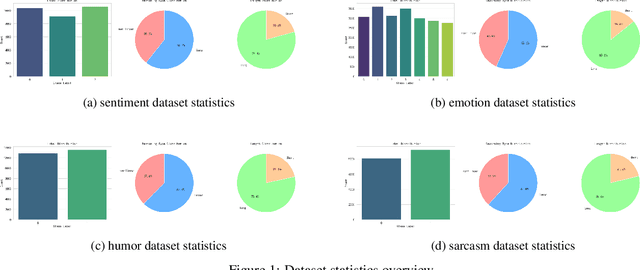
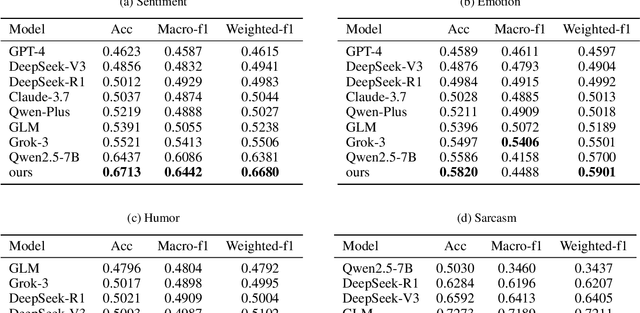
Emotion understanding includes basic tasks (e.g., sentiment/emotion classification) and advanced tasks (e.g., sarcasm/humor detection). Current methods rely on fixed-length CoT reasoning, failing to adapt to the varying complexity of emotions. We propose a task-adaptive reasoning framework that employs DeepSeek-R1 to generate variable-length reasoning chains for different emotion tasks. By combining fine-tuning with reinforcement learning, we design a composite reward function that balances four objectives: prediction accuracy, adaptive reasoning depth control, structural diversity in reasoning paths, and suppression of repetitive logic. This approach achieves dynamic context-sensitive inference while enabling LLMs to autonomously develop deep reasoning capabilities. Experimental results demonstrate consistent improvements in both Acc and F1 scores across four tasks: emotion, sentiment, humor, and sarcasm. Notably, peak enhancements reached 3.56% F1 (2.76% Acc) for basic tasks and 37.95% F1 (23.14% Acc) for advanced tasks. Our work bridges rigid CoT reasoning and emotional complexity through adaptive-depth analysis.