 Add to Chrome
 Add to Firefox
 Add to Edge
Romanized Arabic Across Dialects: Views, Usage Patterns, and Linguistic Variation
Aug 03, 2026
Arabizi refers to Arabic written in Latin script. Although previous studies have shown that the prevalence and usage of Arabizi vary by factors such as region and age group, most NLP research on Arabic texts treats it as a temporary phenomenon resulting from limited technological support for the Arabic script. In this work, we engage with Arabic speakers to collect insights on their perceptions and usage of Arabizi. We further examine writing norms among speakers of different dialects, focusing on Algerian, Egyptian, Lebanese, Moroccan, and Tunisian Arabic. To this end, we release two resources. First, a character-level alignment of Arabic words to study inter- and intra-dialectal variation across these five dialects, based on words transliterated by survey participants, finding systematic intra-dialectal regularity and inter-dialectal variation. Second, to study Arabic speakers' ability to identify this stylistic variation at the sentence-level, we build a manually curated parallel corpus of sentences written in Arabic script alongside multiple Arabizi transliterations, collected from speakers of the same five dialects. Our study presents the largest human-centered, cross-dialectal study of Arabizi's perceptions and practices to date.

MAFALDA: A Benchmark and Comprehensive Study of Fallacy Detection and Classification
Nov 16, 2023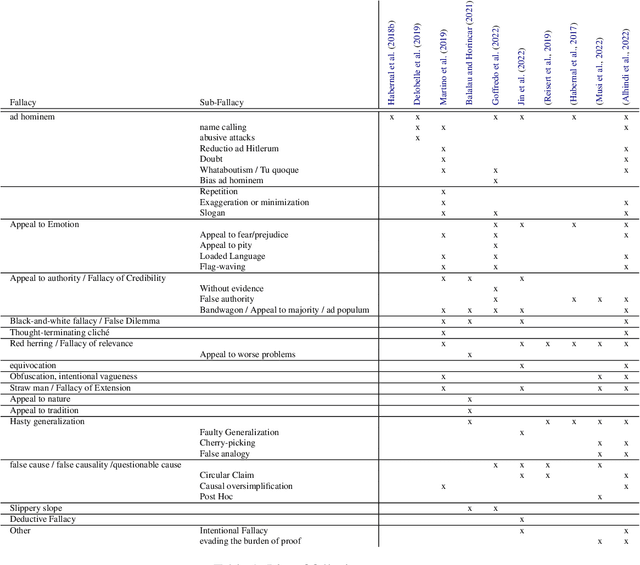
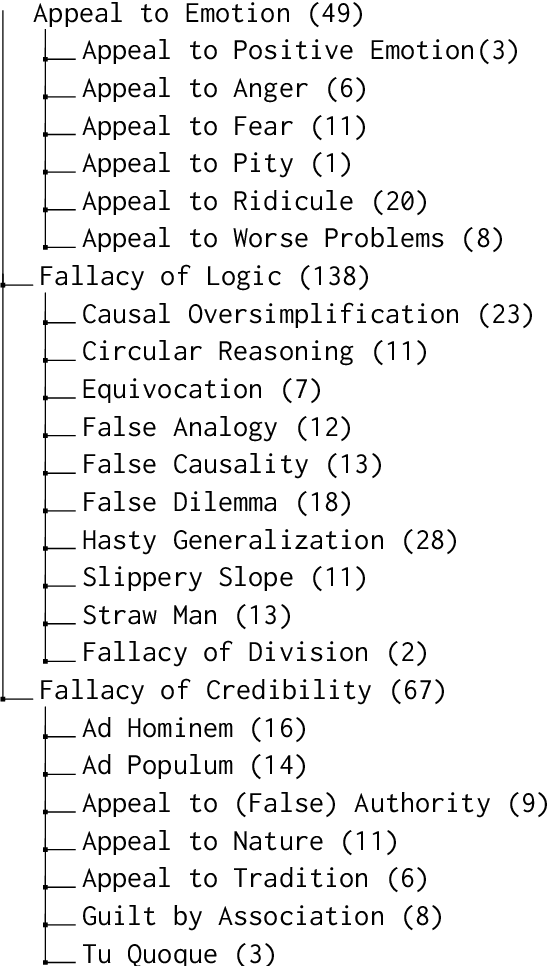
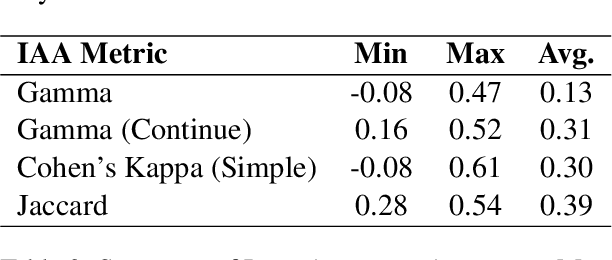
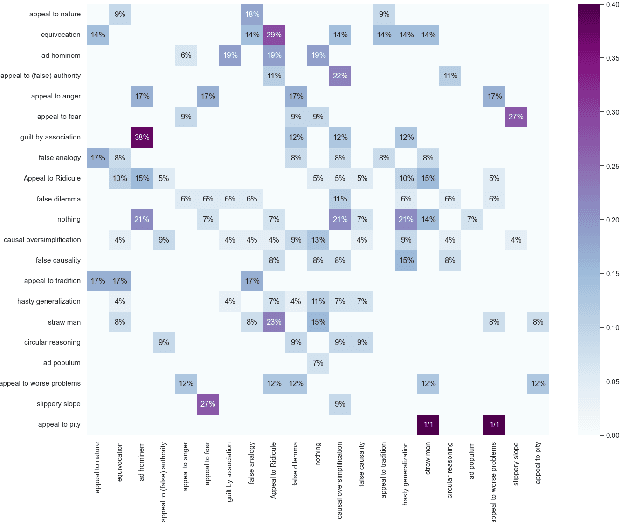
Fallacies can be used to spread disinformation, fake news, and propaganda, underlining the importance of their detection. Automated detection and classification of fallacies, however, remain challenging, mainly because of the innate subjectivity of the task and the need for a comprehensive, unified approach in existing research. Addressing these limitations, our study introduces a novel taxonomy of fallacies that aligns and refines previous classifications, a new annotation scheme tailored for subjective NLP tasks, and a new evaluation method designed to handle subjectivity, adapted to precision, recall, and F1-Score metrics. Using our annotation scheme, the paper introduces MAFALDA (Multi-level Annotated FALlacy DAtaset), a gold standard dataset. MAFALDA is based on examples from various previously existing fallacy datasets under our unified taxonomy across three levels of granularity. We then evaluate several language models under a zero-shot learning setting using MAFALDA to assess their fallacy detection and classification capability. Our comprehensive evaluation not only benchmarks the performance of these models but also provides valuable insights into their strengths and limitations in addressing fallacious reasoning.