 Add to Chrome
 Add to Firefox
 Add to Edge
Declarative Skills for AI Agents in Knowledge-Grounded Tool-Use Workflows
Jun 05, 2026
We study orchestration mechanisms for tool-using AI agents in realistic customer-service workflows over an unstructured knowledge base. We argue that declarative agents -- AI agents equipped with natural-language skill files appended to the system prompt -- are an effective orchestration paradigm. Concretely, we compare (i) a DeclarativeAgent that reads three domain-specific skill files at inference time and decides its own control flow, (ii) an ImperativeAgent based on a programmatic state machine with explicit phases, and (iii) an unscaffolded baseline agent modeled after the $τ$-Knowledge benchmark agent. Our ImperativeAgent is motivated by externalised-control inference as in Recursive Language Models and graph-based orchestration frameworks. We formalise the three agents as policy classes within a decentralised partially-observable Markov decision process and analyse their information-theoretic and structural properties; we then test the predicted differences empirically on five language models and two retrieval regimes. Our results show that retrieval quality is a dominant bottleneck for AI agents: when evidence is incomplete or skewed, all agents degrade substantially, and skill files cannot recover lost performance. Under high-quality retrieval, however, declarative skills consistently improve accuracy on procedural tasks and reduce orchestration errors, while the imperative state machine's brittleness does not reliably improve task success or compliance.

Missing Wedge Inpainting and Joint Alignment in Electron Tomography through Implicit Neural Representations
Dec 08, 2025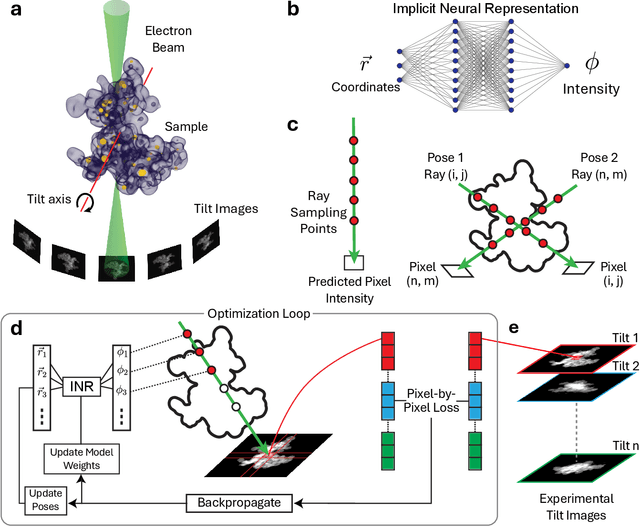
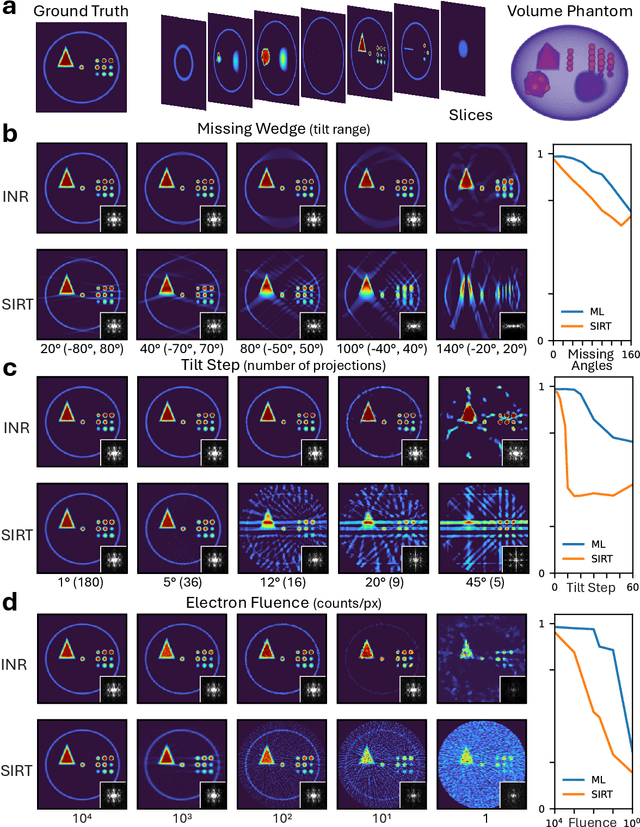
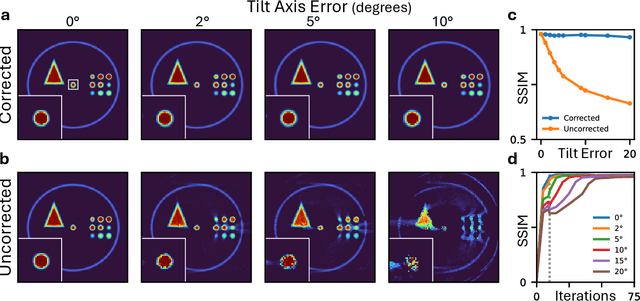
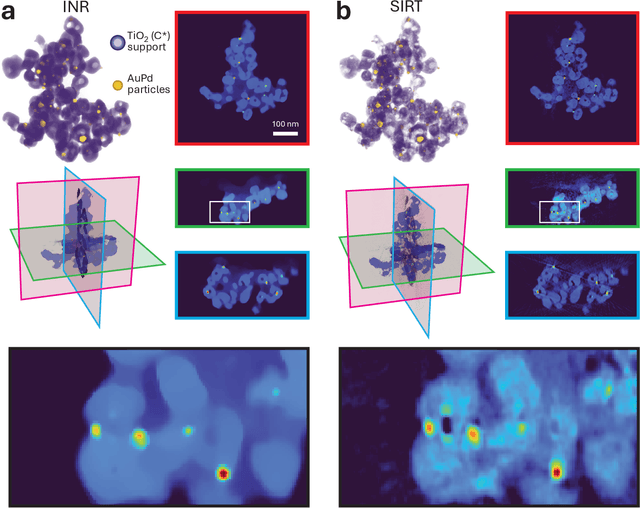
Electron tomography is a powerful tool for understanding the morphology of materials in three dimensions, but conventional reconstruction algorithms typically suffer from missing-wedge artifacts and data misalignment imposed by experimental constraints. Recently proposed supervised machine-learning-enabled reconstruction methods to address these challenges rely on training data and are therefore difficult to generalize across materials systems. We propose a fully self-supervised implicit neural representation (INR) approach using a neural network as a regularizer. Our approach enables fast inline alignment through pose optimization, missing wedge inpainting, and denoising of low dose datasets via model regularization using only a single dataset. We apply our method to simulated and experimental data and show that it produces high-quality tomograms from diverse and information limited datasets. Our results show that INR-based self-supervised reconstructions offer high fidelity reconstructions with minimal user input and preprocessing, and can be readily applied to a wide variety of materials samples and experimental parameters.