 Add to Chrome
 Add to Firefox
 Add to Edge
Unsupervised clustering algorithm for efficient processing of 4D-STEM and 5D-STEM data
Jan 24, 2026
Four-dimensional scanning transmission electron microscopy (4D-STEM) enables mapping of diffraction information with nanometer-scale spatial resolution, offering detailed insight into local structure, orientation, and strain. However, as data dimensionality and sampling density increase, particularly for in situ scanning diffraction experiments (5D-STEM), robust segmentation of spatially coherent regions becomes essential for efficient and physically meaningful analysis. Here, we introduce a clustering framework that identifies crystallographically distinct domains from 4D-STEM datasets. By using local diffraction-pattern similarity as a metric, the method extracts closed contours delineating regions of coherent structural behavior. This approach produces cluster-averaged diffraction patterns that improve signal-to-noise and reduce data volume by orders of magnitude, enabling rapid and accurate orientation, phase, and strain mapping. We demonstrate the applicability of this approach to in situ liquid-cell 4D-STEM data of gold nanoparticle growth. Our method provides a scalable and generalizable route for spatially coherent segmentation, data compression, and quantitative structure-strain mapping across diverse 4D-STEM modalities. The full analysis code and example workflows are publicly available to support reproducibility and reuse.

A Gaussian Parameterization for Direct Atomic Structure Identification in Electron Tomography
Dec 17, 2025Atomic electron tomography (AET) enables the determination of 3D atomic structures by acquiring a sequence of 2D tomographic projection measurements of a particle and then computationally solving for its underlying 3D representation. Classical tomography algorithms solve for an intermediate volumetric representation that is post-processed into the atomic structure of interest. In this paper, we reformulate the tomographic inverse problem to solve directly for the locations and properties of individual atoms. We parameterize an atomic structure as a collection of Gaussians, whose positions and properties are learnable. This representation imparts a strong physical prior on the learned structure, which we show yields improved robustness to real-world imaging artifacts. Simulated experiments and a proof-of-concept result on experimentally-acquired data confirm our method's potential for practical applications in materials characterization and analysis with Transmission Electron Microscopy (TEM). Our code is available at https://github.com/nalinimsingh/gaussian-atoms.
Missing Wedge Inpainting and Joint Alignment in Electron Tomography through Implicit Neural Representations
Dec 08, 2025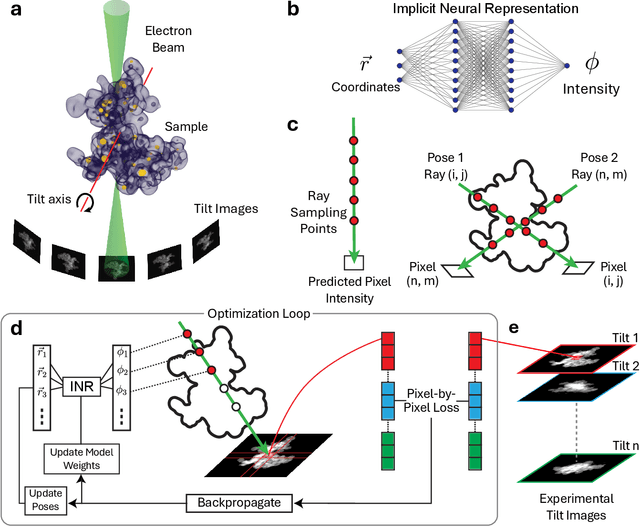
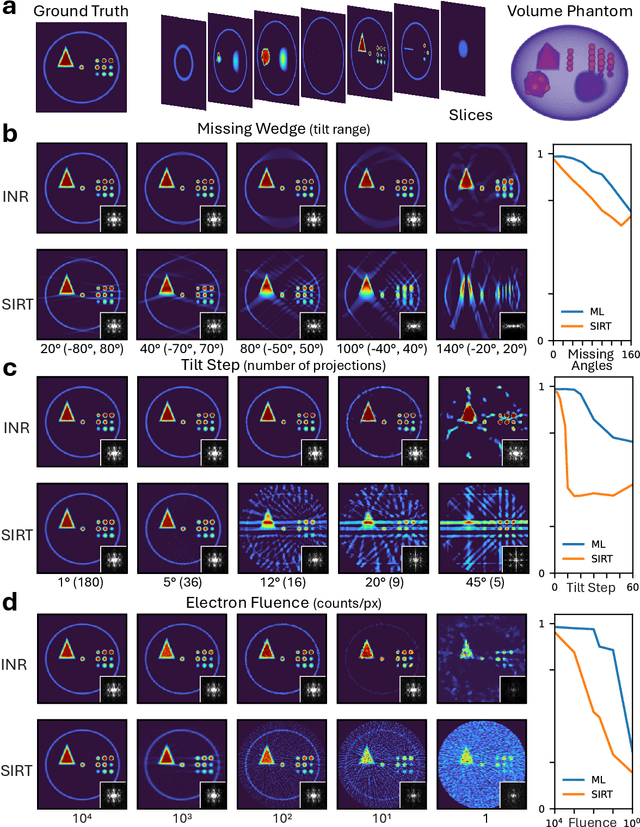
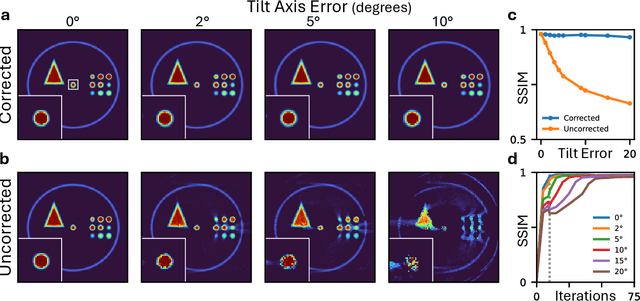
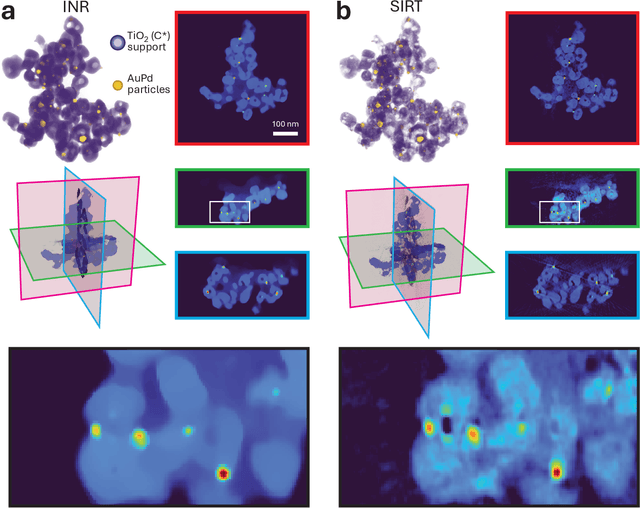
Electron tomography is a powerful tool for understanding the morphology of materials in three dimensions, but conventional reconstruction algorithms typically suffer from missing-wedge artifacts and data misalignment imposed by experimental constraints. Recently proposed supervised machine-learning-enabled reconstruction methods to address these challenges rely on training data and are therefore difficult to generalize across materials systems. We propose a fully self-supervised implicit neural representation (INR) approach using a neural network as a regularizer. Our approach enables fast inline alignment through pose optimization, missing wedge inpainting, and denoising of low dose datasets via model regularization using only a single dataset. We apply our method to simulated and experimental data and show that it produces high-quality tomograms from diverse and information limited datasets. Our results show that INR-based self-supervised reconstructions offer high fidelity reconstructions with minimal user input and preprocessing, and can be readily applied to a wide variety of materials samples and experimental parameters.
Deep generative priors for robust and efficient electron ptychography
Nov 11, 2025Electron ptychography enables dose-efficient atomic-resolution imaging, but conventional reconstruction algorithms suffer from noise sensitivity, slow convergence, and extensive manual hyperparameter tuning for regularization, especially in three-dimensional multislice reconstructions. We introduce a deep generative prior (DGP) framework for electron ptychography that uses the implicit regularization of convolutional neural networks to address these challenges. Two DGPs parameterize the complex-valued sample and probe within an automatic-differentiation mixed-state multislice forward model. Compared to pixel-based reconstructions, DGPs offer four key advantages: (i) greater noise robustness and improved information limits at low dose; (ii) markedly faster convergence, especially at low spatial frequencies; (iii) improved depth regularization; and (iv) minimal user-specified regularization. The DGP framework promotes spatial coherence and suppresses high-frequency noise without extensive tuning, and a pre-training strategy stabilizes reconstructions. Our results establish DGP-enabled ptychography as a robust approach that reduces expertise barriers and computational cost, delivering robust, high-resolution imaging across diverse materials and biological systems.