 Add to Chrome
 Add to Firefox
 Add to Edge
Retrodictive Forecasting: A Proof-of-Concept for Exploiting Temporal Asymmetry in Time Series Prediction
Feb 28, 2026
We propose a retrodictive forecasting paradigm for time series: instead of predicting the future from the past, we identify the future that best explains the observed present via inverse MAP optimization over a Conditional Variational Autoencoder (CVAE). This conditioning is a statistical modeling choice for Bayesian inversion; it does not assert that future events cause past observations. The approach is theoretically grounded in an information-theoretic arrow-of-time measure: the symmetrized Kullback-Leibler divergence between forward and time-reversed trajectory ensembles provides both the conceptual rationale and an operational GO/NO-GO diagnostic for applicability. We implement the paradigm as MAP inference over an inverse CVAE with a learned RealNVP normalizing-flow prior and evaluate it on six time series cases: four synthetic processes with controlled temporal asymmetry and two ERA5 reanalysis datasets (wind speed and solar irradiance). The work makes four contributions: (i) a formal retrodictive inference formulation; (ii) an inverse CVAE architecture; (iii) a model-free irreversibility diagnostic; and (iv) a falsifiable validation protocol with four pre-specified predictions. All pre-specified predictions are empirically supported: the diagnostic correctly classifies all six cases; the learned flow prior improves over an isotropic Gaussian baseline on GO cases; the inverse MAP yields no spurious advantage on time-reversible dynamics; and on irreversible GO cases, it achieves competitive or superior RMSE relative to forward baselines, with a statistically significant 17.7% reduction over a forward MLP on ERA5 solar irradiance. These results provide a structured proof-of-concept that retrodictive forecasting can constitute a viable alternative to conventional forward prediction when statistical time-irreversibility is present and exploitable.

From thermodynamics to protein design: Diffusion models for biomolecule generation towards autonomous protein engineering
Jan 05, 2025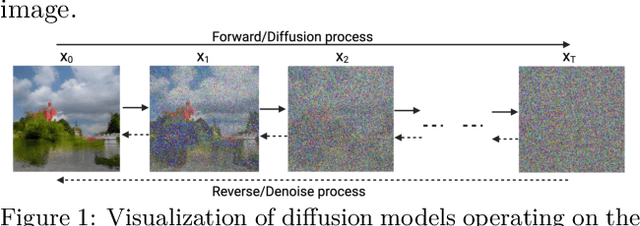
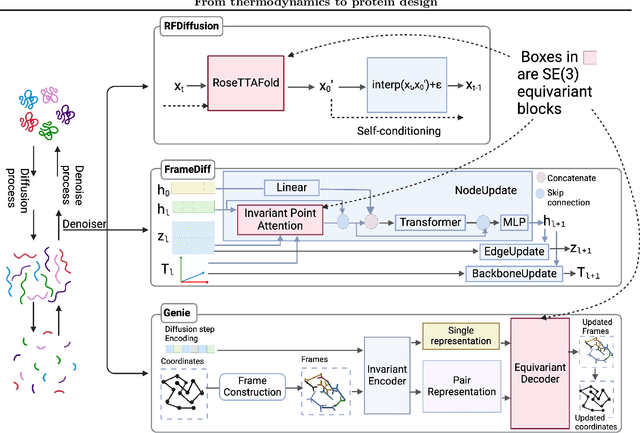
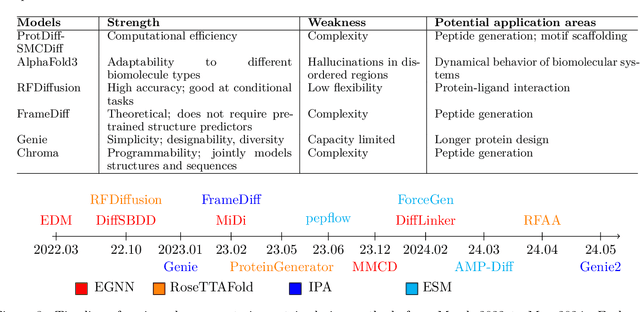
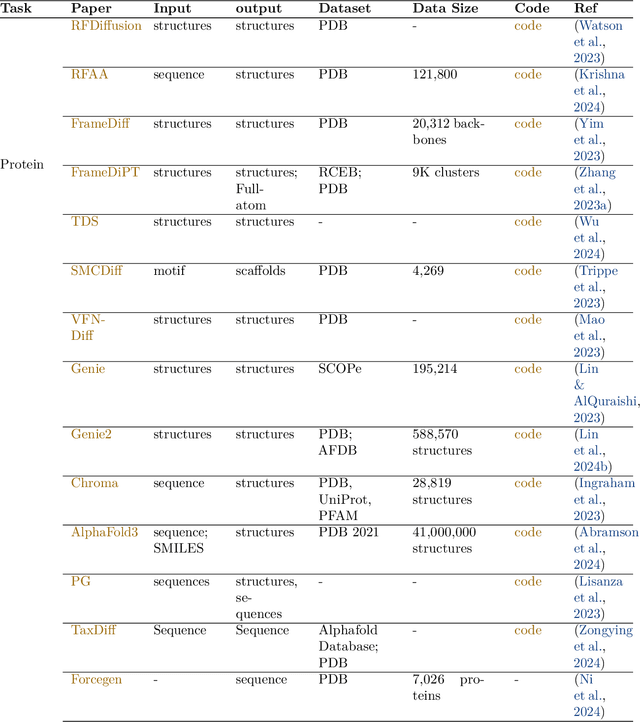
Protein design with desirable properties has been a significant challenge for many decades. Generative artificial intelligence is a promising approach and has achieved great success in various protein generation tasks. Notably, diffusion models stand out for their robust mathematical foundations and impressive generative capabilities, offering unique advantages in certain applications such as protein design. In this review, we first give the definition and characteristics of diffusion models and then focus on two strategies: Denoising Diffusion Probabilistic Models and Score-based Generative Models, where DDPM is the discrete form of SGM. Furthermore, we discuss their applications in protein design, peptide generation, drug discovery, and protein-ligand interaction. Finally, we outline the future perspectives of diffusion models to advance autonomous protein design and engineering. The E(3) group consists of all rotations, reflections, and translations in three-dimensions. The equivariance on the E(3) group can keep the physical stability of the frame of each amino acid as much as possible, and we reflect on how to keep the diffusion model E(3) equivariant for protein generation.