 Add to Chrome
 Add to Firefox
 Add to Edge
OsteoFlow: Lyapunov-Guided Flow Distillation for Predicting Bone Remodeling after Mandibular Reconstruction
Mar 23, 2026
Predicting long-term bone remodeling after mandibular reconstruction would be of great clinical benefit, yet standard generative models struggle to maintain trajectory-level consistency and anatomical fidelity over long horizons. We introduce OsteoFlow, a flow-based framework predicting Year-1 post-operative CT scans from Day-5 scans. Our core contribution is Lyapunov-guided trajectory distillation: Unlike one-step distillation, our method distills a continuous trajectory over transport time from a registration-derived stationary velocity field teacher. Combined with a resection-aware image loss, this enforces geometric correspondence without sacrificing generative capacity. Evaluated on 344 paired regions of interest, OsteoFlow significantly outperforms state of-the-art baselines, reducing mean absolute error in the surgical resection zone by ~20%. This highlights the promise of trajectory distillation for long-term prediction. Code is available on GitHub: OsteoFlow.

VertDetect: Fully End-to-End 3D Vertebral Instance Segmentation Model
Nov 16, 2023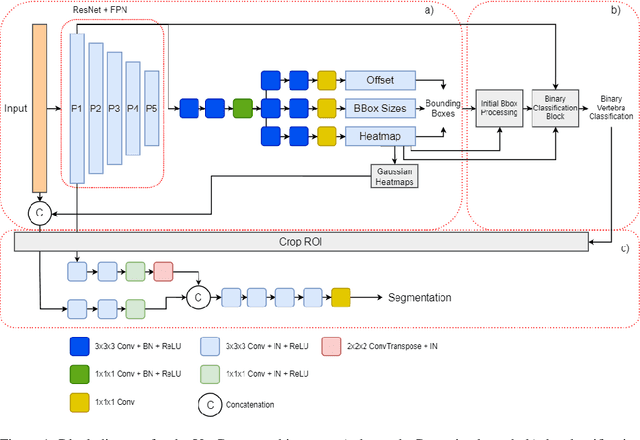
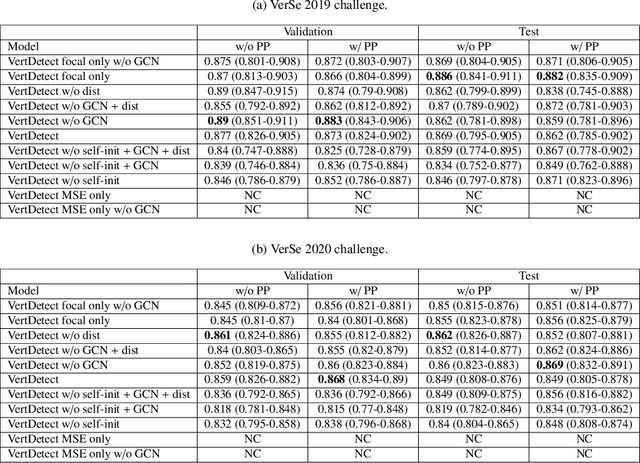
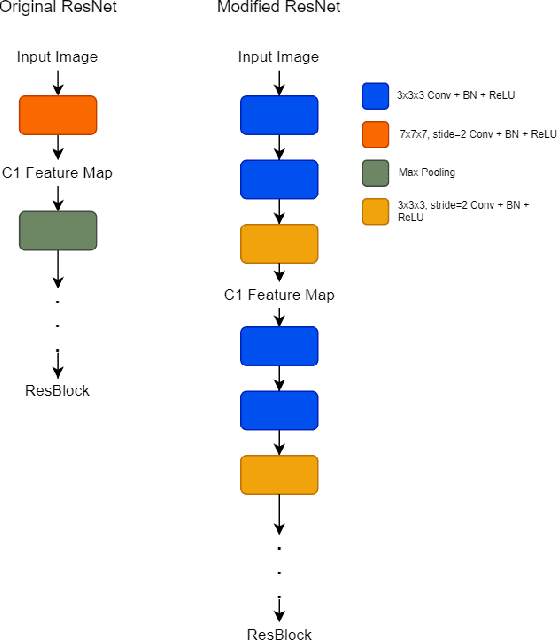
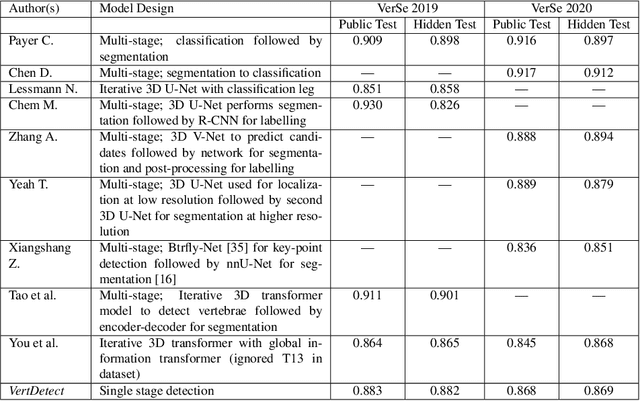
Vertebral detection and segmentation are critical steps for treatment planning in spine surgery and radiation therapy. Accurate identification and segmentation are complicated in imaging that does not include the full spine, in cases with variations in anatomy (T13 and/or L6 vertebrae), and in the presence of fracture or hardware. This paper proposes VertDetect, a fully automated end-to-end 3D vertebral instance segmentation Convolutional Neural Network (CNN) model to predict vertebral level labels and segmentations for all vertebrae present in a CT scan. The utilization of a shared CNN backbone provides the detection and segmentation branches of the network with feature maps containing both spinal and vertebral level information. A Graph Convolutional Network (GCN) layer is used to improve vertebral labelling by using the known structure of the spine. This model achieved a Dice Similarity Coefficient (DSC) of 0.883 (95% CI, 0.843-0.906) and 0.882 (95% CI, 0.835-0.909) in the VerSe 2019 and 0.868 (95\% CI, 0.834-0.890) and 0.869 (95\% CI, 0.832-0.891) in the VerSe 2020 public and hidden test sets, respectively. This model achieved state-of-the-art performance for an end-to-end architecture, whose design facilitates the extraction of features that can be subsequently used for downstream tasks.