 Add to Chrome
 Add to Firefox
 Add to Edge
Enhancing sample efficiency in reinforcement-learning-based flow control: replacing the critic with an adaptive reduced-order model
Apr 05, 2026
Model-free deep reinforcement learning (DRL) methods suffer from poor sample efficiency. To overcome this limitation, this work introduces an adaptive reduced-order-model (ROM)-based reinforcement learning framework for active flow control. In contrast to conventional actor--critic architectures, the proposed approach leverages a ROM to estimate the gradient information required for controller optimization. The design of the ROM structure incorporates physical insights. The ROM integrates a linear dynamical system and a neural ordinary differential equation (NODE) for estimating the nonlinearity in the flow. The parameters of the linear component are identified via operator inference, while the NODE is trained in a data-driven manner using gradient-based optimization. During controller--environment interactions, the ROM is continuously updated with newly collected data, enabling adaptive refinement of the model. The controller is then optimized through differentiable simulation of the ROM. The proposed ROM-based DRL framework is validated on two canonical flow control problems: Blasius boundary layer flow and flow past a square cylinder. For the Blasius boundary layer, the proposed method effectively reduces to a single-episode system identification and controller optimization process, yet it yields controllers that outperform traditional linear designs and achieve performance comparable to DRL approaches with minimal data. For the flow past a square cylinder, the proposed method achieves superior drag reduction with significantly fewer exploration data compared with DRL approaches. The work addresses a key component of model-free DRL control algorithms and lays the foundation for designing more sample-efficient DRL-based active flow controllers.

MarineGym: A High-Performance Reinforcement Learning Platform for Underwater Robotics
Mar 12, 2025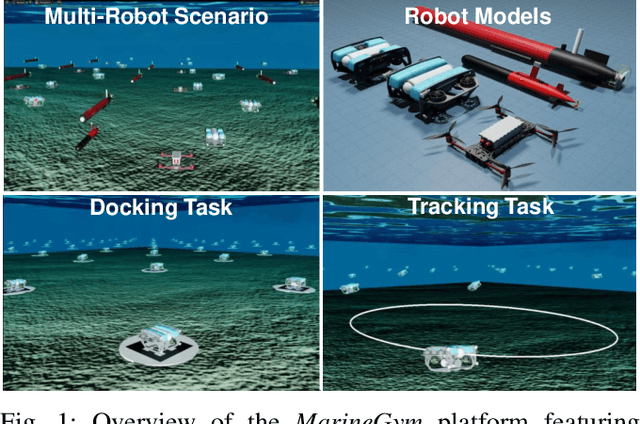
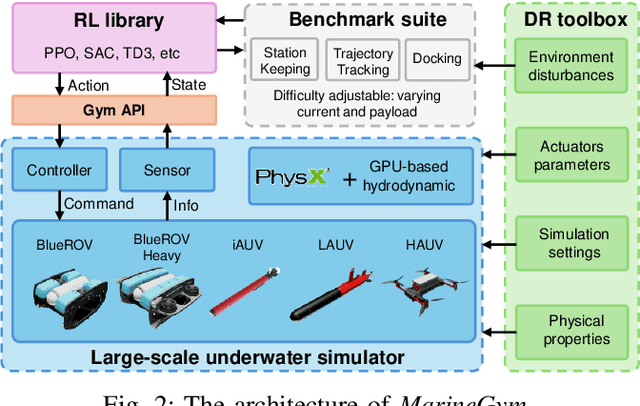
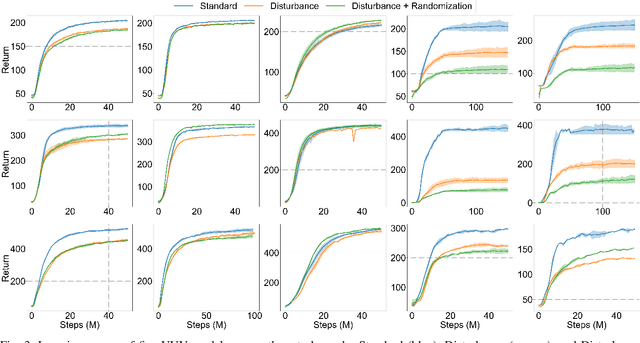
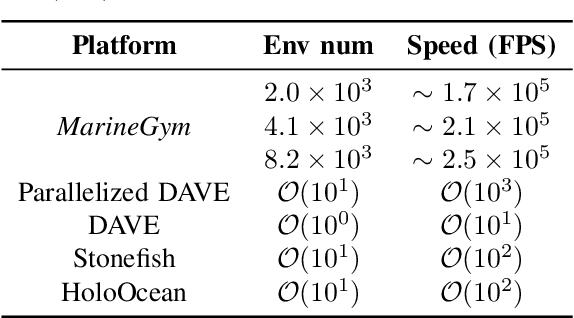
This work presents the MarineGym, a high-performance reinforcement learning (RL) platform specifically designed for underwater robotics. It aims to address the limitations of existing underwater simulation environments in terms of RL compatibility, training efficiency, and standardized benchmarking. MarineGym integrates a proposed GPU-accelerated hydrodynamic plugin based on Isaac Sim, achieving a rollout speed of 250,000 frames per second on a single NVIDIA RTX 3060 GPU. It also provides five models of unmanned underwater vehicles (UUVs), multiple propulsion systems, and a set of predefined tasks covering core underwater control challenges. Additionally, the DR toolkit allows flexible adjustments of simulation and task parameters during training to improve Sim2Real transfer. Further benchmark experiments demonstrate that MarineGym improves training efficiency over existing platforms and supports robust policy adaptation under various perturbations. We expect this platform could drive further advancements in RL research for underwater robotics. For more details about MarineGym and its applications, please visit our project page: https://marine-gym.com/.