 Add to Chrome
 Add to Firefox
 Add to Edge
220-GBd optical coherent waveform generation using temporal unitary transforms
Jun 17, 2026
We use temporal unitary transforms to generate 16-QAM up to 220 GBd using only 50-GHz electrical bandwidth. The technique is theoretically lossless and can generate arbitrary optical waveforms beyond the bandwidth of the constituent modulators.

Dual optical frequency comb downconversion of D-band mm-wave signals
Dec 23, 2025We demonstrate a dual optical frequency comb concept that down-converts arbitrary narrowband D-band (110-170 GHz) signals to baseband without any filter or optical/RF frequency tuning, using low frequency RF components.
Spectro-temporal unitary transformations for coherent modulation: design trade-offs and practical considerations
Dec 19, 2025This paper analyzes the performance of spectro-temporal unitary transforms for coherent optical modulation. Unlike conventional IQ modulation, such transforms are based on a cascade of phase modulators and dispersive elements, so are theoretically lossless and not limited by the bandwidth of the constituent modulators. We analyse the performance limits and design trade-offs of this scheme: estimating how the number of stages, amount of dispersion, modulator bandwidth, symbol block length and electrical signal power impacts the achievable signal-to-distortion ratio (SDR). Importantly, we show that high (>30 dB) SDRs suitable for modern >200 GBd class coherent optical communications are achievable with a low (<6) number of stages and reasonable parameters for driver power, modulator bandwidth and on-chip dispersion. Finally we address the SDR penalties associated with potential phase, amplitude, or dispersion errors, and limited DAC resolution.
Optical arbitrary waveform generation using spectro-temporal unitary transforms
Dec 10, 2025We discuss the prospect of using cascaded phase modulators and dispersive elements to achieve arbitrary optical waveform generation. This transform is not limited by the bandwidth of its constituent modulators and is theoretically lossless.
314-GBaud Single-Wavelength Signaling Generated All-Electronically by a 158-GHz Digital-Band-Interleaved DAC
Apr 21, 2025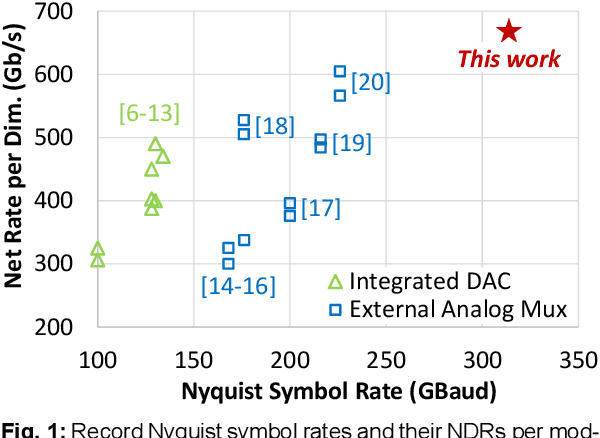
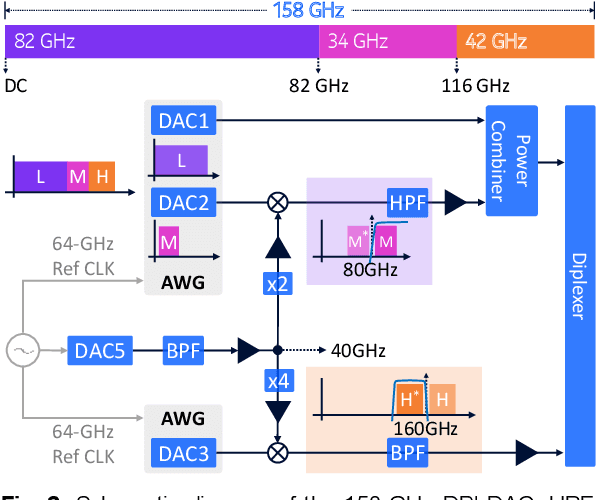
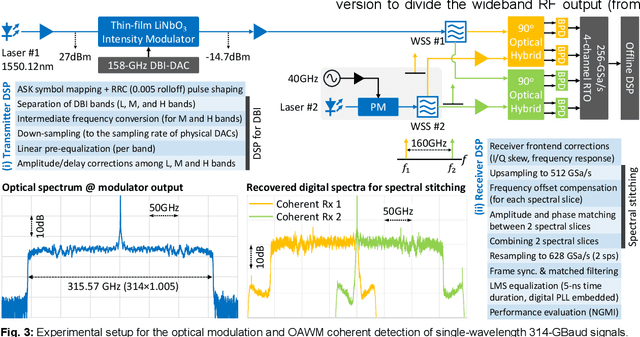
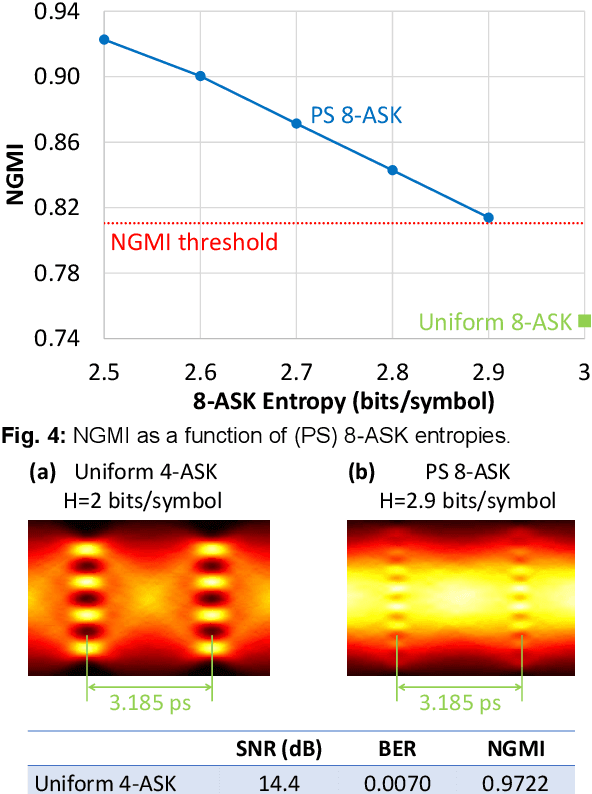
We demonstrate an all-electronic generation of 314-GBaud PS 8-ASK signals by a 158-GHz digital-band-interleaved DAC. The signals drive a thin-film LiNbO3 modulator that achieves over 300 GBaud single-wavelength Nyquist signaling without optical equalization.
Performance limits of spectro-temporal unitary transformations for coherent modulation
Dec 20, 2024We analyse the performance limits of coherent modulation based on lossless unitary transformations, demonstrating that they can achieve high ($>$30~dB) SINAD and outperform conventional IQ modulators at equivalent transmitter laser powers.
2.4-THz Bandwidth Optical Coherent Receiver Based on a Photonic Crystal Microcomb
Jul 04, 2024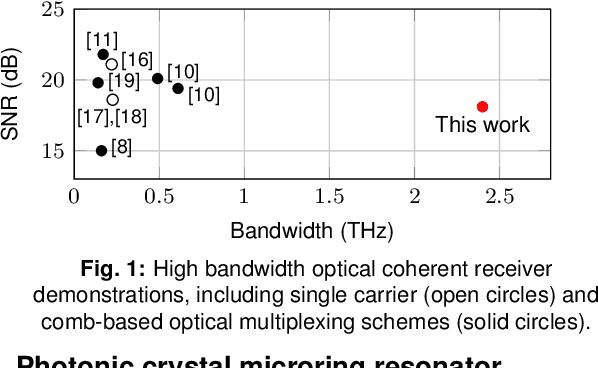
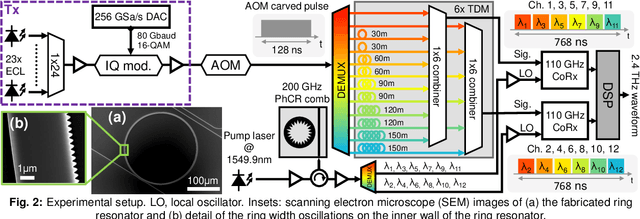
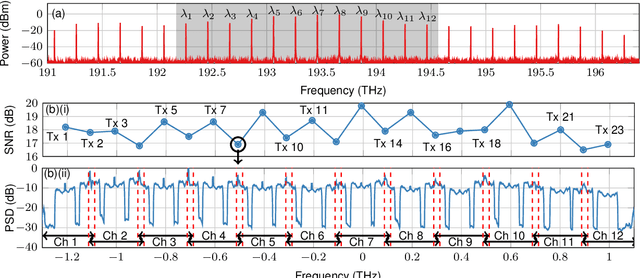
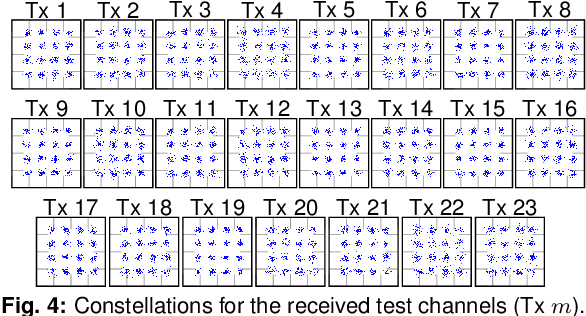
We demonstrate a spectrally-sliced single-polarization optical coherent receiver with a record 2.4-THz bandwidth, using a 200-GHz tantalum pentoxide photonic crystal microring resonator as the local oscillator frequency comb.