 Add to Chrome
 Add to Firefox
 Add to Edge
Deep Learning-Driven Friendly Jamming for Secure Multicarrier ISAC Under Channel Uncertainty
Mar 05, 2026
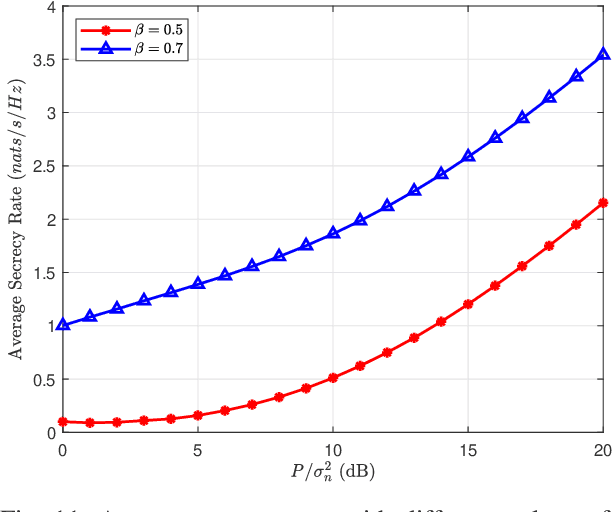
Integrated sensing and communication (ISAC) systems promise efficient spectrum utilization by jointly supporting radar sensing and wireless communication. This paper presents a deep learning-driven framework for enhancing physical-layer security in multicarrier ISAC systems under imperfect channel state information (CSI) and in the presence of unknown eavesdropper (Eve) locations. Unlike conventional ISAC-based friendly jamming (FJ) approaches that require Eve's CSI or precise angle-of-arrival (AoA) estimates, our method exploits radar echo feedback to guide directional jamming without explicit Eve's information. To enhance robustness to radar sensing uncertainty, we propose a radar-aware neural network that jointly optimizes beamforming and jamming by integrating a novel nonparametric Fisher Information Matrix (FIM) estimator based on f-divergence. The jamming design satisfies the Cramer-Rao lower bound (CRLB) constraints even in the presence of noisy AoA. For efficient implementation, we introduce a quantized tensor train-based encoder that reduces the model size by more than 100 times with negligible performance loss. We also integrate a non-overlapping secure scheme into the proposed framework, in which specific sub-bands can be dedicated solely to communication. Extensive simulations demonstrate that the proposed solution achieves significant improvements in secrecy rate, reduced block error rate (BLER), and strong robustness against CSI uncertainty and angular estimation errors, underscoring the effectiveness of the proposed deep learning-driven friendly jamming framework under practical ISAC impairments.

Securing MIMO Wiretap Channel with Learning-Based Friendly Jamming under Imperfect CSI
Dec 12, 2023

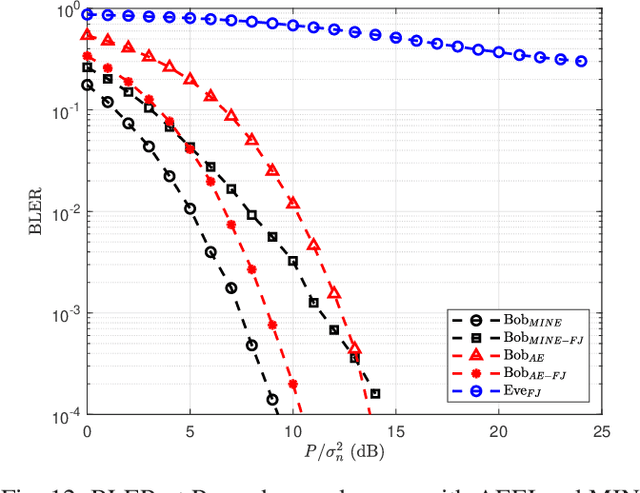
Wireless communications are particularly vulnerable to eavesdropping attacks due to their broadcast nature. To effectively deal with eavesdroppers, existing security techniques usually require accurate channel state information (CSI), e.g., for friendly jamming (FJ), and/or additional computing resources at transceivers, e.g., cryptography-based solutions, which unfortunately may not be feasible in practice. This challenge is even more acute in low-end IoT devices. We thus introduce a novel deep learning-based FJ framework that can effectively defeat eavesdropping attacks with imperfect CSI and even without CSI of legitimate channels. In particular, we first develop an autoencoder-based communication architecture with FJ, namely AEFJ, to jointly maximize the secrecy rate and minimize the block error rate at the receiver without requiring perfect CSI of the legitimate channels. In addition, to deal with the case without CSI, we leverage the mutual information neural estimation (MINE) concept and design a MINE-based FJ scheme that can achieve comparable security performance to the conventional FJ methods that require perfect CSI. Extensive simulations in a multiple-input multiple-output (MIMO) system demonstrate that our proposed solution can effectively deal with eavesdropping attacks in various settings. Moreover, the proposed framework can seamlessly integrate MIMO security and detection tasks into a unified end-to-end learning process. This integrated approach can significantly maximize the throughput and minimize the block error rate, offering a good solution for enhancing communication security in wireless communication systems.