 Add to Chrome
 Add to Firefox
 Add to Edge
EpiNarrate: Agentic Generation of Grounded Narratives from Epidemiological Scenario Projections
Jul 17, 2026
Generation of clear and accessible public health narratives is critical for communicating complex epidemiological projections to policymakers and the general public at large. Such narratives require more than simply reporting numbers: projections must be contextualized and quantitatively grounded across multiple dimensions. Further, projections are often derived from large ensemble datasets which combine intervention assumptions, geographic and demographic strata, outcomes, time horizons, and uncertainty quantiles. However, directly using large language models (LLMs) to summarize and contextualize such data often leads to inconsistencies, omissions, and fragile behavior. We introduce an agentic framework (EpiNarrate) for public health report generation that separates structured numerical reasoning from natural-language generation. The framework first extracts scenario axes and organizes them into a partial-order schema, enabling systematic traversal of the underlying multidimensional space. It then constructs an augmented dataset and derives valid quantitative statements through a comparison grammar that enforces semantic and arithmetic consistency. To balance coverage and non-redundancy, we introduce an interestingness-driven selection mechanism based on maximum-entropy principles. Experiments on the COVID-19 Scenario Modeling Hub demonstrate that our model produces narratives with improved factual grounding and broader coverage of salient epidemiological patterns, while preserving the style of expert-written reports.

Guided Deep List: Automating the Generation of Epidemiological Line Lists from Open Sources
Feb 22, 2017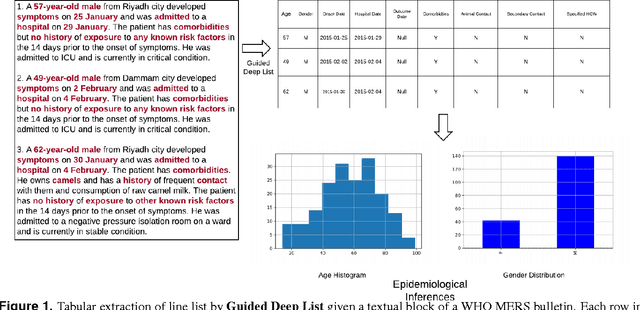
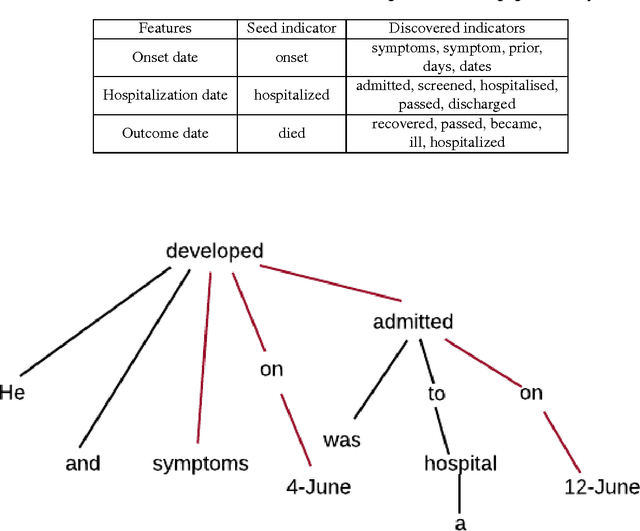
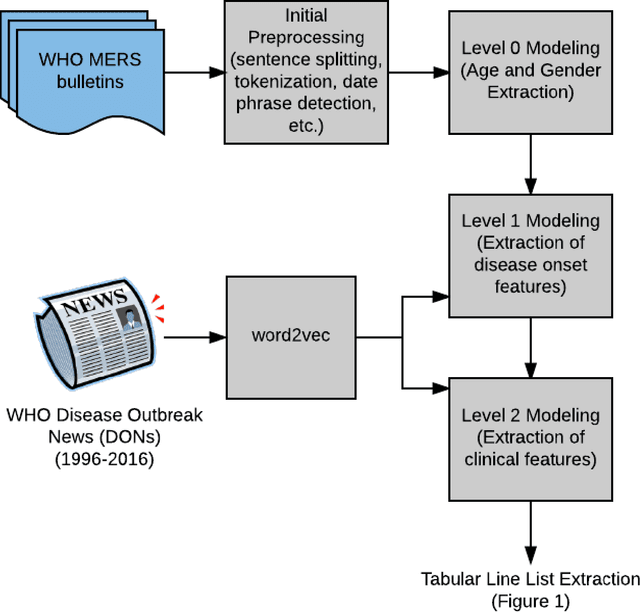
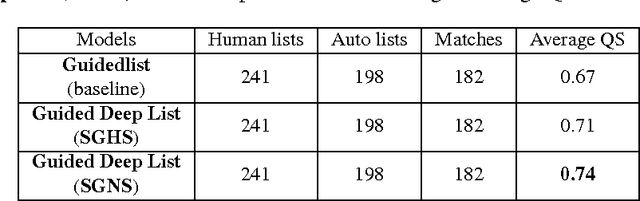
Real-time monitoring and responses to emerging public health threats rely on the availability of timely surveillance data. During the early stages of an epidemic, the ready availability of line lists with detailed tabular information about laboratory-confirmed cases can assist epidemiologists in making reliable inferences and forecasts. Such inferences are crucial to understand the epidemiology of a specific disease early enough to stop or control the outbreak. However, construction of such line lists requires considerable human supervision and therefore, difficult to generate in real-time. In this paper, we motivate Guided Deep List, the first tool for building automated line lists (in near real-time) from open source reports of emerging disease outbreaks. Specifically, we focus on deriving epidemiological characteristics of an emerging disease and the affected population from reports of illness. Guided Deep List uses distributed vector representations (ala word2vec) to discover a set of indicators for each line list feature. This discovery of indicators is followed by the use of dependency parsing based techniques for final extraction in tabular form. We evaluate the performance of Guided Deep List against a human annotated line list provided by HealthMap corresponding to MERS outbreaks in Saudi Arabia. We demonstrate that Guided Deep List extracts line list features with increased accuracy compared to a baseline method. We further show how these automatically extracted line list features can be used for making epidemiological inferences, such as inferring demographics and symptoms-to-hospitalization period of affected individuals.