 Add to Chrome
 Add to Firefox
 Add to Edge
Fine-Grained Food Image Understanding via Target-Aware Data Alignment
Jul 28, 2026
Fine-grained food visual--semantic understanding requires models to capture subtle distinctions across ingredients, cooking methods, doneness, color, texture, and plate composition. Although CLIP-style vision-language models provide a natural framework for this task, their effectiveness is limited when training relies on heterogeneous web-collected image--text pairs. Such data often exhibit a web-to-target domain gap and cross-modal misalignment, where images differ from the target distribution and captions are noisy, multilingual, or weakly grounded in visual content. We propose a data-centric multimodal alignment method for fine-grained food description and recognition. Our method first performs target-aware data selection to identify visually relevant training subsets, then applies VLM-based caption refinement to generate visually grounded, target-style descriptions. Using these curated image--caption pairs, we train complementary CLIP-style retrieval experts and further combine their decisions through a hierarchical VLM-assisted multi-expert decision-level fusion strategy that invokes the VLM only when experts disagree. Experiments show that our data refinement strategy significantly improves retrieval performance over naive web supervision, with VLM-based caption refinement alone yielding an average performance gain of approximately 19%. Our full method also achieves more than twice the retrieval score of pure VLM-based retrieval while remaining substantially more efficient.

Open-KNEAD: Knowledge-grounded Nutrition Estimation via Agentic Decomposition
Jul 14, 2026Multimodal Large Language Models (MLLMs) are increasingly used for dietary assessment from meal images, where retrieval-augmented grounding was shown to sharpen nutrition estimates. However, we find this premise no longer holds for current MLLMs. A modern MLLM's direct estimate now matches or surpasses the full retrieval pipeline. This raises a question: if retrieval no longer improves the overall estimate, can it still deliver the two things clinicians value, accurate portions and a traceable, item-by-item record? We pursue this while preserving what matters for clinical adoption: minimal user burden (a single, unannotated meal image), explainability (an auditable record), and privacy (locally hosted inference). We introduce Open-KNEAD, a knowledge-grounded agentic framework for meal nutrition estimation that is training-free and locally deployable. Each decomposed food item is grounded to a Food and Nutrient Database for Dietary Studies (FNDDS) code via selective, nutrient-aware retrieval, composing an auditable per-item record. Across two open MLLM families and three cuisines, Open-KNEAD improves portion estimates over both prior grounding methods and direct estimation in most backbone-dataset settings. An agent-internal recipe-prior step further recovers the invisible cooking-added energy that biases estimates on non-US cuisine. The advantage is largest on the dietitian-verified ACETADA dataset, where the local open agent surpasses the direct portion estimates of two frontier closed models by roughly $30\%$ and $53\%$, all while keeping every meal image on local hardware. We release the Open-KNEAD framework and its agent-ready FNDDS knowledge base.
Not Your Stereo-Typical Estimator: Combining Vision and Language for Volume Perception
Apr 10, 2026Accurate volume estimation of objects from visual data is a long-standing challenge in computer vision with significant applications in robotics, logistics, and smart health. Existing methods often rely on complex 3D reconstruction pipelines or struggle with the ambiguity inherent in single-view images. To address these limitations, we introduce a new method that fuses implicit 3D cues from stereo vision with explicit prior knowledge from natural language text. Our approach extracts deep features from a stereo image pair and a descriptive text prompt that contains the object's class and an approximate volume, then integrates them using a simple yet effective projection layer into a unified, multi-modal representation for regression. We conduct extensive experiments on public datasets demonstrating that our text-guided approach significantly outperforms vision-only baselines. Our findings show that leveraging even simple textual priors can effectively guide the volume estimation task, paving the way for more context-aware visual measurement systems. Code: https://gitlab.com/viper-purdue/stereo-typical-estimator.
DietDelta: A Vision-Language Approach for Dietary Assessment via Before-and-After Images
Apr 07, 2026Accurate dietary assessment is critical for precision nutrition, yet most image-based methods rely on a single pre-consumption image and provide only coarse, meal-level estimates. These approaches cannot determine what was actually consumed and often require restrictive inputs such as depth sensing, multi-view imagery, or explicit segmentation. In this paper, we propose a simple vision-language framework for food-item-level nutritional analysis using paired before-and-after eating images. Instead of relying on rigid segmentation masks, our method leverages natural language prompts to localize specific food items and estimate their weight directly from a single RGB image. We further estimate food consumption by predicting weight differences between paired images using a two-stage training strategy. We evaluate our method on three publicly available datasets and demonstrate consistent improvements over existing approaches, establishing a strong baseline for before-and-after dietary image analysis.
Can You Hear, Localize, and Segment Continually? An Exemplar-Free Continual Learning Benchmark for Audio-Visual Segmentation
Mar 09, 2026Audio-Visual Segmentation (AVS) aims to produce pixel-level masks of sound producing objects in videos, by jointly learning from audio and visual signals. However, real-world environments are inherently dynamic, causing audio and visual distributions to evolve over time, which challenge existing AVS systems that assume static training settings. To address this gap, we introduce the first exemplar-free continual learning benchmark for Audio-Visual Segmentation, comprising four learning protocols across single-source and multi-source AVS datasets. We further propose a strong baseline, ATLAS, which uses audio-guided pre-fusion conditioning to modulate visual feature channels via projected audio context before cross-modal attention. Finally, we mitigate catastrophic forgetting by introducing Low-Rank Anchoring (LRA), which stabilizes adapted weights based on loss sensitivity. Extensive experiments demonstrate competitive performance across diverse continual scenarios, establishing a foundation for lifelong audio-visual perception. Code is available at${}^{*}$\footnote{Paper under review} - \hyperlink{https://gitlab.com/viper-purdue/atlas}{https://gitlab.com/viper-purdue/atlas} \keywords{Continual Learning \and Audio-Visual Segmentation \and Multi-Modal Learning}
Implicit-Scale 3D Reconstruction for Multi-Food Volume Estimation from Monocular Images
Feb 13, 2026We present Implicit-Scale 3D Reconstruction from Monocular Multi-Food Images, a benchmark dataset designed to advance geometry-based food portion estimation in realistic dining scenarios. Existing dietary assessment methods largely rely on single-image analysis or appearance-based inference, including recent vision-language models, which lack explicit geometric reasoning and are sensitive to scale ambiguity. This benchmark reframes food portion estimation as an implicit-scale 3D reconstruction problem under monocular observations. To reflect real-world conditions, explicit physical references and metric annotations are removed; instead, contextual objects such as plates and utensils are provided, requiring algorithms to infer scale from implicit cues and prior knowledge. The dataset emphasizes multi-food scenes with diverse object geometries, frequent occlusions, and complex spatial arrangements. The benchmark was adopted as a challenge at the MetaFood 2025 Workshop, where multiple teams proposed reconstruction-based solutions. Experimental results show that while strong vision--language baselines achieve competitive performance, geometry-based reconstruction methods provide both improved accuracy and greater robustness, with the top-performing approach achieving 0.21 MAPE in volume estimation and 5.7 L1 Chamfer Distance in geometric accuracy.
Size Matters: Reconstructing Real-Scale 3D Models from Monocular Images for Food Portion Estimation
Jan 27, 2026The rise of chronic diseases related to diet, such as obesity and diabetes, emphasizes the need for accurate monitoring of food intake. While AI-driven dietary assessment has made strides in recent years, the ill-posed nature of recovering size (portion) information from monocular images for accurate estimation of ``how much did you eat?'' is a pressing challenge. Some 3D reconstruction methods have achieved impressive geometric reconstruction but fail to recover the crucial real-world scale of the reconstructed object, limiting its usage in precision nutrition. In this paper, we bridge the gap between 3D computer vision and digital health by proposing a method that recovers a true-to-scale 3D reconstructed object from a monocular image. Our approach leverages rich visual features extracted from models trained on large-scale datasets to estimate the scale of the reconstructed object. This learned scale enables us to convert single-view 3D reconstructions into true-to-life, physically meaningful models. Extensive experiments and ablation studies on two publicly available datasets show that our method consistently outperforms existing techniques, achieving nearly a 30% reduction in mean absolute volume-estimation error, showcasing its potential to enhance the domain of precision nutrition. Code: https://gitlab.com/viper-purdue/size-matters
Evaluating Large Multimodal Models for Nutrition Analysis: A Benchmark Enriched with Contextual Metadata
Jul 09, 2025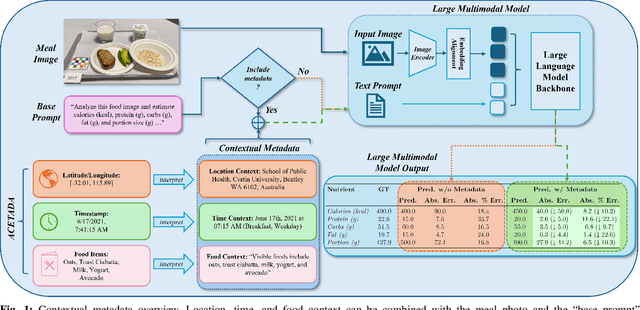
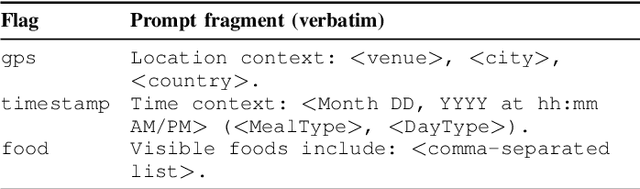
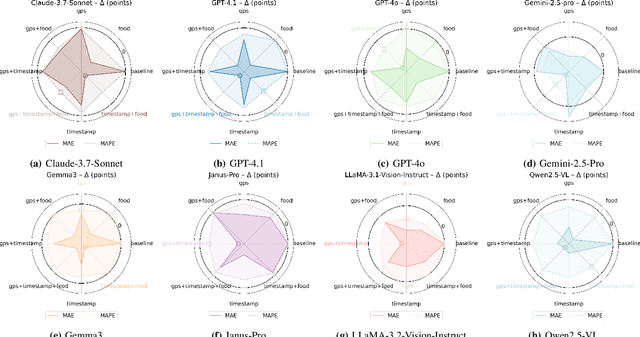
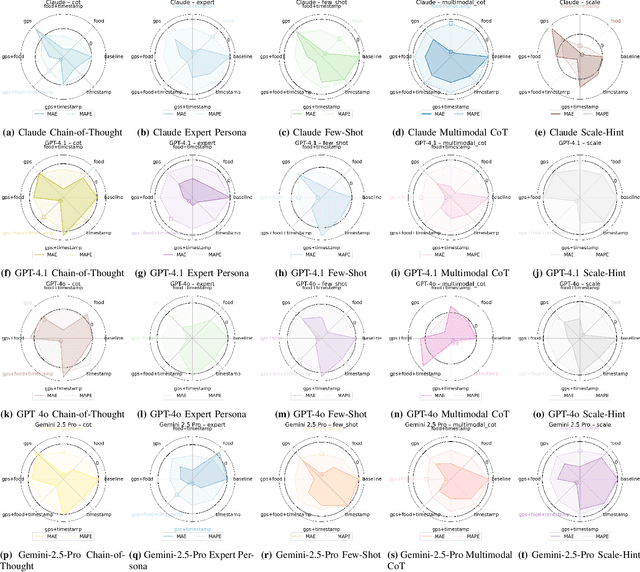
Large Multimodal Models (LMMs) are increasingly applied to meal images for nutrition analysis. However, existing work primarily evaluates proprietary models, such as GPT-4. This leaves the broad range of LLMs underexplored. Additionally, the influence of integrating contextual metadata and its interaction with various reasoning modifiers remains largely uncharted. This work investigates how interpreting contextual metadata derived from GPS coordinates (converted to location/venue type), timestamps (transformed into meal/day type), and the food items present can enhance LMM performance in estimating key nutritional values. These values include calories, macronutrients (protein, carbohydrates, fat), and portion sizes. We also introduce ACETADA, a new food-image dataset slated for public release. This open dataset provides nutrition information verified by the dietitian and serves as the foundation for our analysis. Our evaluation across eight LMMs (four open-weight and four closed-weight) first establishes the benefit of contextual metadata integration over straightforward prompting with images alone. We then demonstrate how this incorporation of contextual information enhances the efficacy of reasoning modifiers, such as Chain-of-Thought, Multimodal Chain-of-Thought, Scale Hint, Few-Shot, and Expert Persona. Empirical results show that integrating metadata intelligently, when applied through straightforward prompting strategies, can significantly reduce the Mean Absolute Error (MAE) and Mean Absolute Percentage Error (MAPE) in predicted nutritional values. This work highlights the potential of context-aware LMMs for improved nutrition analysis.