 Add to Chrome
 Add to Firefox
 Add to Edge
Posterior-Aware Differential Channel Tracking for Reliable Single-Stream DAB+ Passive Radar
May 23, 2026
Digital audio broadcasting plus (DAB+) is an attractive illuminator for passive radar because it provides persistent, high-power, and geographically widespread very high frequency (VHF) orthogonal frequency-division multiplexing (OFDM) signals. A channel state information (CSI) sensing approach can convert a single received DAB+ stream into a CSI sequence for radar sensing, avoiding the need for a separately received reference signal in conventional passive radars. However, CSI estimation in DAB+ is challenging due to the differentially encoded communication symbols across time. A wrong symbol transition estimation leads to a persistent multiplicative error in the sequential CSI sequence within a DAB+ frame. This paper formulates single-stream DAB+ passive radar as a posterior-probability-aware differential CSI tracking problem. The proposed method uses the previously tracked CSI as a channel prior, performs prediction-aided maximum a posteriori detection of current symbol, converts posterior transition reliability into observation uncertainty, and applies linear minimum mean squared error fusion to obtain a stable tracking CSI. A reliability-informed CSI fusion strategy is also introduced to preserve weak target information. Theoretical analysis is provided, showing guaranteed performance again in symbol and CSI estimation. Simulation results show that the proposed method can reduce CSI estimation error by over 15~dB compared with prior art. It also improves median target-to-background ratio by more than 11~dB in random fading scenes. Experiments in Sydney, Australia demonstrate improved range-Doppler maps for commercial aircraft sensing.

Automating UAV Flight Readiness Approval using Goal-Directed Answer Set Programming
Aug 25, 2022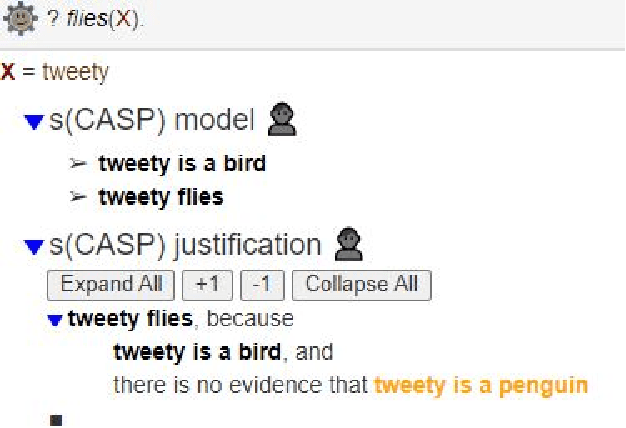
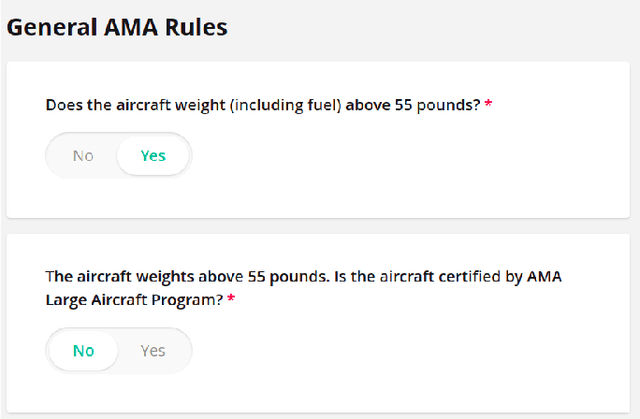
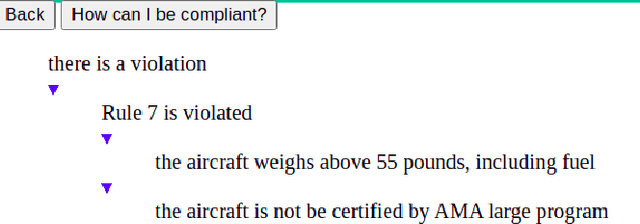
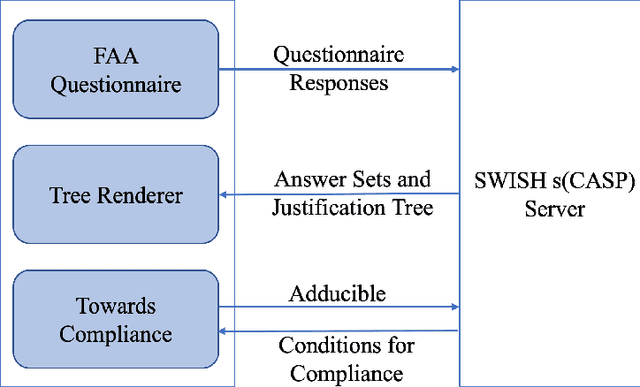
We present a novel application of Goal-Directed Answer Set Programming that digitizes the model aircraft operator's compliance verification against the Academy of Model Aircrafts (AMA) safety code. The AMA safety code regulates how AMA flyers operate Unmanned Aerial Vehicles (UAVs) for limited recreational purposes. Flying drones and their operators are subject to various rules before and after the operation of the aircraft to ensure safe flights. In this paper, we leverage Answer Set Programming to encode the AMA safety code and automate compliance checks. To check compliance, we use the s(CASP) which is a goal-directed ASP engine. By using s(CASP) the operators can easily check for violations and obtain a justification tree explaining the cause of the violations in human-readable natural language. Further, we implement an algorithm to help the operators obtain the minimal set of conditions that need to be satisfied in order to pass the compliance check. We develop a front-end questionnaire interface that accepts various conditions and use the backend s(CASP) engine to evaluate whether the conditions adhere to the regulations. We also leverage s(CASP) implemented in SWI-Prolog, where SWI-Prolog exposes the reasoning capabilities of s(CASP) as a REST service. To the best of our knowledge, this is the first application of ASP in the AMA and Avionics Compliance and Certification space.
Knowledge-Assisted Reasoning of Model-Augmented System Requirements with Event Calculus and Goal-Directed Answer Set Programming
Sep 10, 2021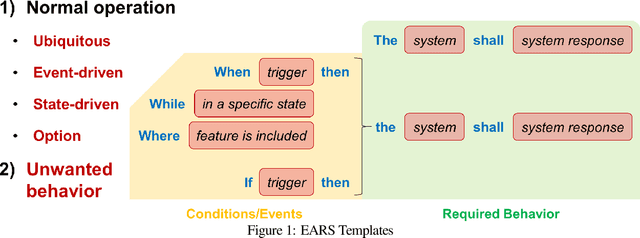
We consider requirements for cyber-physical systems represented in constrained natural language. We present novel automated techniques for aiding in the development of these requirements so that they are consistent and can withstand perceived failures. We show how cyber-physical systems' requirements can be modeled using the event calculus (EC), a formalism used in AI for representing actions and change. We also show how answer set programming (ASP) and its query-driven implementation s(CASP) can be used to directly realize the event calculus model of the requirements. This event calculus model can be used to automatically validate the requirements. Since ASP is an expressive knowledge representation language, it can also be used to represent contextual knowledge about cyber-physical systems, which, in turn, can be used to find gaps in their requirements specifications. We illustrate our approach through an altitude alerting system from the avionics domain.
* In Proceedings HCVS 2021, arXiv:2109.03988