 Add to Chrome
 Add to Firefox
 Add to Edge
Thinking Like a Scientist? A Structural Study of LLM-Generated Research Methods
Jun 15, 2026
Large Language Models (LLMs) are increasingly used to guide research methodology, yet their default methodological tendencies under minimal prompting remain unclear. Here, we prompt GPT-5.1, Gemini 3 Pro, and DeepSeek-V3.2 with an LLM-extracted research question from each of 1,000 recent arXiv computer-science papers and compare the resulting methodology suggestions against a paper-derived experimental inventory. Since we provide only the research question, the differences we measure reflect initial suggestions and not how optimal those suggestions are. We extract structured method features from both sources, map them into a shared taxonomy, and quantify divergence across multiple taxonomy dimensions including model provider, dataset task type, and evaluation metric type. The strongest imbalance appears in provider choice, with Jensen-Shannon divergence about 3-5x larger than any other taxonomy dimension. Other/Academic single-occurrence models are underrepresented by 23-24 percentage points, while reused academic/community models are slightly overrepresented (4-6pp). LLMs also suggest a much narrower range of methods overall: the effective number of model entities contracts from 1,232 to 59-96, and inter-LLM rank correlations (0.55-0.68) generally exceed LLM-to-paper correlations (0.33-0.56), so the distortions are largely shared across models. Popularity baselines, BM25 retrieval calibration, and paper-level similarity tests confirm that the outputs are query-specific responses, but filtered through a narrower set of options. Researchers who rely on LLM suggestions without cross-checking therefore risk narrowing their methodological search space toward a more concentrated default.

Neutrino Fingerprints: Image-Based Encodings of IceCube Events for CNN Direction Reconstruction
Jun 01, 2026Reconstructing the direction of incoming neutrinos in the IceCube Neutrino Observatory is an important problem in astrophysics. The public IceCube--Neutrinos in Deep Ice Kaggle competition provided 140 million simulated events to benchmark reconstruction techniques. To address this challenge from a novel perspective we introduce neutrino fingerprints compact $72 \times 72 \times 3$ images in which each pixel represents a single detector, with pulse timing and charge statistics encoded as color channels. This representation transforms sparse, irregular pulse data into dense images suitable for convolutional processing. Our ResNet18 model achieves a mean angular error of $1.10$ rad, indicating that convolutional networks trained on fingerprints rival more complex architectures while offering an effective, interpretable baseline for IceCube event reconstruction.
Scalable Classification of Course Information Sheets Using Large Language Models: A Reusable Institutional Method for Academic Quality Assurance
Mar 13, 2026Purpose: Higher education institutions face increasing pressure to audit course designs for generative AI (GenAI) integration. This paper presents an end-to-end method for using large language models (LLMs) to scan course information sheets at scale, identify where assessments may be vulnerable to student use of GenAI tools, validate system performance through iterative refinement, and operationalise results through direct stakeholder communication and effort. Method: We developed a four-phase pipeline: (0) manual pilot sampling, (1) iterative prompt engineering with multi-model comparison, (2) full production scan of 4,684 Bachelor and Master course information sheets (Academic Year 2024-2025) from the Vrije Universiteit Brussel (VUB) with automated report generation and email distribution to teaching teams (91.4% address-matched) using a three-tier risk taxonomy (Clear risk, Potential risk, Low risk), and (3) longitudinal re-scan of 4,675 sheets after the next catalogue release. Results: Five iterations of prompt refinement achieved 87% agreement with expert labels. GPT-4o was selected for production based on superior handling of ambiguous cases involving internships and practical components. The Year 1 scan classified 60.3% of courses as Clear risk, 15.2% as Potential risk, and 24.5% as Low risk. Year 2 comparison revealed substantial shifts in risk distributions, with improvements most pronounced in practice-oriented programmes. Implications: The method enables institutions to rapidly transform heterogeneous catalogue data into structured and actionable intelligence. The approach is transferable to other audit domains (sustainability, accessibility, pedagogical alignment) and provides a template for responsible LLM deployment in higher education governance.
Human-in-the-Loop LLM Grading for Handwritten Mathematics Assessments
Mar 13, 2026Providing timely and individualised feedback on handwritten student work is highly beneficial for learning but difficult to achieve at scale. This challenge has become more pressing as generative AI undermines the reliability of take-home assessments, shifting emphasis toward supervised, in-class evaluation. We present a scalable, end-to-end workflow for LLM-assisted grading of short, pen-and-paper assessments. The workflow spans (1) constructing solution keys, (2) developing detailed rubric-style grading keys used to guide the LLM, and (3) a grading procedure that combines automated scanning and anonymisation, multi-pass LLM scoring, automated consistency checks, and mandatory human verification. We deploy the system in two undergraduate mathematics courses using six low-stakes in-class tests. Empirically, LLM assistance reduces grading time by approximately 23% while achieving agreement comparable to, and in several cases tighter than, fully manual grading. Occasional model errors occur but are effectively contained by the hybrid design. Overall, our results show that carefully embedded human-in-the-loop LLM grading can substantially reduce workload while maintaining fairness and accuracy.
Early Evidence of Vibe-Proving with Consumer LLMs: A Case Study on Spectral Region Characterization with ChatGPT-5.2 (Thinking)
Feb 21, 2026Large Language Models (LLMs) are increasingly used as scientific copilots, but evidence on their role in research-level mathematics remains limited, especially for workflows accessible to individual researchers. We present early evidence for vibe-proving with a consumer subscription LLM through an auditable case study that resolves Conjecture 20 of Ran and Teng (2024) on the exact nonreal spectral region of a 4-cycle row-stochastic nonnegative matrix family. We analyze seven shareable ChatGPT-5.2 (Thinking) threads and four versioned proof drafts, documenting an iterative pipeline of generate, referee, and repair. The model is most useful for high-level proof search, while human experts remain essential for correctness-critical closure. The final theorem provides necessary and sufficient region conditions and explicit boundary attainment constructions. Beyond the mathematical result, we contribute a process-level characterization of where LLM assistance materially helps and where verification bottlenecks persist, with implications for evaluation of AI-assisted research workflows and for designing human-in-the-loop theorem proving systems.
Probing the Trajectories of Reasoning Traces in Large Language Models
Jan 30, 2026Large language models (LLMs) increasingly solve difficult problems by producing "reasoning traces" before emitting a final response. However, it remains unclear how accuracy and decision commitment evolve along a reasoning trajectory, and whether intermediate trace segments provide answer-relevant information beyond generic length or stylistic effects. Here, we propose a protocol to systematically probe the trajectories of reasoning traces in LLMs by 1) generating a model's reasoning trace, 2) truncating it at fixed token-percentiles, and 3) injecting each partial trace back into the model (or a different model) to measure the induced distribution over answer choices via next-token probabilities. We apply this protocol to the open-source Qwen3-4B/-8B/-14B and gpt-oss-20b/-120b models across the multiple-choice GPQA Diamond and MMLU-Pro benchmarks. We find that accuracy and decision commitment consistently increase as the percentage of provided reasoning tokens grows. These gains are primarily driven by relevant content in the model generation rather than context length or generic "reasoning style" effects. Stronger models often backtrack successfully from incorrect partial traces, but immediate answers often remain anchored in the weaker model's incorrect response. More broadly, we show that trajectory probing provides diagnostics for efficient and safer deployment of reasoning models as the measurements can inform practical trace-handling and monitoring policies that improve reliability without assuming intermediate tokens are inherently faithful explanations.
Benchmarks Saturate When The Model Gets Smarter Than The Judge
Jan 27, 2026Benchmarks are important tools to track progress in the development of Large Language Models (LLMs), yet inaccuracies in datasets and evaluation methods consistently undermine their effectiveness. Here, we present Omni-MATH-2, a manually revised version of the Omni-MATH dataset comprising a clean, exact-answer subset ($n{=}4181$) and a tagged, non-standard subset ($n{=}247$). Each problem was audited to ensure LaTeX compilability, solvability and verifiability, which involved adding missing figures or information, labeling problems requiring a proof, estimation or image, and removing clutter. This process significantly reduces dataset-induced noise, thereby providing a more precise assessment of model performance. The annotated dataset also allows us to evaluate judge-induced noise by comparing GPT-5 mini with the original Omni-Judge, revealing substantial discrepancies between judges on both the clean and tagged problem subsets. Expert annotations reveal that Omni-Judge is wrong in $96.4\%$ of the judge disagreements, indicating its inability to differentiate between models' abilities, even well before saturation of the benchmark occurs. As problems become more challenging, we find that increasingly competent judges become essential in order to prevent judge errors from masking genuine differences between models. Finally, neither judge identifies the present failure modes for the subset of tagged problems, demonstrating that dataset quality and judge reliability are both critical to develop accurate benchmarks of model performance.
Estimating problem difficulty without ground truth using Large Language Model comparisons
Dec 16, 2025Recent advances in the finetuning of large language models (LLMs) have significantly improved their performance on established benchmarks, emphasizing the need for increasingly difficult, synthetic data. A key step in this data generation pipeline is a method for estimating problem difficulty. Current approaches, such as human calibration or performance-based scoring, fail to generalize to out-of-distribution problems, i.e. problems currently unsolvable by humans and LLMs, because they are not scalable, time-consuming, and ground truth dependent. Therefore, we propose a new method for estimating problem difficulty, LLM compare, that addresses these limitations. An LLM performs pairwise difficulty comparisons, and then Bradley-Terry scores are computed based on the outcomes. To validate our method, we first propose a conceptual framework that positions existing approaches on three orthogonal planes--construction, scale and dependence--identifying which quadrants a measure needs to occupy to score out-of-distribution problems. LLM compare naturally occupies all desirable quadrants as the first measure that is continuous and dynamic, model-agnostic and independent of ground truth information. As a second validation, we show that LLM compare demonstrates strong alignment with human annotations: Pearson $r \geq 0.80$ for $n=1876$. Thirdly, we show that LLM compare is robust to hallucinations, with less than $6\%$ degradation in Pearson correlation for $10\%$ noise injection. Our work represents a significant step towards replacing time-consuming human annotations and synthetic data generation, and will be an important driver for curriculum design, model evaluation, and AI-assisted research ideation.
How Deep Do Large Language Models Internalize Scientific Literature and Citation Practices?
Apr 03, 2025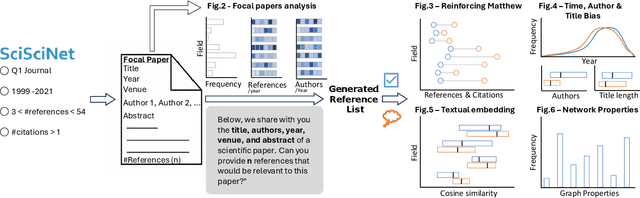
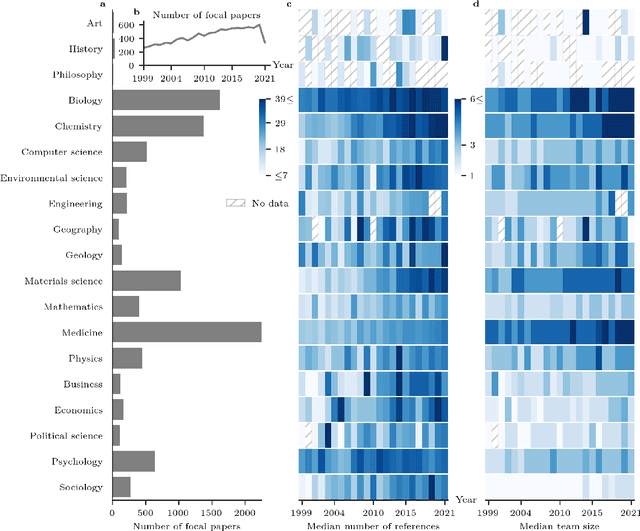
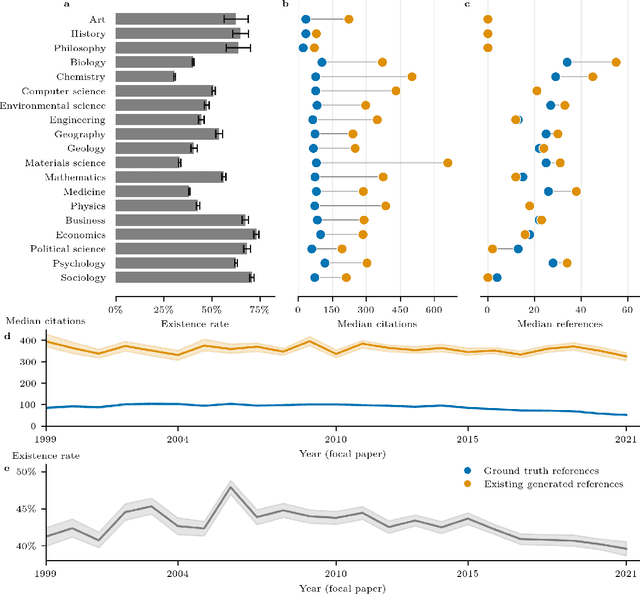
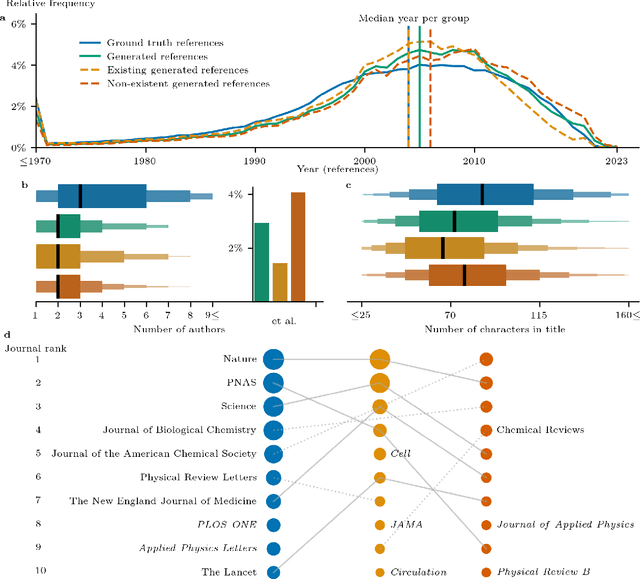
The spread of scientific knowledge depends on how researchers discover and cite previous work. The adoption of large language models (LLMs) in the scientific research process introduces a new layer to these citation practices. However, it remains unclear to what extent LLMs align with human citation practices, how they perform across domains, and may influence citation dynamics. Here, we show that LLMs systematically reinforce the Matthew effect in citations by consistently favoring highly cited papers when generating references. This pattern persists across scientific domains despite significant field-specific variations in existence rates, which refer to the proportion of generated references that match existing records in external bibliometric databases. Analyzing 274,951 references generated by GPT-4o for 10,000 papers, we find that LLM recommendations diverge from traditional citation patterns by preferring more recent references with shorter titles and fewer authors. Emphasizing their content-level relevance, the generated references are semantically aligned with the content of each paper at levels comparable to the ground truth references and display similar network effects while reducing author self-citations. These findings illustrate how LLMs may reshape citation practices and influence the trajectory of scientific discovery by reflecting and amplifying established trends. As LLMs become more integrated into the scientific research process, it is important to understand their role in shaping how scientific communities discover and build upon prior work.
Humanity's Last Exam
Jan 24, 2025Benchmarks are important tools for tracking the rapid advancements in large language model (LLM) capabilities. However, benchmarks are not keeping pace in difficulty: LLMs now achieve over 90\% accuracy on popular benchmarks like MMLU, limiting informed measurement of state-of-the-art LLM capabilities. In response, we introduce Humanity's Last Exam (HLE), a multi-modal benchmark at the frontier of human knowledge, designed to be the final closed-ended academic benchmark of its kind with broad subject coverage. HLE consists of 3,000 questions across dozens of subjects, including mathematics, humanities, and the natural sciences. HLE is developed globally by subject-matter experts and consists of multiple-choice and short-answer questions suitable for automated grading. Each question has a known solution that is unambiguous and easily verifiable, but cannot be quickly answered via internet retrieval. State-of-the-art LLMs demonstrate low accuracy and calibration on HLE, highlighting a significant gap between current LLM capabilities and the expert human frontier on closed-ended academic questions. To inform research and policymaking upon a clear understanding of model capabilities, we publicly release HLE at https://lastexam.ai.