 Add to Chrome
 Add to Firefox
 Add to Edge
Motion-guided sparse correction enables expert-quality point tracking across diverse microscopy regimes
May 28, 2026
Tracking the dynamics of non-canonical biological systems in microscopy videos remains a persistent challenge. Both classical and learning-based trackers depend on expert-reviewed data to be evaluated and adapted, yet exhaustive manual annotation rarely scales to the videos where these tools are needed most. We developed RIPPLE (Refinement Interpolation Platform for Point Location Estimation), which recasts annotation as sparse correction: a user clicks a starting point, RIPPLE proposes a full trajectory, and the user intervenes only where the trajectory drifts. We tested RIPPLE on five challenging microscopy datasets from our laboratories, four from the transparent jellyfish Clytia hemisphaerica and one tracking landmarks on rapidly moving sperm. Across these, RIPPLE matched the quality of exhaustive manual annotation while reducing manual clicks by 3 to 25 times across datasets. RIPPLE thereby fills a missing layer between manual annotation and fully automated tracking, enabling immediate quantification of biological dynamics, method benchmarking, and the production of the gold-standard data needed to adapt future automated microscopy trackers.

Self-Supervised Keypoint Discovery in Behavioral Videos
Dec 09, 2021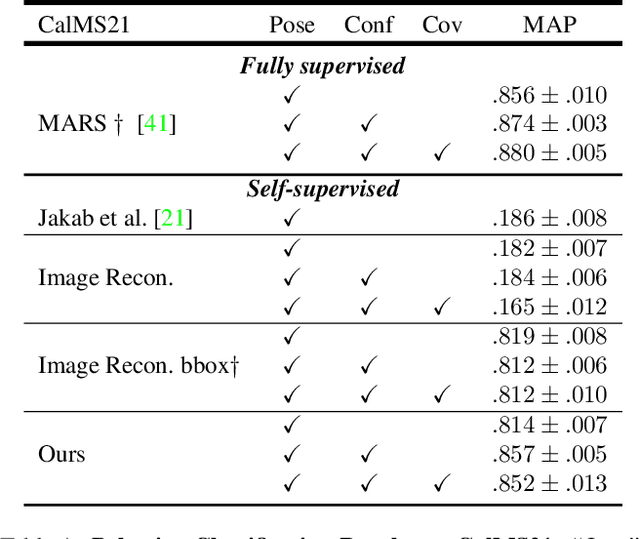
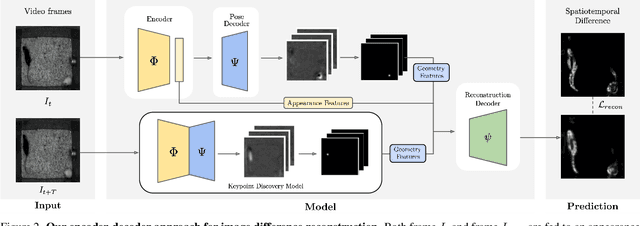
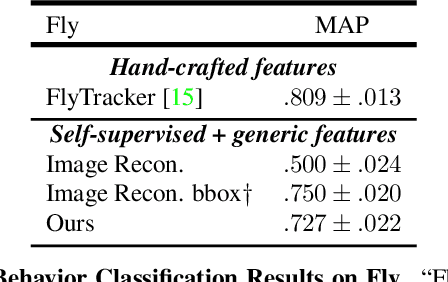
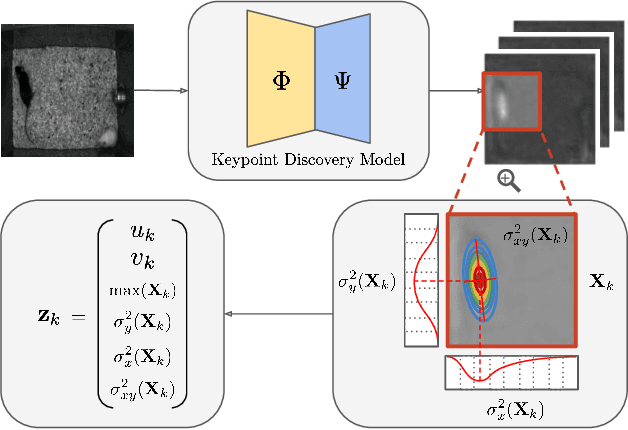
We propose a method for learning the posture and structure of agents from unlabelled behavioral videos. Starting from the observation that behaving agents are generally the main sources of movement in behavioral videos, our method uses an encoder-decoder architecture with a geometric bottleneck to reconstruct the difference between video frames. By focusing only on regions of movement, our approach works directly on input videos without requiring manual annotations, such as keypoints or bounding boxes. Experiments on a variety of agent types (mouse, fly, human, jellyfish, and trees) demonstrate the generality of our approach and reveal that our discovered keypoints represent semantically meaningful body parts, which achieve state-of-the-art performance on keypoint regression among self-supervised methods. Additionally, our discovered keypoints achieve comparable performance to supervised keypoints on downstream tasks, such as behavior classification, suggesting that our method can dramatically reduce the cost of model training vis-a-vis supervised methods.