 Add to Chrome
 Add to Firefox
 Add to Edge
Property-Constrained 3D Porous Media Reconstruction from 2D Images via Conditional Generative Adversarial Networks
Jul 02, 2026
This study presents a conditional Generative Adversarial Network (cGAN) framework for generating 3D porous media volumes with controlled porosity, trained exclusively on 2D thin section images. The key innovation lies in combining property-conditioned generation with 2D-to-3D reconstruction, eliminating the need for expensive 3D training data while maintaining control over petrophysical properties. The framework employs a hybrid architecture with a 3D generator and 2D discriminator, where multi-axis slice extraction enables learning 3D-consistent structures from 2D training data. Porosity labels are extracted using an Enhanced U-Net segmentation model. The methodology was demonstrated on two carbonate samples with different lithologies: dolomite-anhydrite and pure dolomite. Results show that the framework successfully generates realistic 3D volumes capturing lithological features such as anhydrite inclusions and fine crystalline textures. Porosity control achieved an $R^2$ of 0.93, with mean absolute errors of 0.019 and 0.010 for the heterogeneous and homogeneous samples, respectively.
* 6 pages, 3 figures. Submitted to the 87th EAGE Annual Conference & Exhibition, Aberdeen, UK, June 2026

A Decade of Generative Adversarial Networks for Porous Material Reconstruction
Mar 12, 2026Digital reconstruction of porous materials has become increasingly critical for applications ranging from geological reservoir characterization to tissue engineering and electrochemical device design. While traditional methods such as micro-computed tomography and statistical reconstruction approaches have established foundations in this field, the emergence of deep learning techniques, particularly Generative Adversarial Networks (GANs), has revolutionized porous media reconstruction capabilities. This review systematically analyzes 96 peer-reviewed articles published from 2017 to early 2026, examining the evolution and applications of GAN-based approaches for porous material image reconstruction. We categorize GAN architectures into six distinct classes, namely Vanilla GANs, Multi-Scale GANs, Conditional GANs, Attention-Enhanced GANs, Style-based GANs, and Hybrid Architecture GANs. Our analysis reveals substantial progress including improvements in porosity accuracy (within 1% of original samples), permeability prediction (up to 79% reduction in mean relative errors), and achievable reconstruction volumes (from initial $64^3$ to current $2{,}200^3$ voxels). Despite these advances, persistent challenges remain in computational efficiency, memory constraints for large-scale reconstruction, and maintaining structural continuity in 2D-to-3D transformations. This systematic analysis provides a comprehensive framework for selecting appropriate GAN architectures based on specific application requirements.
The performance of multiple language models in identifying offensive language on social media
Dec 10, 2023Text classification is an important topic in the field of natural language processing. It has been preliminarily applied in information retrieval, digital library, automatic abstracting, text filtering, word semantic discrimination and many other fields. The aim of this research is to use a variety of algorithms to test the ability to identify offensive posts and evaluate their performance against a variety of assessment methods. The motivation for this project is to reduce the harm of these languages to human censors by automating the screening of offending posts. The field is a new one, and despite much interest in the past two years, there has been no focus on the object of the offence. Through the experiment of this project, it should inspire future research on identification methods as well as identification content.
Vagueness in Predicates and Objects
Feb 25, 2023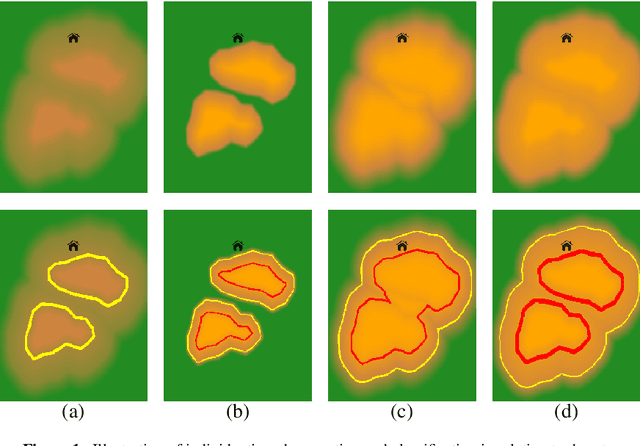
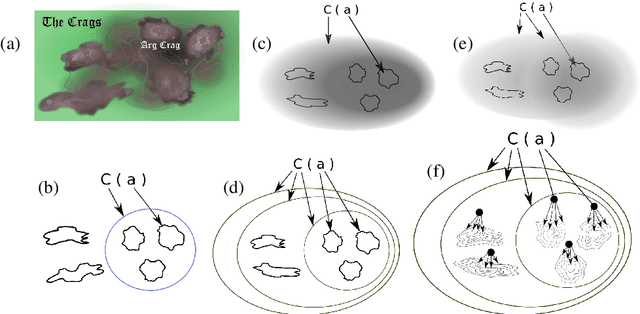
Classical semantics assumes that one can model reference, predication and quantification with respect to a fixed domain of precise referent objects. Non-logical terms and quantification are then interpreted directly in terms of elements and subsets of this domain. We explore ways to generalise this classical picture of precise predicates and objects to account for variability of meaning due to factors such as vagueness, context and diversity of definitions or opinions. Both names and predicative expressions can be given either multiple semantic referents or be associated with semantic referents that incorporate some model of variability. We present a semantic framework, Variable Reference Semantics, that can accommodate several modes of variability in relation to both predicates and objects.
Tackling Domain-Specific Winograd Schemas with Knowledge-Based Reasoning and Machine Learning
Nov 24, 2020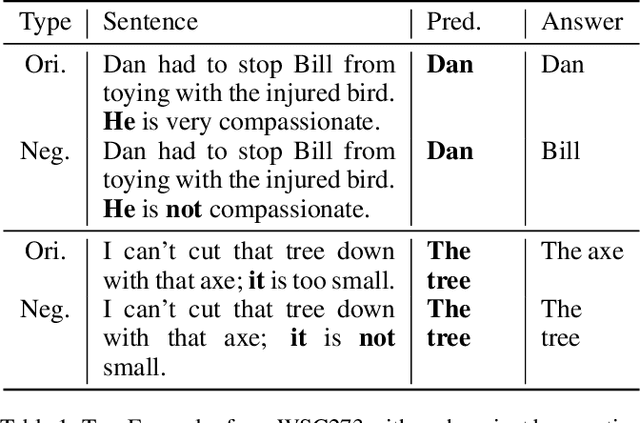
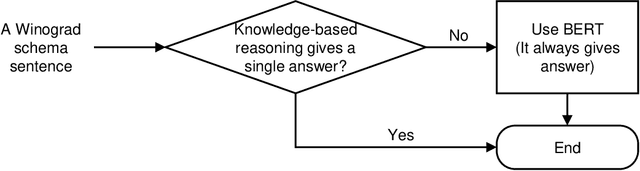
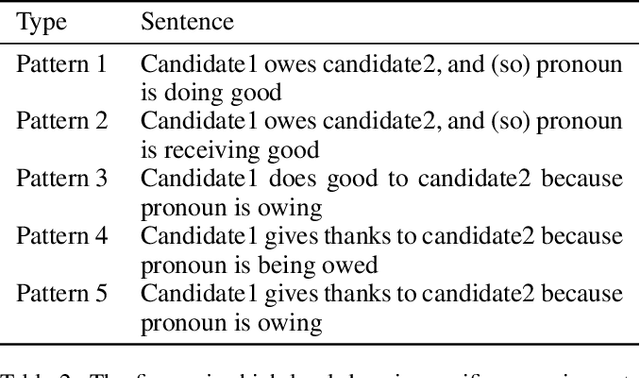
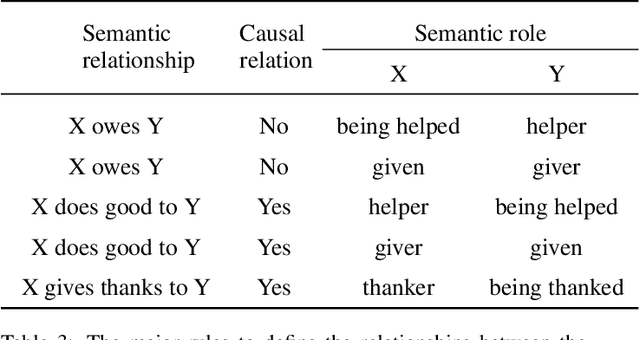
The Winograd Schema Challenge (WSC) is a common-sense reasoning task that requires background knowledge. In this paper, we contribute to tackling WSC in four ways. Firstly, we suggest a keyword method to define a restricted domain where distinctive high-level semantic patterns can be found. A thanking domain was defined by key-words, and the data set in this domain is used in our experiments. Secondly, we develop a high-level knowledge-based reasoning method using semantic roles which is based on the method of Sharma [2019]. Thirdly, we propose an ensemble method to combine knowledge-based reasoning and machine learning which shows the best performance in our experiments. As a machine learning method, we used Bidirectional Encoder Representations from Transformers (BERT) [Kocijan et al., 2019]. Lastly, in terms of evaluation, we suggest a "robust" accuracy measurement by modifying that of Trichelair et al. [2018]. As with their switching method, we evaluate a model by considering its performance on trivial variants of each sentence in the test set.