 Add to Chrome
 Add to Firefox
 Add to Edge
Offload or Overload: A Platform Measurement Study of Mobile Robotic Manipulation Workloads
Mar 18, 2026
Mobile robotic manipulation--the ability of robots to navigate spaces and interact with objects--is a core capability of physical AI. Foundation models have led to breakthroughs in their performance, but at a significant computational cost. We present the first measurement study of mobile robotic manipulation workloads across onboard, edge, and cloud GPU platforms. We find that the full workload stack is infeasible to run on smaller onboard GPUs, while larger onboard GPUs drain robot batteries several hours faster. Offloading alleviates these constraints but introduces its own challenges, as additional network latency degrades task accuracy, and the bandwidth requirement makes naive cloud offloading impractical. Finally, we quantify opportunities and pitfalls of sharing compute across robot fleets. We believe our measurement study will be crucial to designing inference systems for mobile robots.

Distributed AI Platform for the 6G RAN
Oct 01, 2024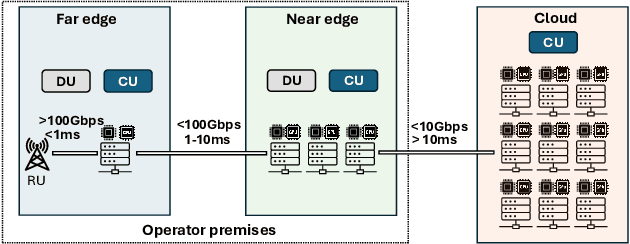
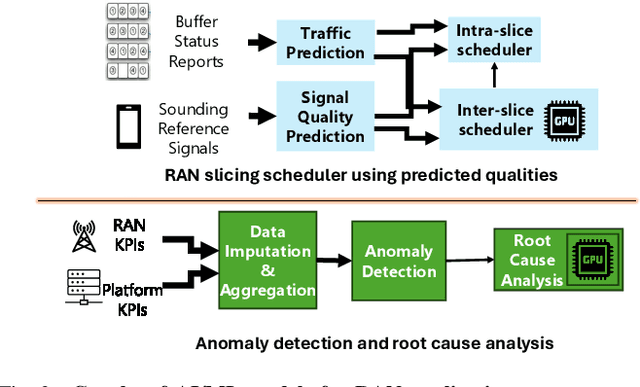
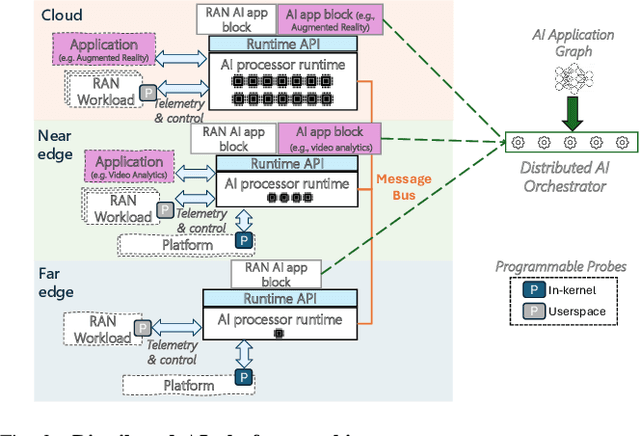
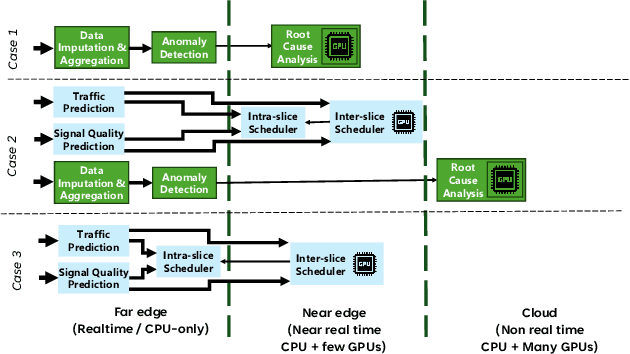
Cellular Radio Access Networks (RANs) are rapidly evolving towards 6G, driven by the need to reduce costs and introduce new revenue streams for operators and enterprises. In this context, AI emerges as a key enabler in solving complex RAN problems spanning both the management and application domains. Unfortunately, and despite the undeniable promise of AI, several practical challenges still remain, hindering the widespread adoption of AI applications in the RAN space. This article attempts to shed light to these challenges and argues that existing approaches in addressing them are inadequate for realizing the vision of a truly AI-native 6G network. Motivated by this lack of solutions, it proposes a generic distributed AI platform architecture, tailored to the needs of an AI-native RAN and discusses its alignment with ongoing standardization efforts.
Distributed Non-Stochastic Experts
Nov 14, 2012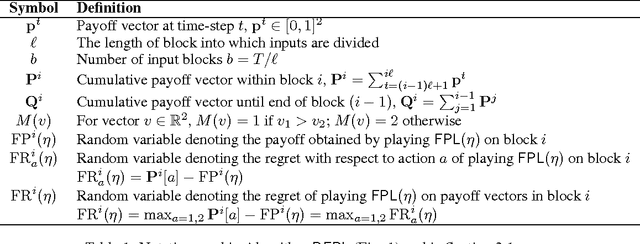
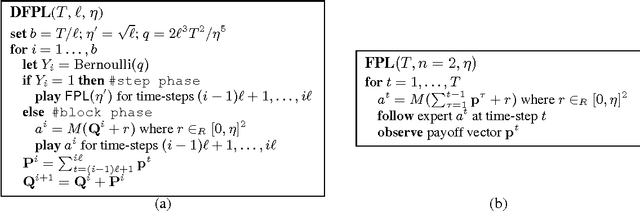
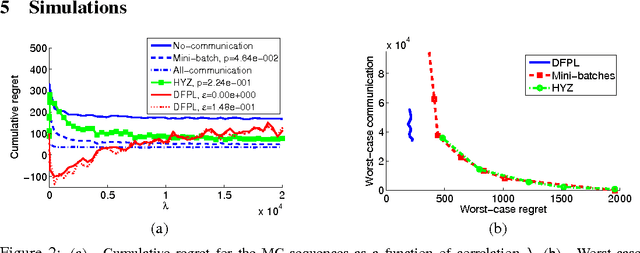
We consider the online distributed non-stochastic experts problem, where the distributed system consists of one coordinator node that is connected to $k$ sites, and the sites are required to communicate with each other via the coordinator. At each time-step $t$, one of the $k$ site nodes has to pick an expert from the set ${1, ..., n}$, and the same site receives information about payoffs of all experts for that round. The goal of the distributed system is to minimize regret at time horizon $T$, while simultaneously keeping communication to a minimum. The two extreme solutions to this problem are: (i) Full communication: This essentially simulates the non-distributed setting to obtain the optimal $O(\sqrt{\log(n)T})$ regret bound at the cost of $T$ communication. (ii) No communication: Each site runs an independent copy : the regret is $O(\sqrt{log(n)kT})$ and the communication is 0. This paper shows the difficulty of simultaneously achieving regret asymptotically better than $\sqrt{kT}$ and communication better than $T$. We give a novel algorithm that for an oblivious adversary achieves a non-trivial trade-off: regret $O(\sqrt{k^{5(1+\epsilon)/6} T})$ and communication $O(T/k^{\epsilon})$, for any value of $\epsilon \in (0, 1/5)$. We also consider a variant of the model, where the coordinator picks the expert. In this model, we show that the label-efficient forecaster of Cesa-Bianchi et al. (2005) already gives us strategy that is near optimal in regret vs communication trade-off.