 Add to Chrome
 Add to Firefox
 Add to Edge
ASK: Adaptive Self-improving Knowledge Framework for Audio Text Retrieval
Dec 11, 2025
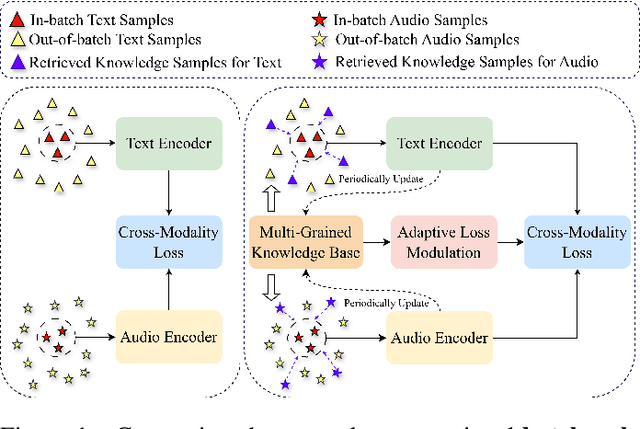
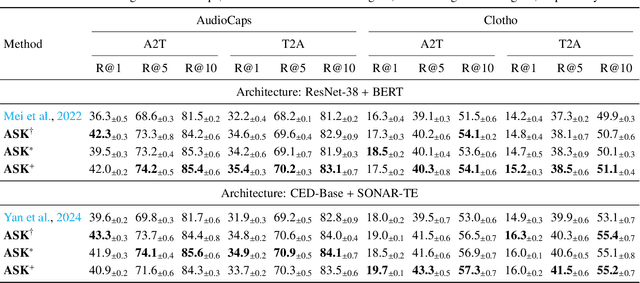
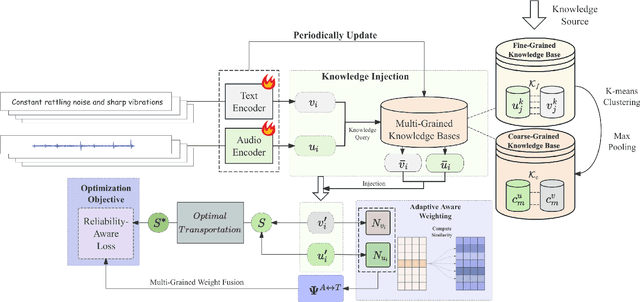
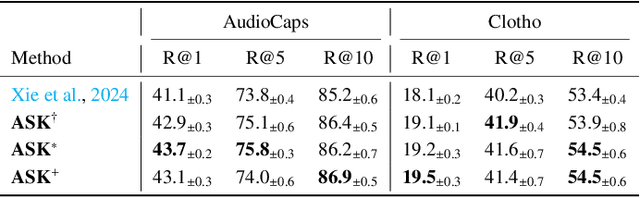
The dominant paradigm for Audio-Text Retrieval (ATR) relies on mini-batch-based contrastive learning. This process, however, is inherently limited by what we formalize as the Gradient Locality Bottleneck (GLB), which structurally prevents models from leveraging out-of-batch knowledge and thus impairs fine-grained and long-tail learning. While external knowledge-enhanced methods can alleviate the GLB, we identify a critical, unaddressed side effect: the Representation-Drift Mismatch (RDM), where a static knowledge base becomes progressively misaligned with the evolving model, turning guidance into noise. To address this dual challenge, we propose the Adaptive Self-improving Knowledge (ASK) framework, a model-agnostic, plug-and-play solution. ASK breaks the GLB via multi-grained knowledge injection, systematically mitigates RDM through dynamic knowledge refinement, and introduces a novel adaptive reliability weighting scheme to ensure consistent knowledge contributes to optimization. Experimental results on two benchmark datasets with superior, state-of-the-art performance justify the efficacy of our proposed ASK framework.

Scalable Supervising Software Agents with Patch Reasoner
Oct 26, 2025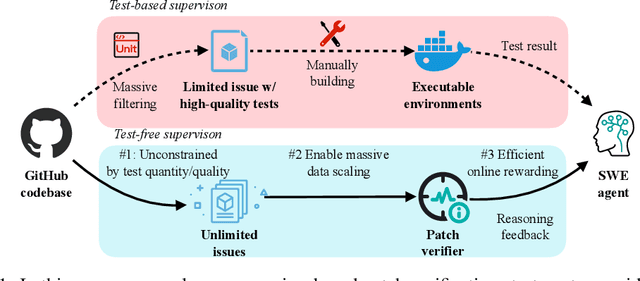
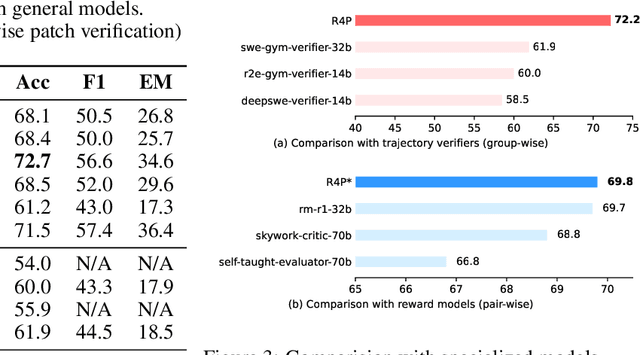
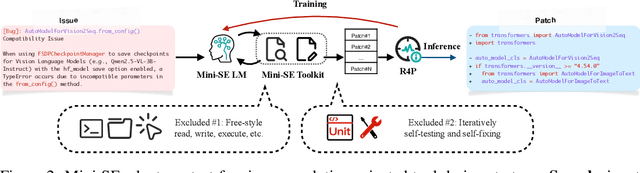
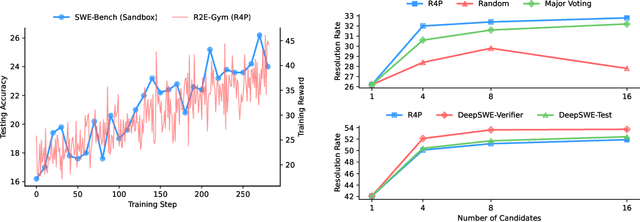
While large language model agents have advanced software engineering tasks, the unscalable nature of existing test-based supervision is limiting the potential improvement of data scaling. The reason is twofold: (1) building and running test sandbox is rather heavy and fragile, and (2) data with high-coverage tests is naturally rare and threatened by test hacking via edge cases. In this paper, we propose R4P, a patch verifier model to provide scalable rewards for training and testing SWE agents via reasoning. We consider that patch verification is fundamentally a reasoning task, mirroring how human repository maintainers review patches without writing and running new reproduction tests. To obtain sufficient reference and reduce the risk of reward hacking, R4P uses a group-wise objective for RL training, enabling it to verify multiple patches against each other's modification and gain a dense reward for stable training. R4P achieves 72.2% Acc. for verifying patches from SWE-bench-verified, surpassing OpenAI o3. To demonstrate R4P's practicality, we design and train a lite scaffold, Mini-SE, with pure reinforcement learning where all rewards are derived from R4P. As a result, Mini-SE achieves 26.2% Pass@1 on SWE-bench-verified, showing a 10.0% improvement over the original Qwen3-32B. This can be further improved to 32.8% with R4P for test-time scaling. Furthermore, R4P verifies patches within a second, 50x faster than testing on average. The stable scaling curves of rewards and accuracy along with high efficiency reflect R4P's practicality.