 Add to Chrome
 Add to Firefox
 Add to Edge
Sink-Aware Pruning for Diffusion Language Models
Feb 19, 2026
Diffusion Language Models (DLMs) incur high inference cost due to iterative denoising, motivating efficient pruning. Existing pruning heuristics largely inherited from autoregressive (AR) LLMs, typically preserve attention sink tokens because AR sinks serve as stable global anchors. We show that this assumption does not hold for DLMs: the attention-sink position exhibits substantially higher variance over the full generation trajectory (measured by how the dominant sink locations shift across timesteps), indicating that sinks are often transient and less structurally essential than in AR models. Based on this observation, we propose ${\bf \texttt{Sink-Aware Pruning}}$, which automatically identifies and prunes unstable sinks in DLMs (prior studies usually keep sinks for AR LLMs). Without retraining, our method achieves a better quality-efficiency trade-off and outperforms strong prior pruning baselines under matched compute. Our code is available at https://github.com/VILA-Lab/Sink-Aware-Pruning.

Mobile-MMLU: A Mobile Intelligence Language Understanding Benchmark
Mar 26, 2025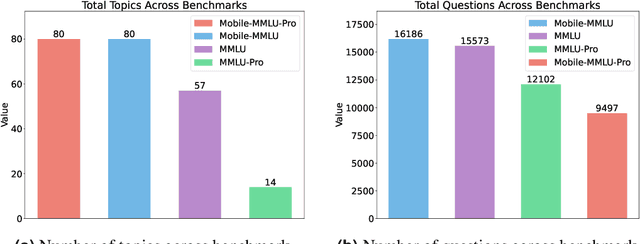
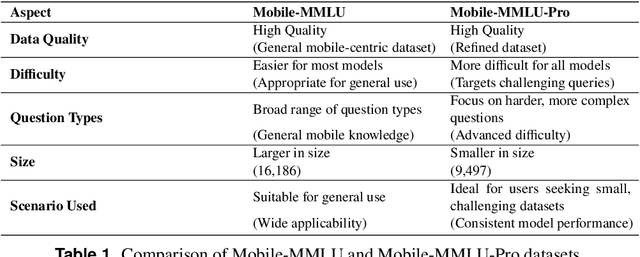
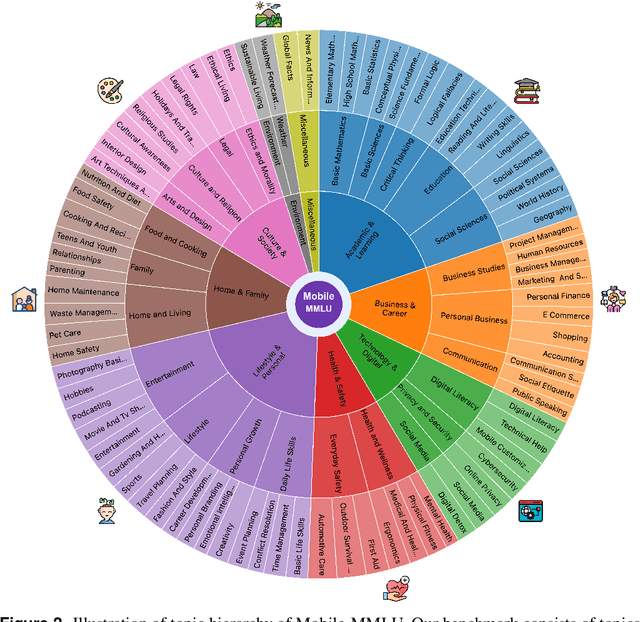
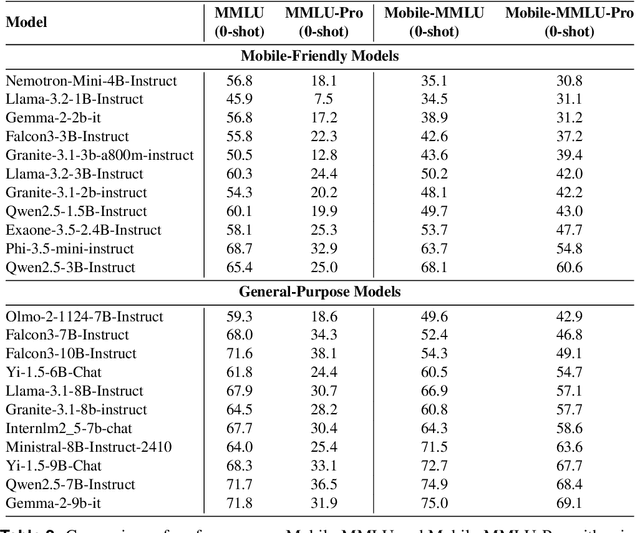
Rapid advancements in large language models (LLMs) have increased interest in deploying them on mobile devices for on-device AI applications. Mobile users interact differently with LLMs compared to desktop users, creating unique expectations and data biases. Current benchmark datasets primarily target at server and desktop environments, and there is a notable lack of extensive datasets specifically designed for mobile contexts. Additionally, mobile devices face strict limitations in storage and computing resources, constraining model size and capabilities, thus requiring optimized efficiency and prioritized knowledge. To address these challenges, we introduce Mobile-MMLU, a large-scale benchmark dataset tailored for mobile intelligence. It consists of 16,186 questions across 80 mobile-related fields, designed to evaluate LLM performance in realistic mobile scenarios. A challenging subset, Mobile-MMLU-Pro, provides advanced evaluation similar in size to MMLU-Pro but significantly more difficult than our standard full set. Both benchmarks use multiple-choice, order-invariant questions focused on practical mobile interactions, such as recipe suggestions, travel planning, and essential daily tasks. The dataset emphasizes critical mobile-specific metrics like inference latency, energy consumption, memory usage, and response quality, offering comprehensive insights into model performance under mobile constraints. Moreover, it prioritizes privacy and adaptability, assessing models' ability to perform on-device processing, maintain user privacy, and adapt to personalized usage patterns. Mobile-MMLU family offers a standardized framework for developing and comparing mobile-optimized LLMs, enabling advancements in productivity and decision-making within mobile computing environments. Our code and data are available at: https://github.com/VILA-Lab/Mobile-MMLU.