 Add to Chrome
 Add to Firefox
 Add to Edge
Emerging Standards for Machine-to-Machine Video Coding
Dec 11, 2025
Machines are increasingly becoming the primary consumers of visual data, yet most deployments of machine-to-machine systems still rely on remote inference where pixel-based video is streamed using codecs optimized for human perception. Consequently, this paradigm is bandwidth intensive, scales poorly, and exposes raw images to third parties. Recent efforts in the Moving Picture Experts Group (MPEG) redesigned the pipeline for machine-to-machine communication: Video Coding for Machines (VCM) is designed to apply task-aware coding tools in the pixel domain, and Feature Coding for Machines (FCM) is designed to compress intermediate neural features to reduce bitrate, preserve privacy, and support compute offload. Experiments show that FCM is capable of maintaining accuracy close to edge inference while significantly reducing bitrate. Additional analysis of H.26X codecs used as inner codecs in FCM reveals that H.265/High Efficiency Video Coding (HEVC) and H.266/Versatile Video Coding (VVC) achieve almost identical machine task performance, with an average BD-Rate increase of 1.39% when VVC is replaced with HEVC. In contrast, H.264/Advanced Video Coding (AVC) yields an average BD-Rate increase of 32.28% compared to VVC. However, for the tracking task, the impact of codec choice is minimal, with HEVC outperforming VVC and achieving BD Rate of -1.81% and 8.79% for AVC, indicating that existing hardware for already deployed codecs can support machine-to-machine communication without degrading performance.

Feature Coding for Scalable Machine Vision
Dec 11, 2025Deep neural networks (DNNs) drive modern machine vision but are challenging to deploy on edge devices due to high compute demands. Traditional approaches-running the full model on-device or offloading to the cloud face trade-offs in latency, bandwidth, and privacy. Splitting the inference workload between the edge and the cloud offers a balanced solution, but transmitting intermediate features to enable such splitting introduces new bandwidth challenges. To address this, the Moving Picture Experts Group (MPEG) initiated the Feature Coding for Machines (FCM) standard, establishing a bitstream syntax and codec pipeline tailored for compressing intermediate features. This paper presents the design and performance of the Feature Coding Test Model (FCTM), showing significant bitrate reductions-averaging 85.14%-across multiple vision tasks while preserving accuracy. FCM offers a scalable path for efficient and interoperable deployment of intelligent features in bandwidth-limited and privacy-sensitive consumer applications.
* This article has been accepted for publication in IEEE Consumer Electronics Magazine
Enabling Next-Generation Consumer Experience with Feature Coding for Machines
Dec 10, 2025As consumer devices become increasingly intelligent and interconnected, efficient data transfer solutions for machine tasks have become essential. This paper presents an overview of the latest Feature Coding for Machines (FCM) standard, part of MPEG-AI and developed by the Moving Picture Experts Group (MPEG). FCM supports AI-driven applications by enabling the efficient extraction, compression, and transmission of intermediate neural network features. By offloading computationally intensive operations to base servers with high computing resources, FCM allows low-powered devices to leverage large deep learning models. Experimental results indicate that the FCM standard maintains the same level of accuracy while reducing bitrate requirements by 75.90% compared to remote inference.
ROI-Packing: Efficient Region-Based Compression for Machine Vision
Dec 10, 2025This paper introduces ROI-Packing, an efficient image compression method tailored specifically for machine vision. By prioritizing regions of interest (ROI) critical to end-task accuracy and packing them efficiently while discarding less relevant data, ROI-Packing achieves significant compression efficiency without requiring retraining or fine-tuning of end-task models. Comprehensive evaluations across five datasets and two popular tasks-object detection and instance segmentation-demonstrate up to a 44.10% reduction in bitrate without compromising end-task accuracy, along with an 8.88 % improvement in accuracy at the same bitrate compared to the state-of-the-art Versatile Video Coding (VVC) codec standardized by the Moving Picture Experts Group (MPEG).
Efficient Feature Compression for Machines with Global Statistics Preservation
Dec 10, 2025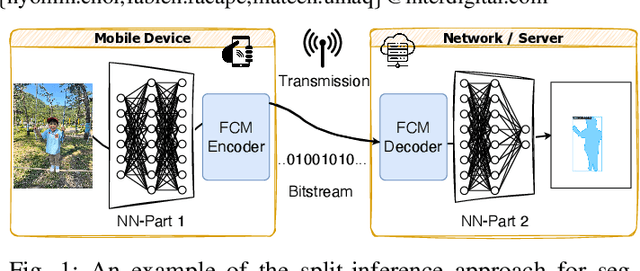
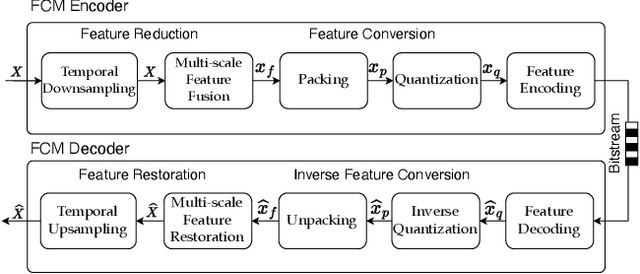
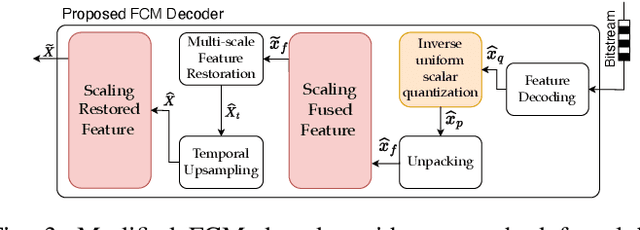
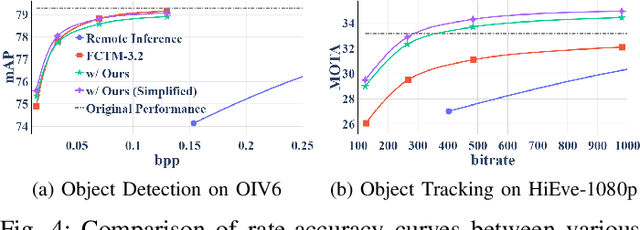
The split-inference paradigm divides an artificial intelligence (AI) model into two parts. This necessitates the transfer of intermediate feature data between the two halves. Here, effective compression of the feature data becomes vital. In this paper, we employ Z-score normalization to efficiently recover the compressed feature data at the decoder side. To examine the efficacy of our method, the proposed method is integrated into the latest Feature Coding for Machines (FCM) codec standard under development by the Moving Picture Experts Group (MPEG). Our method supersedes the existing scaling method used by the current standard under development. It both reduces the overhead bits and improves the end-task accuracy. To further reduce the overhead in certain circumstances, we also propose a simplified method. Experiments show that using our proposed method shows 17.09% reduction in bitrate on average across different tasks and up to 65.69% for object tracking without sacrificing the task accuracy.
Anomalous Behavior Detection in Trajectory Data of Older Drivers
Nov 29, 2023


Given a road network and a set of trajectory data, the anomalous behavior detection (ABD) problem is to identify drivers that show significant directional deviations, hardbrakings, and accelerations in their trips. The ABD problem is important in many societal applications, including Mild Cognitive Impairment (MCI) detection and safe route recommendations for older drivers. The ABD problem is computationally challenging due to the large size of temporally-detailed trajectories dataset. In this paper, we propose an Edge-Attributed Matrix that can represent the key properties of temporally-detailed trajectory datasets and identify abnormal driving behaviors. Experiments using real-world datasets demonstrated that our approach identifies abnormal driving behaviors.
In-vehicle Sensing and Data Analysis for Older Drivers with Mild Cognitive Impairment
Nov 15, 2023


Driving is a complex daily activity indicating age and disease related cognitive declines. Therefore, deficits in driving performance compared with ones without mild cognitive impairment (MCI) can reflect changes in cognitive functioning. There is increasing evidence that unobtrusive monitoring of older adults driving performance in a daily-life setting may allow us to detect subtle early changes in cognition. The objectives of this paper include designing low-cost in-vehicle sensing hardware capable of obtaining high-precision positioning and telematics data, identifying important indicators for early changes in cognition, and detecting early-warning signs of cognitive impairment in a truly normal, day-to-day driving condition with machine learning approaches. Our statistical analysis comparing drivers with MCI to those without reveals that those with MCI exhibit smoother and safer driving patterns. This suggests that drivers with MCI are cognizant of their condition and tend to avoid erratic driving behaviors. Furthermore, our Random Forest models identified the number of night trips, number of trips, and education as the most influential factors in our data evaluation.
Methods and Tools for Monitoring Driver's Behavior
Jan 28, 2023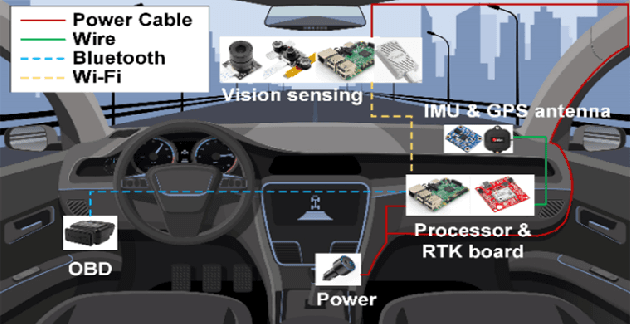
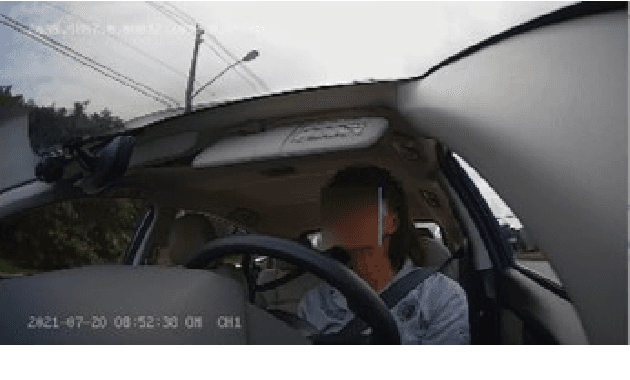
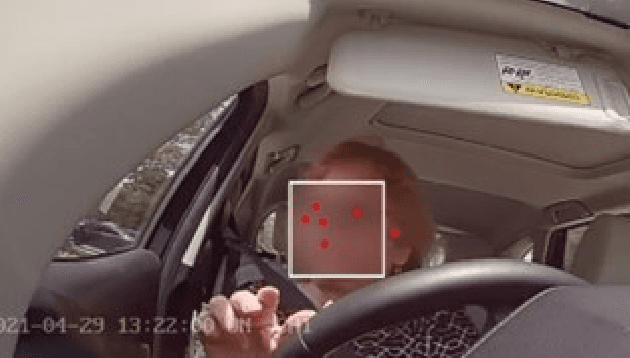
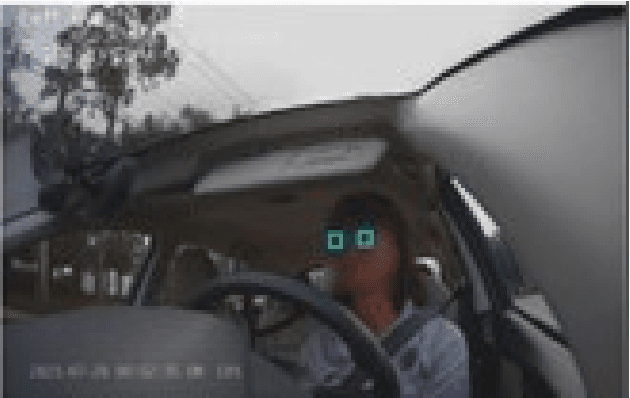
In-vehicle sensing technology has gained tremendous attention due to its ability to support major technological developments, such as connected vehicles and self-driving cars. In-vehicle sensing data are invaluable and important data sources for traffic management systems. In this paper we propose an innovative architecture of unobtrusive in-vehicle sensors and present methods and tools that are used to measure the behavior of drivers. The proposed architecture including methods and tools are used in our NIH project to monitor and identify older drivers with early dementia