 Add to Chrome
 Add to Firefox
 Add to Edge
DeCo-DETR: Decoupled Cognition DETR for efficient Open-Vocabulary Object Detection
Apr 03, 2026
Open-vocabulary Object Detection (OVOD) enables models to recognize objects beyond predefined categories, but existing approaches remain limited in practical deployment. On the one hand, multimodal designs often incur substantial computational overhead due to their reliance on text encoders at inference time. On the other hand, tightly coupled training objectives introduce a trade-off between closed-set detection accuracy and open-world generalization. Thus, we propose Decoupled Cognition DETR (DeCo-DETR), a vision-centric framework that addresses these challenges through a unified decoupling paradigm. Instead of depending on online text encoding, DeCo-DETR constructs a hierarchical semantic prototype space from region-level descriptions generated by pre-trained LVLMs and aligned via CLIP, enabling efficient and reusable semantic representation. Building upon this representation, the framework further disentangles semantic reasoning from localization through a decoupled training strategy, which separates alignment and detection into parallel optimization streams. Extensive experiments on standard OVOD benchmarks demonstrate that DeCo-DETR achieves competitive zero-shot detection performance while significantly improving inference efficiency. These results highlight the effectiveness of decoupling semantic cognition from detection, offering a practical direction for scalable OVOD systems.

GAME: Learning Multimodal Interactions via Graph Structures for Personality Trait Estimation
May 05, 2025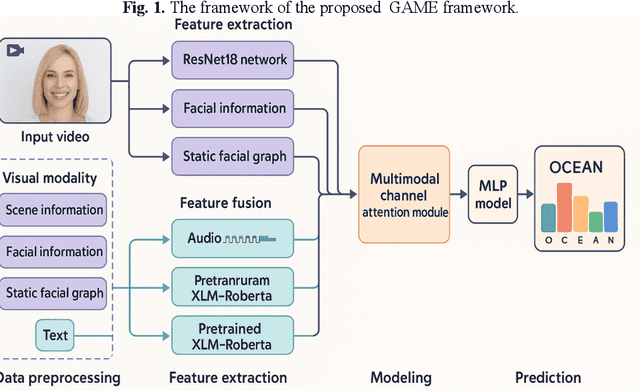
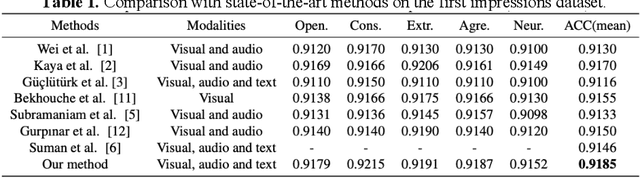
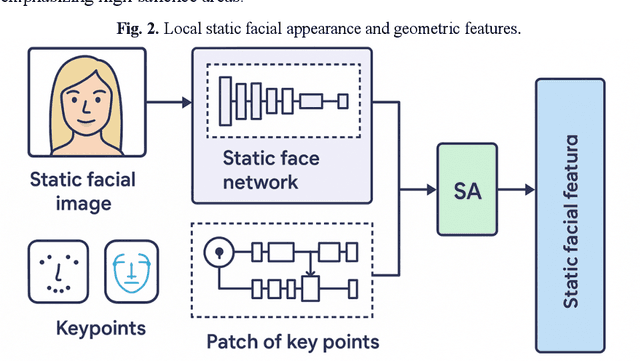
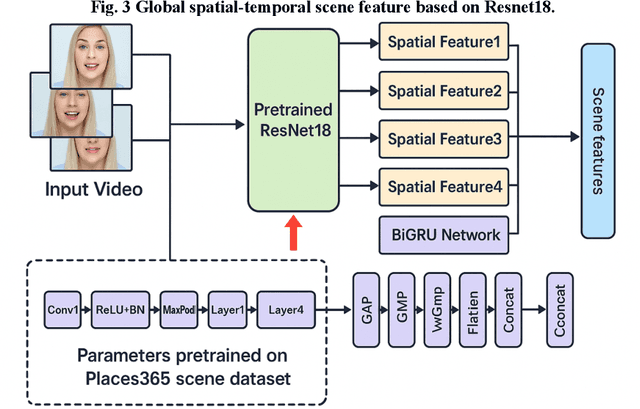
Apparent personality analysis from short videos poses significant chal-lenges due to the complex interplay of visual, auditory, and textual cues. In this paper, we propose GAME, a Graph-Augmented Multimodal Encoder designed to robustly model and fuse multi-source features for automatic personality prediction. For the visual stream, we construct a facial graph and introduce a dual-branch Geo Two-Stream Network, which combines Graph Convolutional Networks (GCNs) and Convolutional Neural Net-works (CNNs) with attention mechanisms to capture both structural and appearance-based facial cues. Complementing this, global context and iden-tity features are extracted using pretrained ResNet18 and VGGFace back-bones. To capture temporal dynamics, frame-level features are processed by a BiGRU enhanced with temporal attention modules. Meanwhile, audio representations are derived from the VGGish network, and linguistic se-mantics are captured via the XLM-Roberta transformer. To achieve effective multimodal integration, we propose a Channel Attention-based Fusion module, followed by a Multi-Layer Perceptron (MLP) regression head for predicting personality traits. Extensive experiments show that GAME con-sistently outperforms existing methods across multiple benchmarks, vali-dating its effectiveness and generalizability.