 Add to Chrome
 Add to Firefox
 Add to Edge
Measuring cross-language intelligibility between Romance languages with computational tools
Feb 07, 2026
We present an analysis of mutual intelligibility in related languages applied for languages in the Romance family. We introduce a novel computational metric for estimating intelligibility based on lexical similarity using surface and semantic similarity of related words, and use it to measure mutual intelligibility for the five main Romance languages (French, Italian, Portuguese, Spanish, and Romanian), and compare results using both the orthographic and phonetic forms of words as well as different parallel corpora and vectorial models of word meaning representation. The obtained intelligibility scores confirm intuitions related to intelligibility asymmetry across languages and significantly correlate with results of cloze tests in human experiments.

RoCode: A Dataset for Measuring Code Intelligence from Problem Definitions in Romanian
Feb 20, 2024


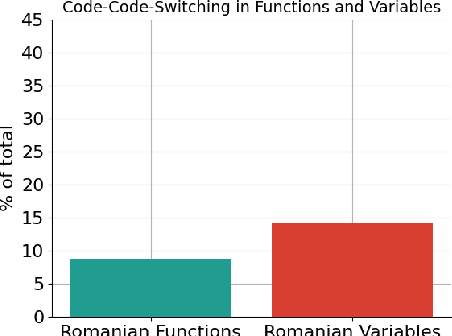
Recently, large language models (LLMs) have become increasingly powerful and have become capable of solving a plethora of tasks through proper instructions in natural language. However, the vast majority of testing suites assume that the instructions are written in English, the de facto prompting language. Code intelligence and problem solving still remain a difficult task, even for the most advanced LLMs. Currently, there are no datasets to measure the generalization power for code-generation models in a language other than English. In this work, we present RoCode, a competitive programming dataset, consisting of 2,642 problems written in Romanian, 11k solutions in C, C++ and Python and comprehensive testing suites for each problem. The purpose of RoCode is to provide a benchmark for evaluating the code intelligence of language models trained on Romanian / multilingual text as well as a fine-tuning set for pretrained Romanian models. Through our results and review of related works, we argue for the need to develop code models for languages other than English.