 Add to Chrome
 Add to Firefox
 Add to Edge
PearlVLA: Progressive Embodied Action-Plan Refinement in Latent Space
Jun 16, 2026
Current Vision-Language-Action (VLA) models face a trade-off between efficient action generation and explicit deliberation. Directly decoding actions from vision-language backbone representations enables low-latency control, whereas explicit reasoning through textual chains, pixel-level subgoals, or action search can improve planning but incurs substantial latency and computational cost. We propose PearlVLA, a VLA framework that moves deliberation into the latent space of a vision-language model (VLM). PearlVLA separates VLM meta-query representations into a fixed visual grounding branch and an iterative latent plan branch. At each refinement round, a plan-conditioned world query probes a lightweight frozen latent world model for an action-free future observation latent, which is fed back to guide plan refinement. A future-guided RefineNet then applies scheduled residual updates to progressively refine a coarse semantic draft into a fine-grained latent action plan. The refined plan after K rounds is then decoded in parallel into an action chunk for low-latency execution. We further introduce Causal Refinement-Grouped Process-Reward RL to optimize the latent refinement process with rewards from longer-horizon imagined futures induced by latent plan edits. Empirical evaluations on the LIBERO benchmark demonstrate that PearlVLA achieves state-of-the-art performance among existing methods.

Memorized action chunking with Transformers: Imitation learning for vision-based tissue surface scanning
Nov 06, 2024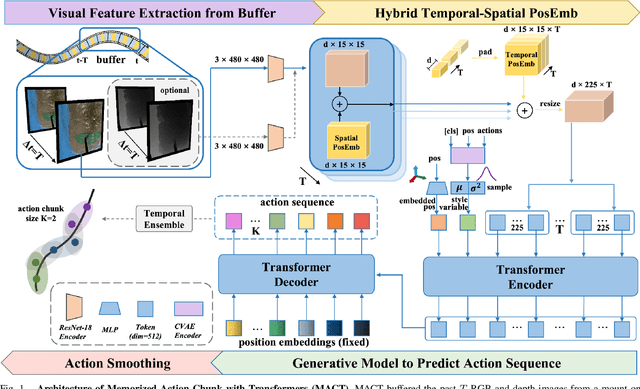
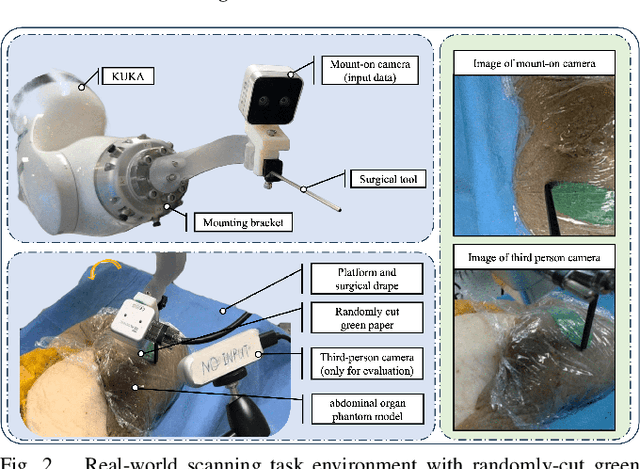
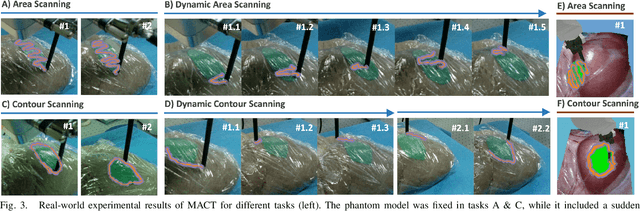
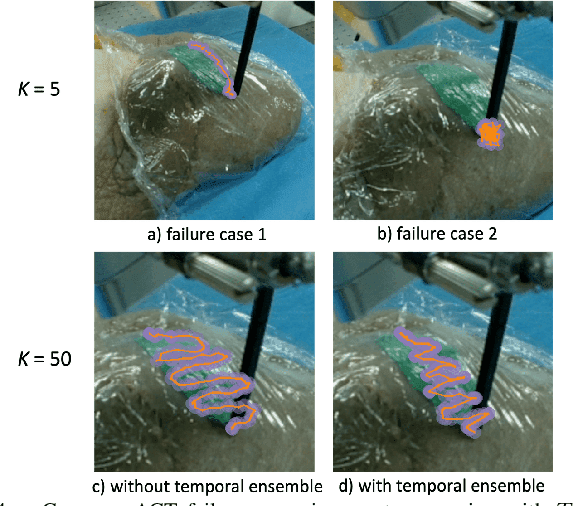
Optical sensing technologies are emerging technologies used in cancer surgeries to ensure the complete removal of cancerous tissue. While point-wise assessment has many potential applications, incorporating automated large area scanning would enable holistic tissue sampling. However, such scanning tasks are challenging due to their long-horizon dependency and the requirement for fine-grained motion. To address these issues, we introduce Memorized Action Chunking with Transformers (MACT), an intuitive yet efficient imitation learning method for tissue surface scanning tasks. It utilizes a sequence of past images as historical information to predict near-future action sequences. In addition, hybrid temporal-spatial positional embeddings were employed to facilitate learning. In various simulation settings, MACT demonstrated significant improvements in contour scanning and area scanning over the baseline model. In real-world testing, with only 50 demonstration trajectories, MACT surpassed the baseline model by achieving a 60-80% success rate on all scanning tasks. Our findings suggest that MACT is a promising model for adaptive scanning in surgical settings.