 Add to Chrome
 Add to Firefox
 Add to Edge
RADIANCE: Relative Adaptive Denoising with IP-Adapter for Novel Concept Enhancement
Jul 06, 2026
Text-to-image (T2I) diffusion models have achieved striking progress but still struggle to synthesize rare concepts involving unusual attribute-object pairings, often resulting in concept omission or semantic drift where a dominant entity overwhelms the generation. Tracing these failures to a lack of compositional balance during the denoising trajectory, we propose RADIANCE, a training-free framework that treats inference as a closed-loop feedback process. RADIANCE augments pretrained backbones with three modular components: (1) a Compositional Similarity Monitor (CSM) that tracks the emergence of objects and attributes in intermediate latents via CLIP-based feedback; (2) a Bidirectional Scale Controller (BSC) that applies a reactive "restoring force" using positive and negative IP-Adapter scales to rebalance biased trajectories; and (3) a Feedback Guidance Scheduler (FGS) that coordinates these updates across timesteps without additional training. We further extend the framework to multi-object prompts via Delayed Adapter Activation (DAA) and Layer-wise Alternating Guidance (LAG) to prevent premature concept fusion. By overlapping monitoring and denoising through pipelined execution, RADIANCE maintains competitive latency while significantly enhancing the per-sample success rate and effective throughput. Experiments on RareBench and T2I-CompBench demonstrate that RADIANCE consistently enhances compositional alignment and perceptual quality over state-of-the-art baselines.

HyperPatch: Sequential Knowledge Editing Under n-ary Structural Drift
Jun 02, 2026Large Language Models (LLMs) rely on Knowledge Editing (KE) to maintain temporal validity, yet real-world knowledge is inherently n-ary. We demonstrate that in non-stationary environments, sequential updates to complex relations induce N-ary Structural Drift, a phenomenon where the binary reification of n-ary events into triples fractures relational atomicity. This precipitates Structure-Conditioned Knowledge Transfer Failure, a systematic mis-grounding of the retriever frequently misdiagnosed as parametric hallucination. To tackle this, we propose HyperPatch, a parameter-preserving framework that reformulates sequential KE as a stability problem over hypergraph manifolds. HyperPatch preserves event integrity through three phases: (i) Structural Prior Initialization, establishing a topology-aware embedding space via contrastive learning on a Hypergraph Neural Network (HGNN) to capture high-order correlations; (ii) Sequential Topology Editing, utilizing a dual-stage mechanism that employs SimHash-based Topological Alignment for rapid conflict resolution and Topological LoRA Adaptation to track drift without backbone retraining; and (iii) Structure-Conditioned Reasoning, which integrates globally consistent evidence from fused linguistic and structural manifolds. On the MQuAKE-CF and MQuAKE-T benchmarks, HyperPatch achieves relative gains in Hop-wise Accuracy (H-Acc) of 96.24% and 21.06% over the strongest baseline, respectively. Further ablations demonstrate superior reliability under continuous n-ary update streams, whereas the standard KG-based variant suffers H-Acc collapses of up to 88.3% due to structural misalignment.
HyperRAG: Reasoning N-ary Facts over Hypergraphs for Retrieval Augmented Generation
Feb 16, 2026Graph-based retrieval-augmented generation (RAG) methods, typically built on knowledge graphs (KGs) with binary relational facts, have shown promise in multi-hop open-domain QA. However, their rigid retrieval schemes and dense similarity search often introduce irrelevant context, increase computational overhead, and limit relational expressiveness. In contrast, n-ary hypergraphs encode higher-order relational facts that capture richer inter-entity dependencies and enable shallower, more efficient reasoning paths. To address this limitation, we propose HyperRAG, a RAG framework tailored for n-ary hypergraphs with two complementary retrieval variants: (i) HyperRetriever learns structural-semantic reasoning over n-ary facts to construct query-conditioned relational chains. It enables accurate factual tracking, adaptive high-order traversal, and interpretable multi-hop reasoning under context constraints. (ii) HyperMemory leverages the LLM's parametric memory to guide beam search, dynamically scoring n-ary facts and entities for query-aware path expansion. Extensive evaluations on WikiTopics (11 closed-domain datasets) and three open-domain QA benchmarks (HotpotQA, MuSiQue, and 2WikiMultiHopQA) validate HyperRAG's effectiveness. HyperRetriever achieves the highest answer accuracy overall, with average gains of 2.95% in MRR and 1.23% in Hits@10 over the strongest baseline. Qualitative analysis further shows that HyperRetriever bridges reasoning gaps through adaptive and interpretable n-ary chain construction, benefiting both open and closed-domain QA.
VecSet-Edit: Unleashing Pre-trained LRM for Mesh Editing from Single Image
Feb 04, 20263D editing has emerged as a critical research area to provide users with flexible control over 3D assets. While current editing approaches predominantly focus on 3D Gaussian Splatting or multi-view images, the direct editing of 3D meshes remains underexplored. Prior attempts, such as VoxHammer, rely on voxel-based representations that suffer from limited resolution and necessitate labor-intensive 3D mask. To address these limitations, we propose \textbf{VecSet-Edit}, the first pipeline that leverages the high-fidelity VecSet Large Reconstruction Model (LRM) as a backbone for mesh editing. Our approach is grounded on a analysis of the spatial properties in VecSet tokens, revealing that token subsets govern distinct geometric regions. Based on this insight, we introduce Mask-guided Token Seeding and Attention-aligned Token Gating strategies to precisely localize target regions using only 2D image conditions. Also, considering the difference between VecSet diffusion process versus voxel we design a Drift-aware Token Pruning to reject geometric outliers during the denoising process. Finally, our Detail-preserving Texture Baking module ensures that we not only preserve the geometric details of original mesh but also the textural information. More details can be found in our project page: https://github.com/BlueDyee/VecSet-Edit/tree/main
Not All Thats Rare Is Lost: Causal Paths to Rare Concept Synthesis
May 27, 2025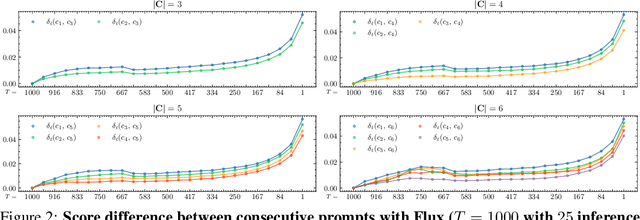
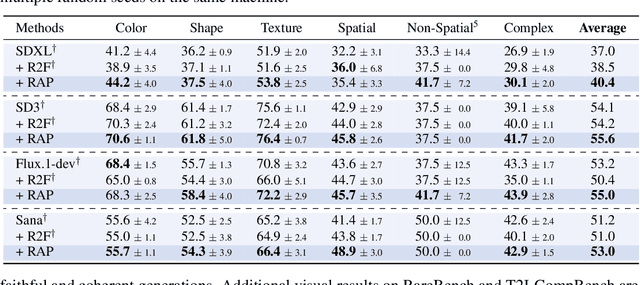
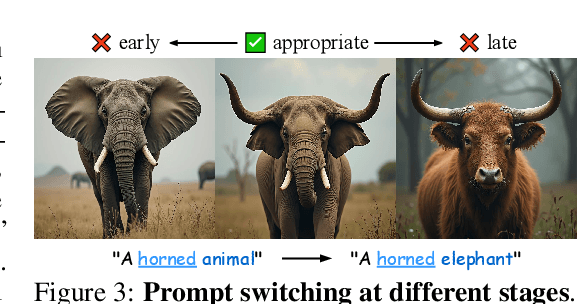

Diffusion models have shown strong capabilities in high-fidelity image generation but often falter when synthesizing rare concepts, i.e., prompts that are infrequently observed in the training distribution. In this paper, we introduce RAP, a principled framework that treats rare concept generation as navigating a latent causal path: a progressive, model-aligned trajectory through the generative space from frequent concepts to rare targets. Rather than relying on heuristic prompt alternation, we theoretically justify that rare prompt guidance can be approximated by semantically related frequent prompts. We then formulate prompt switching as a dynamic process based on score similarity, enabling adaptive stage transitions. Furthermore, we reinterpret prompt alternation as a second-order denoising mechanism, promoting smooth semantic progression and coherent visual synthesis. Through this causal lens, we align input scheduling with the model's internal generative dynamics. Experiments across diverse diffusion backbones demonstrate that RAP consistently enhances rare concept generation, outperforming strong baselines in both automated evaluations and human studies.
MAD: Makeup All-in-One with Cross-Domain Diffusion Model
Apr 03, 2025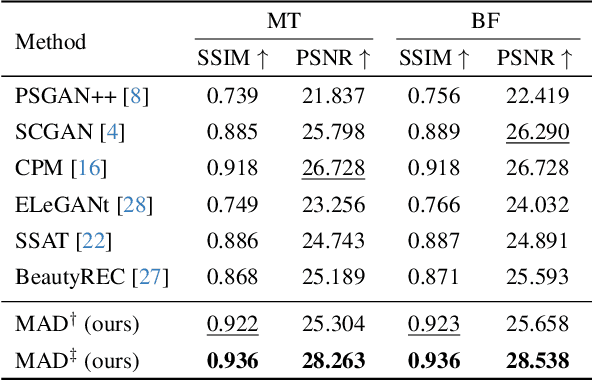
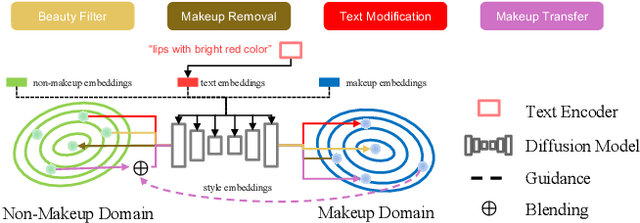
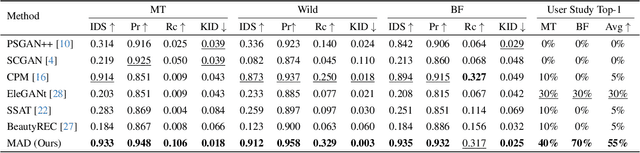
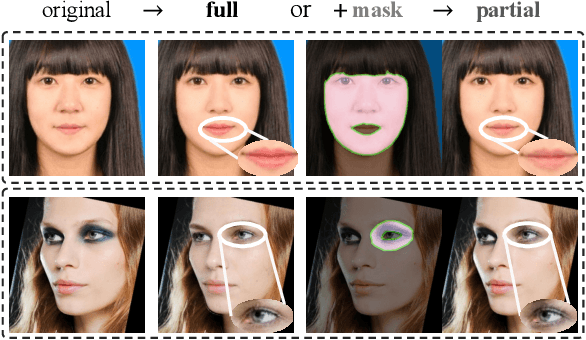
Existing makeup techniques often require designing multiple models to handle different inputs and align features across domains for different makeup tasks, e.g., beauty filter, makeup transfer, and makeup removal, leading to increased complexity. Another limitation is the absence of text-guided makeup try-on, which is more user-friendly without needing reference images. In this study, we make the first attempt to use a single model for various makeup tasks. Specifically, we formulate different makeup tasks as cross-domain translations and leverage a cross-domain diffusion model to accomplish all tasks. Unlike existing methods that rely on separate encoder-decoder configurations or cycle-based mechanisms, we propose using different domain embeddings to facilitate domain control. This allows for seamless domain switching by merely changing embeddings with a single model, thereby reducing the reliance on additional modules for different tasks. Moreover, to support precise text-to-makeup applications, we introduce the MT-Text dataset by extending the MT dataset with textual annotations, advancing the practicality of makeup technologies.
Anomaly Detection for Hybrid Butterfly Subspecies via Probability Filtering
Apr 02, 2025Detecting butterfly hybrids requires knowledge of the parent subspecies, and the process can be tedious when encountering a new subspecies. This study focuses on a specific scenario where a model trained to recognize hybrid species A can generalize to species B when B biologically mimics A. Since species A and B share similar patterns, we leverage BioCLIP as our feature extractor to capture features based on their taxonomy. Consequently, the algorithm designed for species A can be transferred to B, as their hybrid and non-hybrid patterns exhibit similar relationships. To determine whether a butterfly is a hybrid, we adopt proposed probability filtering and color jittering to augment and simulate the mimicry. With these approaches, we achieve second place in the official development phase. Our code is publicly available at https://github.com/Justin900429/NSF-HDR-Challenge.
TF-TI2I: Training-Free Text-and-Image-to-Image Generation via Multi-Modal Implicit-Context Learning in Text-to-Image Models
Mar 19, 2025Text-and-Image-To-Image (TI2I), an extension of Text-To-Image (T2I), integrates image inputs with textual instructions to enhance image generation. Existing methods often partially utilize image inputs, focusing on specific elements like objects or styles, or they experience a decline in generation quality with complex, multi-image instructions. To overcome these challenges, we introduce Training-Free Text-and-Image-to-Image (TF-TI2I), which adapts cutting-edge T2I models such as SD3 without the need for additional training. Our method capitalizes on the MM-DiT architecture, in which we point out that textual tokens can implicitly learn visual information from vision tokens. We enhance this interaction by extracting a condensed visual representation from reference images, facilitating selective information sharing through Reference Contextual Masking -- this technique confines the usage of contextual tokens to instruction-relevant visual information. Additionally, our Winner-Takes-All module mitigates distribution shifts by prioritizing the most pertinent references for each vision token. Addressing the gap in TI2I evaluation, we also introduce the FG-TI2I Bench, a comprehensive benchmark tailored for TI2I and compatible with existing T2I methods. Our approach shows robust performance across various benchmarks, confirming its effectiveness in handling complex image-generation tasks.
FreeCond: Free Lunch in the Input Conditions of Text-Guided Inpainting
Nov 30, 2024In this study, we aim to determine and solve the deficiency of Stable Diffusion Inpainting (SDI) in following the instruction of both prompt and mask. Due to the training bias from masking, the inpainting quality is hindered when the prompt instruction and image condition are not related. Therefore, we conduct a detailed analysis of the internal representations learned by SDI, focusing on how the mask input influences the cross-attention layer. We observe that adapting text key tokens toward the input mask enables the model to selectively paint within the given area. Leveraging these insights, we propose FreeCond, which adjusts only the input mask condition and image condition. By increasing the latent mask value and modifying the frequency of image condition, we align the cross-attention features with the model's training bias to improve generation quality without additional computation, particularly when user inputs are complicated and deviate from the training setup. Extensive experiments demonstrate that FreeCond can enhance any SDI-based model, e.g., yielding up to a 60% and 58% improvement of SDI and SDXLI in the CLIP score.
Traffic Scene Generation from Natural Language Description for Autonomous Vehicles with Large Language Model
Sep 15, 2024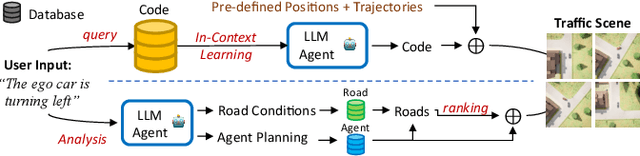
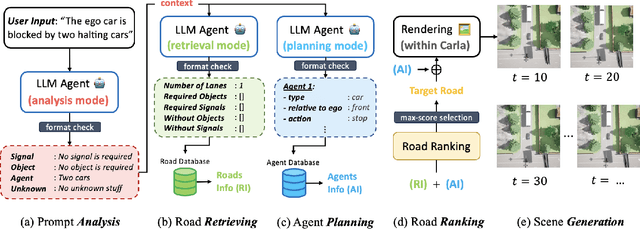
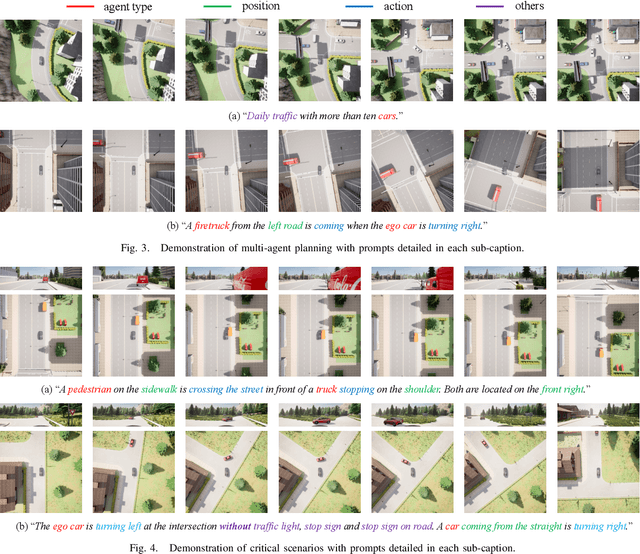
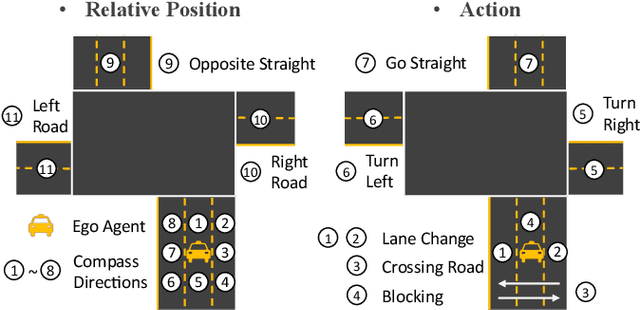
Text-to-scene generation, transforming textual descriptions into detailed scenes, typically relies on generating key scenarios along predetermined paths, constraining environmental diversity and limiting customization flexibility. To address these limitations, we propose a novel text-to-traffic scene framework that leverages a large language model to generate diverse traffic scenarios within the Carla simulator based on natural language descriptions. Users can define specific parameters such as weather conditions, vehicle types, and road signals, while our pipeline can autonomously select the starting point and scenario details, generating scenes from scratch without relying on predetermined locations or trajectories. Furthermore, our framework supports both critical and routine traffic scenarios, enhancing its applicability. Experimental results indicate that our approach promotes diverse agent planning and road selection, enhancing the training of autonomous agents in traffic environments. Notably, our methodology has achieved a 16% reduction in average collision rates. Our work is made publicly available at https://basiclab.github.io/TTSG.