 Add to Chrome
 Add to Firefox
 Add to Edge
RADIANCE: Relative Adaptive Denoising with IP-Adapter for Novel Concept Enhancement
Jul 06, 2026
Text-to-image (T2I) diffusion models have achieved striking progress but still struggle to synthesize rare concepts involving unusual attribute-object pairings, often resulting in concept omission or semantic drift where a dominant entity overwhelms the generation. Tracing these failures to a lack of compositional balance during the denoising trajectory, we propose RADIANCE, a training-free framework that treats inference as a closed-loop feedback process. RADIANCE augments pretrained backbones with three modular components: (1) a Compositional Similarity Monitor (CSM) that tracks the emergence of objects and attributes in intermediate latents via CLIP-based feedback; (2) a Bidirectional Scale Controller (BSC) that applies a reactive "restoring force" using positive and negative IP-Adapter scales to rebalance biased trajectories; and (3) a Feedback Guidance Scheduler (FGS) that coordinates these updates across timesteps without additional training. We further extend the framework to multi-object prompts via Delayed Adapter Activation (DAA) and Layer-wise Alternating Guidance (LAG) to prevent premature concept fusion. By overlapping monitoring and denoising through pipelined execution, RADIANCE maintains competitive latency while significantly enhancing the per-sample success rate and effective throughput. Experiments on RareBench and T2I-CompBench demonstrate that RADIANCE consistently enhances compositional alignment and perceptual quality over state-of-the-art baselines.

Not All Thats Rare Is Lost: Causal Paths to Rare Concept Synthesis
May 27, 2025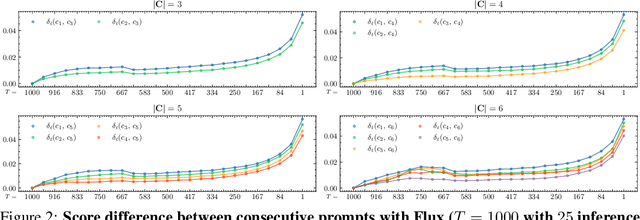
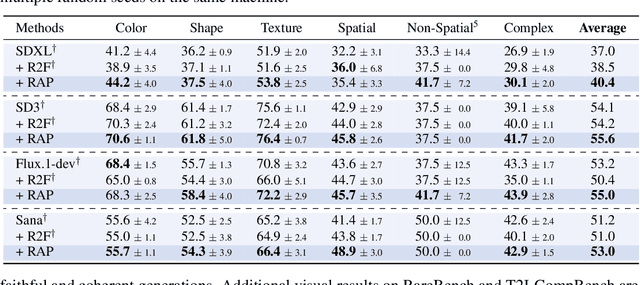
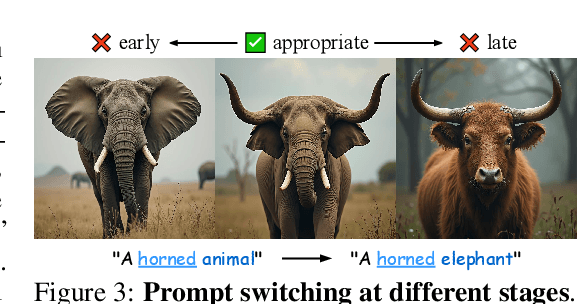

Diffusion models have shown strong capabilities in high-fidelity image generation but often falter when synthesizing rare concepts, i.e., prompts that are infrequently observed in the training distribution. In this paper, we introduce RAP, a principled framework that treats rare concept generation as navigating a latent causal path: a progressive, model-aligned trajectory through the generative space from frequent concepts to rare targets. Rather than relying on heuristic prompt alternation, we theoretically justify that rare prompt guidance can be approximated by semantically related frequent prompts. We then formulate prompt switching as a dynamic process based on score similarity, enabling adaptive stage transitions. Furthermore, we reinterpret prompt alternation as a second-order denoising mechanism, promoting smooth semantic progression and coherent visual synthesis. Through this causal lens, we align input scheduling with the model's internal generative dynamics. Experiments across diverse diffusion backbones demonstrate that RAP consistently enhances rare concept generation, outperforming strong baselines in both automated evaluations and human studies.