 Add to Chrome
 Add to Firefox
 Add to Edge
Greedy Coordinate Diffusion: Effective and Semantically Coherent Adversarial Attacks via Diffusion Guidance
Jun 16, 2026
Adversarial attacks on large language models have limited practical impact despite extensive research. Optimization-based attacks such as Greedy Coordinate Gradient (GCG) (Zou et al., 2023) produce high-perplexity, incoherent suffixes that existing defenses easily detect (Bengio et al., 2024). Moreover, attempting to enforce coherence constraints during optimization often prevents the attack from successfully eliciting the specific targeted response, resulting in low success rates against robust models. Conversely, attacks that maintain coherence often alter the semantic intent of queries; when the model complies with these altered queries, responses fail to address the adversary's original goal. In this work, we introduce Greedy Coordinate Diffusion (GCD), a novel framework that efficiently generates adversarial attacks against safety-aligned models while maintaining low perplexity and high semantic adherence to the adversary's original intent. GCD leverages the generative priors of discrete diffusion language models to guide the search for adversarial suffixes that achieve semantic coherence and adherence. Unlike GCG, GCD does not require direct gradient access, allowing it to operate in a gray-box setting. We show GCD achieves highest ASR while remaining competitive on response-quality scores, and that the constructed adversarial prompts are detected at lower rates than other methods by perplexity-based and guard-model filters.

The Geometry of Alignment Collapse: When Fine-Tuning Breaks Safety
Feb 17, 2026Fine-tuning aligned language models on benign tasks unpredictably degrades safety guardrails, even when training data contains no harmful content and developers have no adversarial intent. We show that the prevailing explanation, that fine-tuning updates should be orthogonal to safety-critical directions in high-dimensional parameter space, offers false reassurance: we show this orthogonality is structurally unstable and collapses under the dynamics of gradient descent. We then resolve this through a novel geometric analysis, proving that alignment concentrates in low-dimensional subspaces with sharp curvature, creating a brittle structure that first-order methods cannot detect or defend. While initial fine-tuning updates may indeed avoid these subspaces, the curvature of the fine-tuning loss generates second-order acceleration that systematically steers trajectories into alignment-sensitive regions. We formalize this mechanism through the Alignment Instability Condition, three geometric properties that, when jointly satisfied, lead to safety degradation. Our main result establishes a quartic scaling law: alignment loss grows with the fourth power of training time, governed by the sharpness of alignment geometry and the strength of curvature coupling between the fine-tuning task and safety-critical parameters. These results expose a structural blind spot in the current safety paradigm. The dominant approaches to safe fine-tuning address only the initial snapshot of a fundamentally dynamic problem. Alignment fragility is not a bug to be patched; it is an intrinsic geometric property of gradient descent on curved manifolds. Our results motivate the development of curvature-aware methods, and we hope will further enable a shift in alignment safety analysis from reactive red-teaming to predictive diagnostics for open-weight model deployment.
Matched Pair Calibration for Ranking Fairness
Jun 20, 2023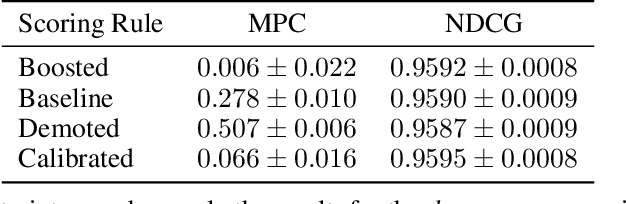
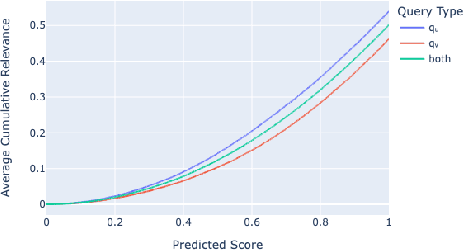
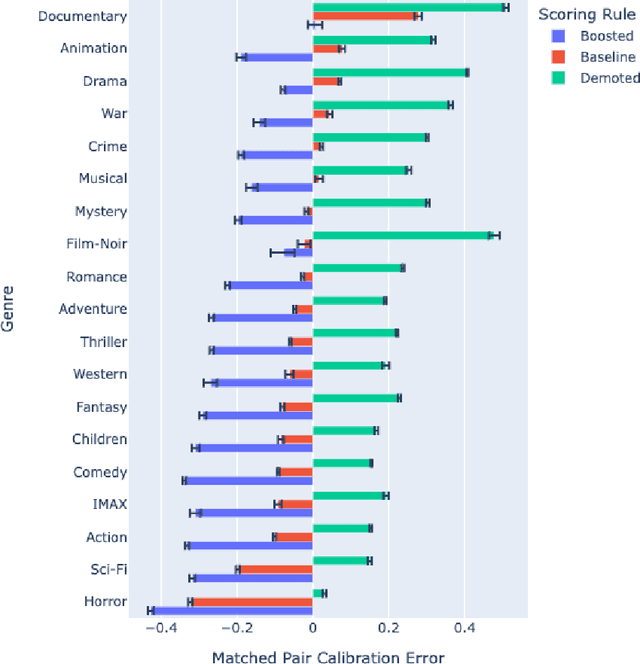
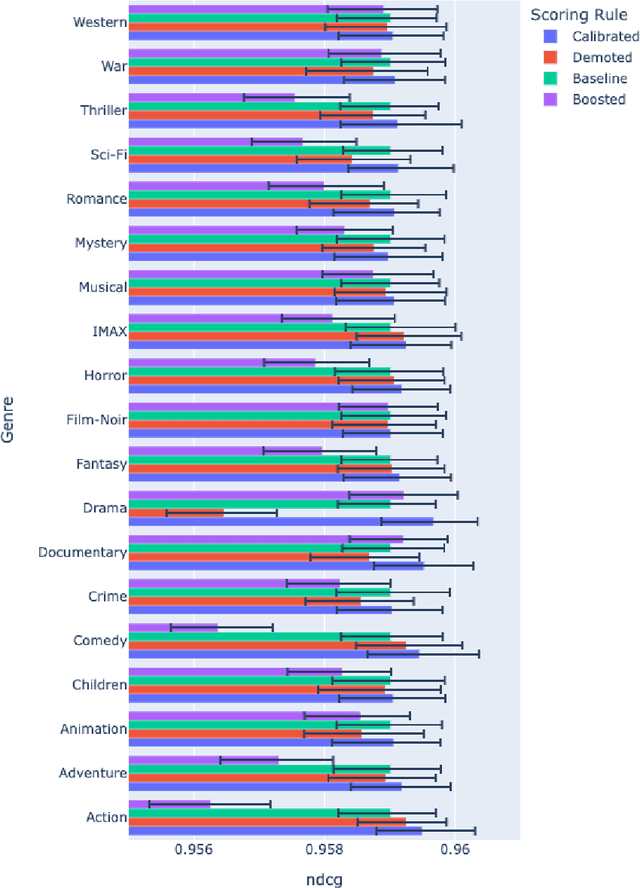
We propose a test of fairness in score-based ranking systems called matched pair calibration. Our approach constructs a set of matched item pairs with minimal confounding differences between subgroups before computing an appropriate measure of ranking error over the set. The matching step ensures that we compare subgroup outcomes between identically scored items so that measured performance differences directly imply unfairness in subgroup-level exposures. We show how our approach generalizes the fairness intuitions of calibration from a binary classification setting to ranking and connect our approach to other proposals for ranking fairness measures. Moreover, our strategy shows how the logic of marginal outcome tests extends to cases where the analyst has access to model scores. Lastly, we provide an example of applying matched pair calibration to a real-word ranking data set to demonstrate its efficacy in detecting ranking bias.
Enforcing Delayed-Impact Fairness Guarantees
Aug 24, 2022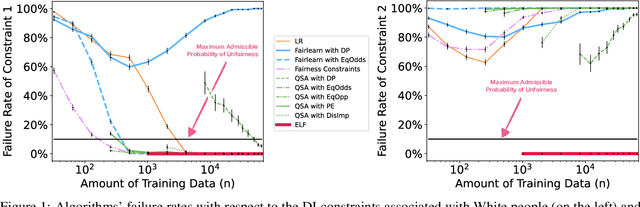
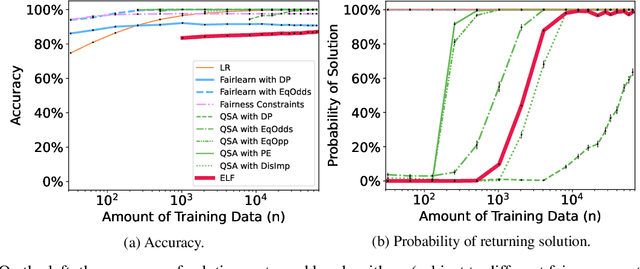
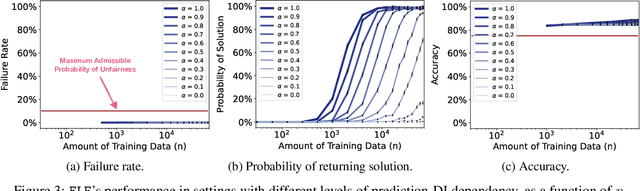
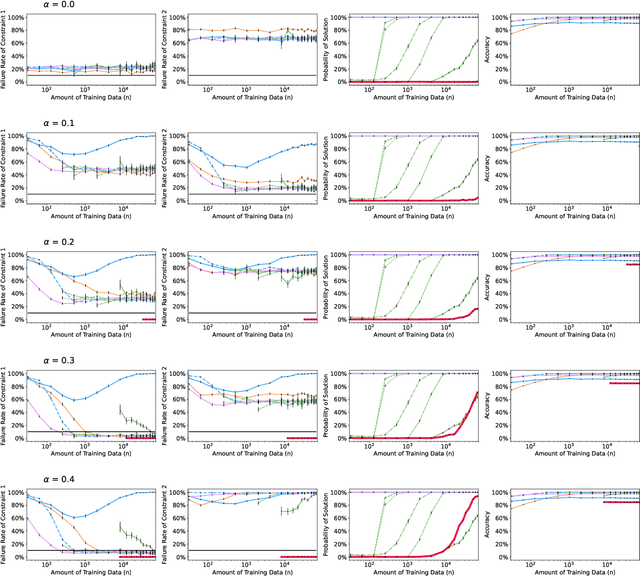
Recent research has shown that seemingly fair machine learning models, when used to inform decisions that have an impact on peoples' lives or well-being (e.g., applications involving education, employment, and lending), can inadvertently increase social inequality in the long term. This is because prior fairness-aware algorithms only consider static fairness constraints, such as equal opportunity or demographic parity. However, enforcing constraints of this type may result in models that have negative long-term impact on disadvantaged individuals and communities. We introduce ELF (Enforcing Long-term Fairness), the first classification algorithm that provides high-confidence fairness guarantees in terms of long-term, or delayed, impact. We prove that the probability that ELF returns an unfair solution is less than a user-specified tolerance and that (under mild assumptions), given sufficient training data, ELF is able to find and return a fair solution if one exists. We show experimentally that our algorithm can successfully mitigate long-term unfairness.
Reinforcement Learning When All Actions are Not Always Available
Jun 05, 2019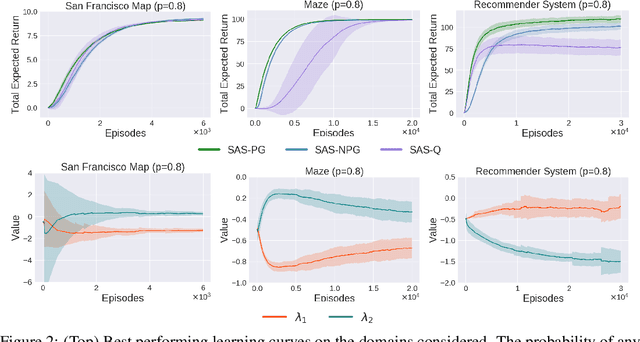
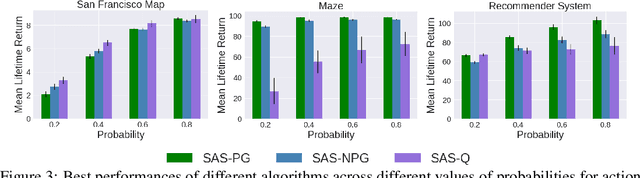
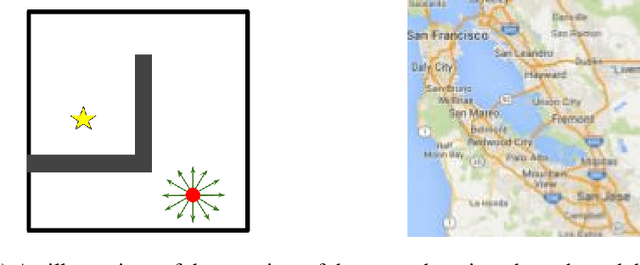
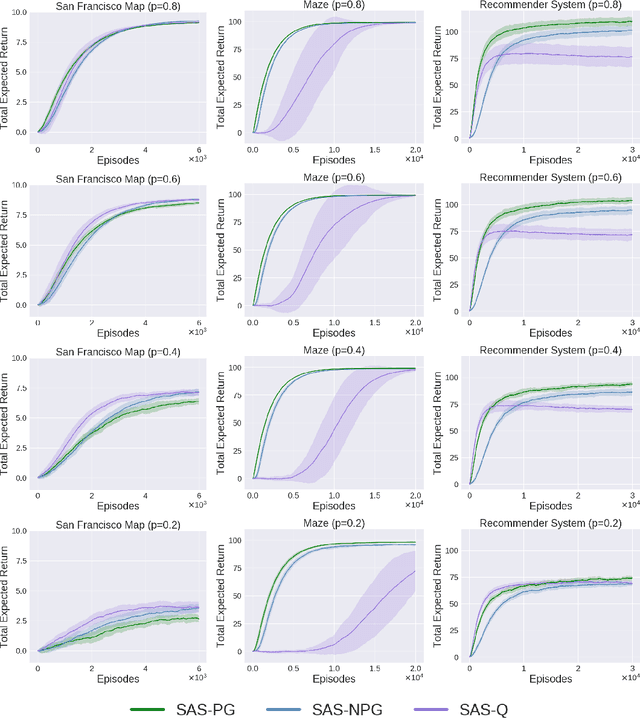
The Markov decision process (MDP) formulation used to model many real-world sequential decision making problems does not capture the setting where the set of available decisions (actions) at each time step is stochastic. Recently, the stochastic action set Markov decision process (SAS-MDP) formulation has been proposed, which captures the concept of a stochastic action set. In this paper we argue that existing RL algorithms for SAS-MDPs suffer from divergence issues, and present new algorithms for SAS-MDPs that incorporate variance reduction techniques unique to this setting, and provide conditions for their convergence. We conclude with experiments that demonstrate the practicality of our approaches using several tasks inspired by real-life use cases wherein the action set is stochastic.