 Add to Chrome
 Add to Firefox
 Add to Edge
Greedy Coordinate Diffusion: Effective and Semantically Coherent Adversarial Attacks via Diffusion Guidance
Jun 16, 2026
Adversarial attacks on large language models have limited practical impact despite extensive research. Optimization-based attacks such as Greedy Coordinate Gradient (GCG) (Zou et al., 2023) produce high-perplexity, incoherent suffixes that existing defenses easily detect (Bengio et al., 2024). Moreover, attempting to enforce coherence constraints during optimization often prevents the attack from successfully eliciting the specific targeted response, resulting in low success rates against robust models. Conversely, attacks that maintain coherence often alter the semantic intent of queries; when the model complies with these altered queries, responses fail to address the adversary's original goal. In this work, we introduce Greedy Coordinate Diffusion (GCD), a novel framework that efficiently generates adversarial attacks against safety-aligned models while maintaining low perplexity and high semantic adherence to the adversary's original intent. GCD leverages the generative priors of discrete diffusion language models to guide the search for adversarial suffixes that achieve semantic coherence and adherence. Unlike GCG, GCD does not require direct gradient access, allowing it to operate in a gray-box setting. We show GCD achieves highest ASR while remaining competitive on response-quality scores, and that the constructed adversarial prompts are detected at lower rates than other methods by perplexity-based and guard-model filters.

The Geometry of Alignment Collapse: When Fine-Tuning Breaks Safety
Feb 17, 2026Fine-tuning aligned language models on benign tasks unpredictably degrades safety guardrails, even when training data contains no harmful content and developers have no adversarial intent. We show that the prevailing explanation, that fine-tuning updates should be orthogonal to safety-critical directions in high-dimensional parameter space, offers false reassurance: we show this orthogonality is structurally unstable and collapses under the dynamics of gradient descent. We then resolve this through a novel geometric analysis, proving that alignment concentrates in low-dimensional subspaces with sharp curvature, creating a brittle structure that first-order methods cannot detect or defend. While initial fine-tuning updates may indeed avoid these subspaces, the curvature of the fine-tuning loss generates second-order acceleration that systematically steers trajectories into alignment-sensitive regions. We formalize this mechanism through the Alignment Instability Condition, three geometric properties that, when jointly satisfied, lead to safety degradation. Our main result establishes a quartic scaling law: alignment loss grows with the fourth power of training time, governed by the sharpness of alignment geometry and the strength of curvature coupling between the fine-tuning task and safety-critical parameters. These results expose a structural blind spot in the current safety paradigm. The dominant approaches to safe fine-tuning address only the initial snapshot of a fundamentally dynamic problem. Alignment fragility is not a bug to be patched; it is an intrinsic geometric property of gradient descent on curved manifolds. Our results motivate the development of curvature-aware methods, and we hope will further enable a shift in alignment safety analysis from reactive red-teaming to predictive diagnostics for open-weight model deployment.
ElliCE: Efficient and Provably Robust Algorithmic Recourse via the Rashomon Sets
Feb 07, 2026Machine learning models now influence decisions that directly affect people's lives, making it important to understand not only their predictions, but also how individuals could act to obtain better results. Algorithmic recourse provides actionable input modifications to achieve more favorable outcomes, typically relying on counterfactual explanations to suggest such changes. However, when the Rashomon set - the set of near-optimal models - is large, standard counterfactual explanations can become unreliable, as a recourse action valid for one model may fail under another. We introduce ElliCE, a novel framework for robust algorithmic recourse that optimizes counterfactuals over an ellipsoidal approximation of the Rashomon set. The resulting explanations are provably valid over this ellipsoid, with theoretical guarantees on uniqueness, stability, and alignment with key feature directions. Empirically, ElliCE generates counterfactuals that are not only more robust but also more flexible, adapting to user-specified feature constraints while being substantially faster than existing baselines. This provides a principled and practical solution for reliable recourse under model uncertainty, ensuring stable recommendations for users even as models evolve.
On Adversarial Robustness of Language Models in Transfer Learning
Dec 29, 2024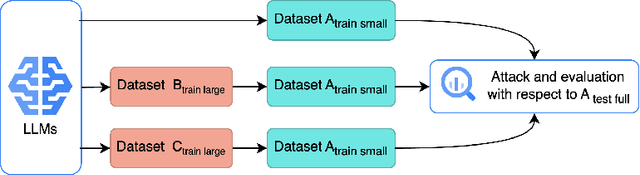
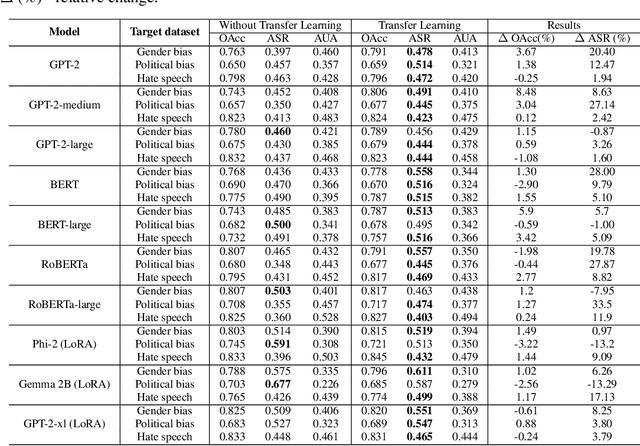
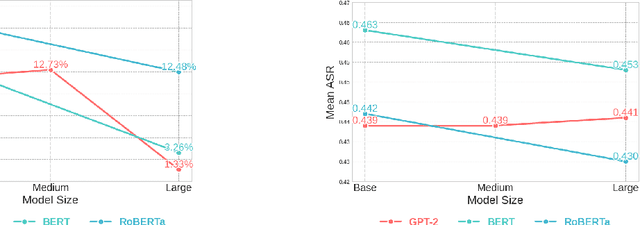
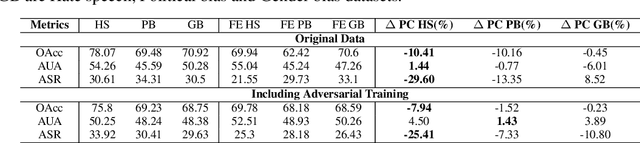
We investigate the adversarial robustness of LLMs in transfer learning scenarios. Through comprehensive experiments on multiple datasets (MBIB Hate Speech, MBIB Political Bias, MBIB Gender Bias) and various model architectures (BERT, RoBERTa, GPT-2, Gemma, Phi), we reveal that transfer learning, while improving standard performance metrics, often leads to increased vulnerability to adversarial attacks. Our findings demonstrate that larger models exhibit greater resilience to this phenomenon, suggesting a complex interplay between model size, architecture, and adaptation methods. Our work highlights the crucial need for considering adversarial robustness in transfer learning scenarios and provides insights into maintaining model security without compromising performance. These findings have significant implications for the development and deployment of LLMs in real-world applications where both performance and robustness are paramount.