 Add to Chrome
 Add to Firefox
 Add to Edge
EnerInfer: Energy-Aware On-Device LLM Inference
Jun 24, 2026
On-device LLM inference is increasingly attractive for privacy-preserving, reliable, and cost-effective deployment, yet its energy and thermal costs remain a critical bottleneck. Existing systems primarily optimize for decoding speed, implicitly assuming that faster execution is always preferable. We show instead that on-device LLM inference often has exploitable configuration slack: modestly lowering NPU and memory frequencies preserves quality of experience (QoE) while substantially improving energy efficiency and reducing heat. Realizing this opportunity in production is challenging. The most energy-efficient NPU/DDR setting varies with the model, inference engine, platform, and runtime conditions, with no stable ranking across configurations. Commercial devices further lack component-level power sensing, and shell temperature evolves with request arrivals, response lengths, and thermal history. To address these challenges, we propose EnerInfer, the first on-device LLM inference framework that jointly manages energy efficiency, throughput, and thermal comfort for LLM workloads. EnerInfer replaces per-model profiling and sensor-heavy control with disaggregated, model-structure-aware prediction and ranking-driven online feedback. It predicts throughput and power for unseen LLMs across NPU/DDR frequency settings, selects QoE-satisfying efficient configurations under runtime interference, and uses lightweight limited-horizon thermal prediction to dynamically switch between energy-optimized and thermally constrained inference. Evaluations on real-world LLMs show that EnerInfer improves energy efficiency by up to 65%, 12%, and 24% on phones, a laptop, and a development board, respectively, without QoE violation.

Strict Partitioning for Sporadic Rigid Gang Tasks
Mar 15, 2024
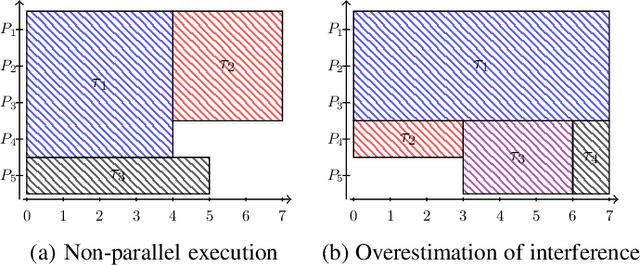
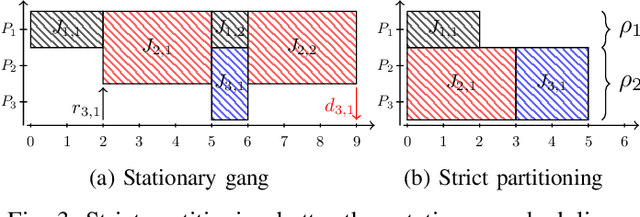
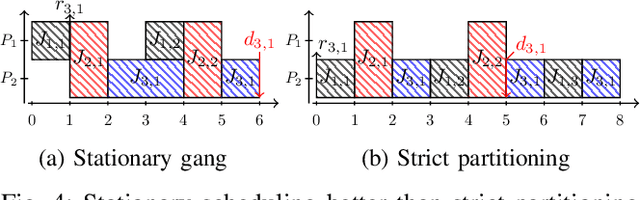
The rigid gang task model is based on the idea of executing multiple threads simultaneously on a fixed number of processors to increase efficiency and performance. Although there is extensive literature on global rigid gang scheduling, partitioned approaches have several practical advantages (e.g., task isolation and reduced scheduling overheads). In this paper, we propose a new partitioned scheduling strategy for rigid gang tasks, named strict partitioning. The method creates disjoint partitions of tasks and processors to avoid inter-partition interference. Moreover, it tries to assign tasks with similar volumes (i.e., parallelisms) to the same partition so that the intra-partition interference can be reduced. Within each partition, the tasks can be scheduled using any type of scheduler, which allows the use of a less pessimistic schedulability test. Extensive synthetic experiments and a case study based on Edge TPU benchmarks show that strict partitioning achieves better schedulability performance than state-of-the-art global gang schedulability analyses for both preemptive and non-preemptive rigid gang task sets.
Edge Generation Scheduling for DAG Tasks using Deep Reinforcement Learning
Aug 28, 2023


Directed acyclic graph (DAG) tasks are currently adopted in the real-time domain to model complex applications from the automotive, avionics, and industrial domain that implement their functionalities through chains of intercommunicating tasks. This paper studies the problem of scheduling real-time DAG tasks by presenting a novel schedulability test based on the concept of trivial schedulability. Using this schedulability test, we propose a new DAG scheduling framework (edge generation scheduling -- EGS) that attempts to minimize the DAG width by iteratively generating edges while guaranteeing the deadline constraint. We study how to efficiently solve the problem of generating edges by developing a deep reinforcement learning algorithm combined with a graph representation neural network to learn an efficient edge generation policy for EGS. We evaluate the effectiveness of the proposed algorithm by comparing it with state-of-the-art DAG scheduling heuristics and an optimal mixed-integer linear programming baseline. Experimental results show that the proposed algorithm outperforms the state-of-the-art by requiring fewer processors to schedule the same DAG tasks.