 Add to Chrome
 Add to Firefox
 Add to Edge
HiSem: Hierarchical Semantic Disentangling for Remote Sensing Image Change Captioning
May 14, 2026
Remote sensing image change captioning (RSICC) aims to achieve high-level semantic understanding of genuine changes occurring between bi-temporal images. Despite notable progress, existing methods are fundamentally limited by a shared modeling assumption: changed and unchanged image pairs, which have intrinsically different semantic granularities, are processed under a unified modeling strategy. This modeling inconsistency leads to semantic entanglement between coarse-grained change existence judgment and fine-grained semantic understanding.To address the above limitation, we propose a novel hierarchical semantic disentangling network (HiSem) that explicitly disentangles semantic representations of different granularities. Specifically, we first introduce the Bidirectional Differential Attention Modulation (BDAM) module that leverages discrepancy-aware attention to enhance cross-temporal interactions, thereby amplifying true change signals while suppressing irrelevant variations. Building upon this, we design a Hierarchical Adaptive Semantic Disentanglement (HASD) module that performs adaptive routing at two hierarchical levels: a coarse-grained image-level routing mechanism distinguishes changed and unchanged image pairs, while a fine-grained token-level Mixture-of-Experts (MoE) block models diverse and heterogeneous change semantics for changed samples. Extensive experiments on two benchmark datasets demonstrate that HiSem outperfoms previous methods, achieving a significant improvement of +7.52\% BLEU-4 on the WHU-CDC dataset. More importantly, our approach provides a structured perspective for RSICC by explicitly aligning model design with the intrinsic semantic heterogeneity of bi-temporal scenes. The code will be available at https://github.com/Man-Wang-star/HiSem

Modelling Power Consumptions for Multi-rotor UAVs
Sep 09, 2022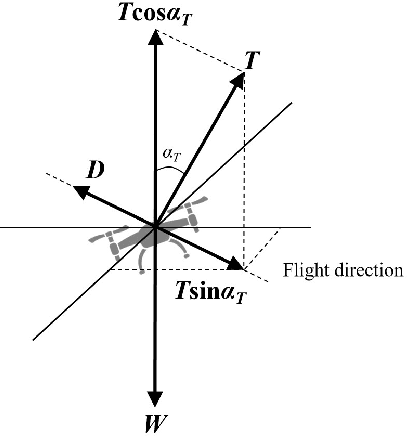
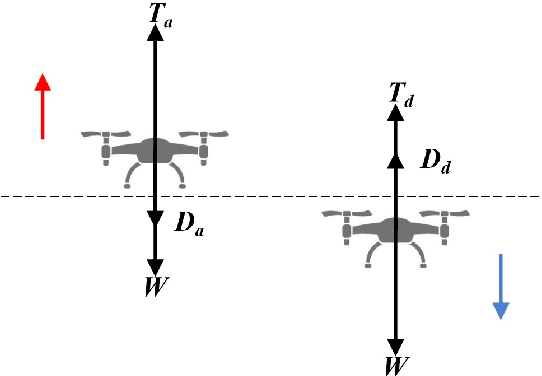
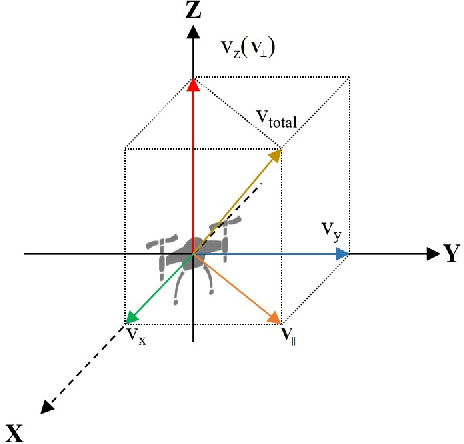
Unmanned aerial vehicles (UAVs) have various advantages, but their practical applications are influenced by their limited energy. Therefore, it is important to manage their power consumption and also important to establish corresponding power consumption models. However, most of existing works either establish theoretical power consumption models for fixed-wing UAVs and single-rotor UAVs, or provide heuristic power consumption models for multi-rotor UAVs without rigorous mathematical derivations. This paper aims to establish theoretical power consumption models for multi-rotor UAVs. To be specific, the closed-form power consumption models for a multi-rotor UAV in three flight statuses, i.e., forward flight, vertical ascent and vertical descent, are derived by leveraging the relationship between single-rotor UAVs and multi-rotor UAVs in terms of power consumptions. On this basis, a generic flight power consumption model for the UAV in a three-dimensional (3-D) scenario is obtained. Extensive experiments are conducted by using DJI M210 and a mobile app made by DJI Mobile SDK in real scenarios, and confirm the correctness and effectiveness of these models; in addition, simulations are performed to further investigate the effect of the rotor numbers on the power consumption for the UAV. The proposed power consumption models not only reveal how the power consumption of multi-rotor UAVs are affected by various factors, but also pave the way for introducing other novel applications.