 Add to Chrome
 Add to Firefox
 Add to Edge
BRIDGE: Benchmark for multi-hop Reasoning In long multimodal Documents with Grounded Evidence
Mar 09, 2026
Multi-hop question answering (QA) is widely used to evaluate the reasoning capabilities of large language models, yet most benchmarks focus on final answer correctness and overlook intermediate reasoning, especially in long multimodal documents. We introduce BRIDGE, a benchmark for multi-hop reasoning over long scientific papers that require integrating evidence across text, tables, and figures. The dataset supports both chain-like and fan-out structures and provides explicit multi-hop reasoning annotations for step-level evaluation beyond answer accuracy. Experiments with state-of-the-art LLMs and multimodal retrieval-augmented generation (RAG) systems reveal systematic deficiencies in evidence aggregation and grounding that remain hidden under conventional answer-only evaluation. BRIDGE provides a targeted testbed for diagnosing reasoning failures in long multimodal documents.

Feature Propagation on Graph: A New Perspective to Graph Representation Learning
Apr 17, 2018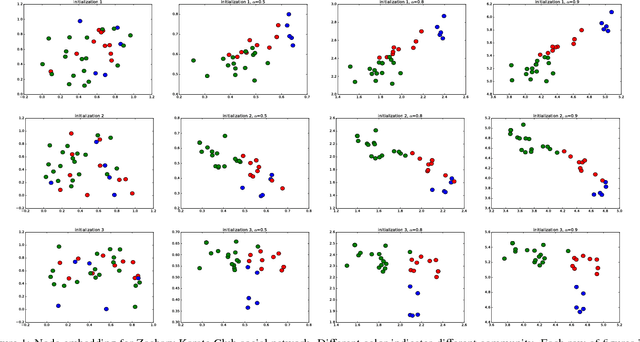

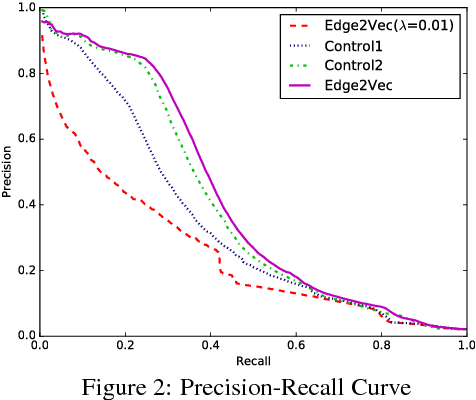
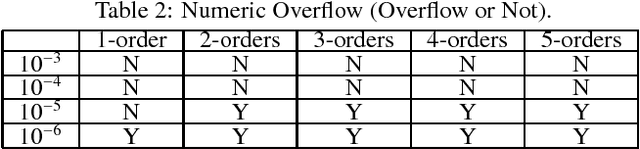
We study feature propagation on graph, an inference process involved in graph representation learning tasks. It's to spread the features over the whole graph to the $t$-th orders, thus to expand the end's features. The process has been successfully adopted in graph embedding or graph neural networks, however few works studied the convergence of feature propagation. Without convergence guarantees, it may lead to unexpected numerical overflows and task failures. In this paper, we first define the concept of feature propagation on graph formally, and then study its convergence conditions to equilibrium states. We further link feature propagation to several established approaches such as node2vec and structure2vec. In the end of this paper, we extend existing approaches from represent nodes to edges (edge2vec) and demonstrate its applications on fraud transaction detection in real world scenario. Experiments show that it is quite competitive.