 Add to Chrome
 Add to Firefox
 Add to Edge
PinEqualizer: Full Funnel Content Exploration and Debiasing System at Pinterest
Jul 24, 2026
In this paper, we propose a new solution for addressing the content cold-start problem in industry-scale search and recommender systems. Compared to prior approaches, we have made the following new contributions: 1) our solution spans the entire multi-stage funnel and generalizes well for both search and recommendation surfaces, 2) our solution reduces bias favoring existing content, allowing more accurate model prediction across content types and reducing short-term tradeoffs associated with high volumes of explicit content exploration, 3) our solution is evaluated with a scalable measurement framework that enables fast short-term experimentation while validating long-term impact. We have iteratively built and successfully deployed this new system at Pinterest in the past two years and observed significant improvements in fresh content exploration, overall user engagement, and content ecosystem health.

InteractRank: Personalized Web-Scale Search Pre-Ranking with Cross Interaction Features
Apr 09, 2025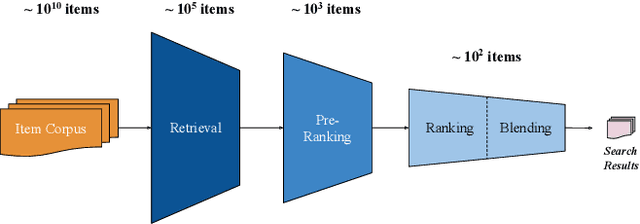

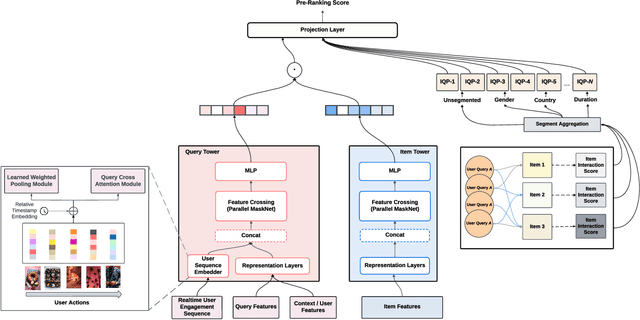
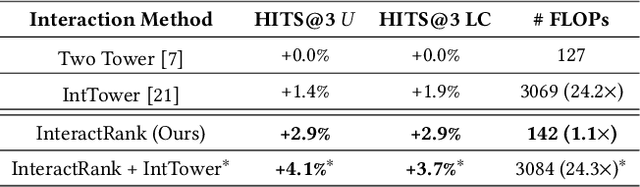
Modern search systems use a multi-stage architecture to deliver personalized results efficiently. Key stages include retrieval, pre-ranking, full ranking, and blending, which refine billions of items to top selections. The pre-ranking stage, vital for scoring and filtering hundreds of thousands of items down to a few thousand, typically relies on two tower models due to their computational efficiency, despite often lacking in capturing complex interactions. While query-item cross interaction features are paramount for full ranking, integrating them into pre-ranking models presents efficiency-related challenges. In this paper, we introduce InteractRank, a novel two tower pre-ranking model with robust cross interaction features used at Pinterest. By incorporating historical user engagement-based query-item interactions in the scoring function along with the two tower dot product, InteractRank significantly boosts pre-ranking performance with minimal latency and computation costs. In real-world A/B experiments at Pinterest, InteractRank improves the online engagement metric by 6.5% over a BM25 baseline and by 3.7% over a vanilla two tower baseline. We also highlight other components of InteractRank, like real-time user-sequence modeling, and analyze their contributions through offline ablation studies. The code for InteractRank is available at https://github.com/pinterest/atg-research/tree/main/InteractRank.
Representation Online Matters: Practical End-to-End Diversification in Search and Recommender Systems
May 26, 2023As the use of online platforms continues to grow across all demographics, users often express a desire to feel represented in the content. To improve representation in search results and recommendations, we introduce end-to-end diversification, ensuring that diverse content flows throughout the various stages of these systems, from retrieval to ranking. We develop, experiment, and deploy scalable diversification mechanisms in multiple production surfaces on the Pinterest platform, including Search, Related Products, and New User Homefeed, to improve the representation of different skin tones in beauty and fashion content. Diversification in production systems includes three components: identifying requests that will trigger diversification, ensuring diverse content is retrieved from the large content corpus during the retrieval stage, and finally, balancing the diversity-utility trade-off in a self-adjusting manner in the ranking stage. Our approaches, which evolved from using Strong-OR logical operator to bucketized retrieval at the retrieval stage and from greedy re-rankers to multi-objective optimization using determinantal point processes for the ranking stage, balances diversity and utility while enabling fast iterations and scalable expansion to diversification over multiple dimensions. Our experiments indicate that these approaches significantly improve diversity metrics, with a neutral to a positive impact on utility metrics and improved user satisfaction, both qualitatively and quantitatively, in production. An accessible PDF of this article is available at https://drive.google.com/file/d/1p5PkqC-sdtX19Y_IAjZCtiSxSEX1IP3q/view