 Add to Chrome
 Add to Firefox
 Add to Edge
PEANUT: Perturbations by Eigenvector Alignment for Attacking Graph Neural Networks Under Topology-Driven Message Passing
Mar 30, 2026
Graph Neural Networks (GNNs) have achieved remarkable performance on tasks involving relational data. However, small perturbations to the graph structure can significantly alter GNN outputs, raising concerns about their robustness in real-world deployments. In this work, we explore the core vulnerability of GNNs which explicitly consume graph topology in the form of the adjacency matrix or Laplacian as a means for message passing, and propose PEANUT, a simple, gradient-free, restricted black-box attack that injects virtual nodes to capitalize on this vulnerability. PEANUT is a injection based attack, which is widely considered to be more practical and realistic scenario than graph modification attacks, where the attacker is able to modify the original graph structure directly. Our method works at the inference phase, making it an evasion attack, and is applicable almost immediately, since it does not involve lengthy iterative optimizations or parameter learning, which add computational and time overhead, or training surrogate models, which are susceptible to failure due to differences in model priors and generalization capabilities. PEANUT also does not require any features on the injected node and consequently demonstrates that GNN performance can be significantly deteriorated even with injected nodes with zeros for features, highlighting the significance of effectively designed connectivity in such attacks. Extensive experiments on real-world datasets across three graph tasks demonstrate the effectiveness of our attack despite its simplicity.

PEANUT: Perturbations by Eigenvalue Alignment for Attacking GNNs Under Topology-Driven Message Passing
Mar 27, 2026Graph Neural Networks (GNNs) have achieved remarkable performance on tasks involving relational data. However, small perturbations to the graph structure can significantly alter GNN outputs, raising concerns about their robustness in real-world deployments. In this work, we explore the core vulnerability of GNNs which explicitly consume graph topology in the form of the adjacency matrix or Laplacian as a means for message passing, and propose PEANUT, a simple, gradient-free, restricted black-box attack that injects virtual nodes to capitalize on this vulnerability. PEANUT is a injection based attack, which is widely considered to be more practical and realistic scenario than graph modification attacks, where the attacker is able to modify the original graph structure directly. Our method works at the inference phase, making it an evasion attack, and is applicable almost immediately, since it does not involve lengthy iterative optimizations or parameter learning, which add computational and time overhead, or training surrogate models, which are susceptible to failure due to differences in model priors and generalization capabilities. PEANUT also does not require any features on the injected node and consequently demonstrates that GNN performance can be significantly deteriorated even with injected nodes with zeros for features, highlighting the significance of effectively designed connectivity in such attacks. Extensive experiments on real-world datasets across three graph tasks demonstrate the effectiveness of our attack despite its simplicity.
Energy-Efficient Seizure Detection Suitable for low-power Applications
Jun 19, 2024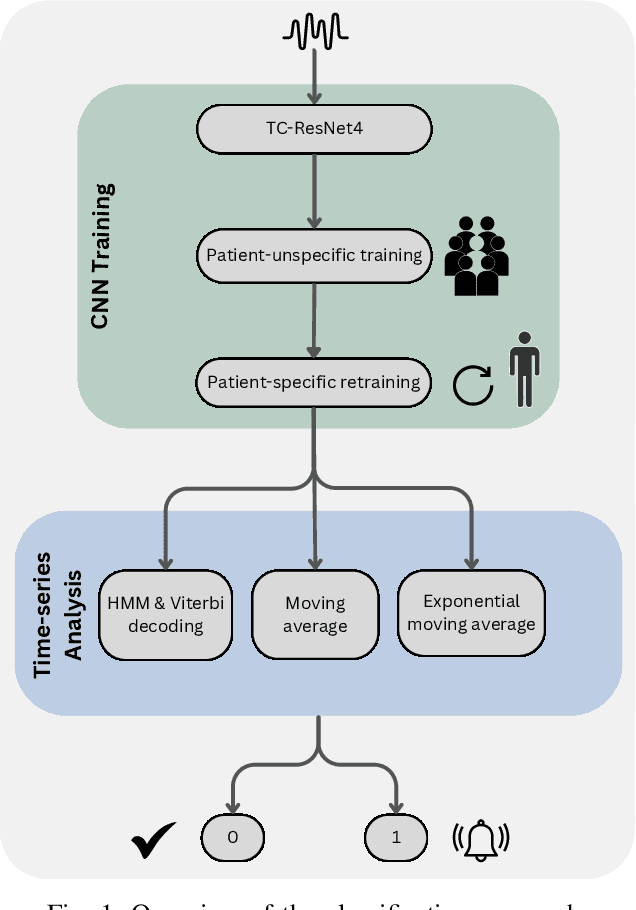
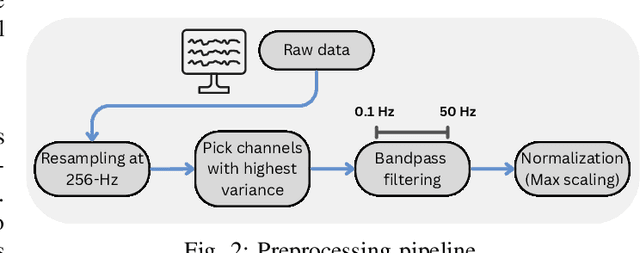
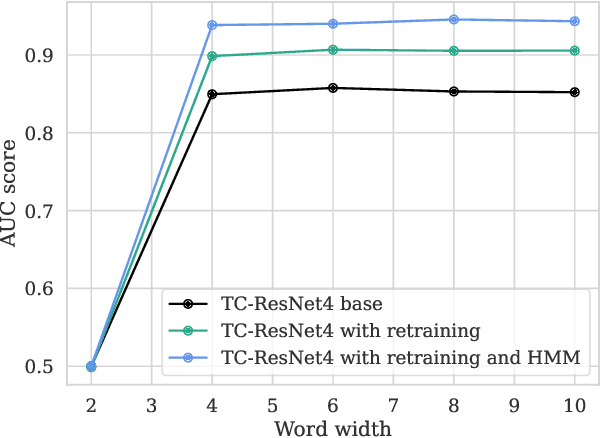
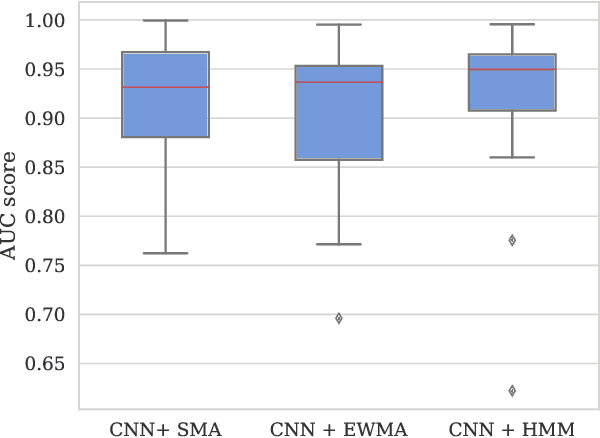
Epilepsy is the most common, chronic, neurological disease worldwide and is typically accompanied by reoccurring seizures. Neuro implants can be used for effective treatment by suppressing an upcoming seizure upon detection. Due to the restricted size and limited battery lifetime of those medical devices, the employed approach also needs to be limited in size and have low energy requirements. We present an energy-efficient seizure detection approach involving a TC-ResNet and time-series analysis which is suitable for low-power edge devices. The presented approach allows for accurate seizure detection without preceding feature extraction while considering the stringent hardware requirements of neural implants. The approach is validated using the CHB-MIT Scalp EEG Database with a 32-bit floating point model and a hardware suitable 4-bit fixed point model. The presented method achieves an accuracy of 95.28%, a sensitivity of 92.34% and an AUC score of 0.9384 on this dataset with 4-bit fixed point representation. Furthermore, the power consumption of the model is measured with the low-power AI accelerator UltraTrail, which only requires 495 nW on average. Due to this low-power consumption this classification approach is suitable for real-time seizure detection on low-power wearable devices such as neural implants.