 Add to Chrome
 Add to Firefox
 Add to Edge
SPIRAL: Symbolic LLM Planning via Grounded and Reflective Search
Dec 29, 2025
Large Language Models (LLMs) often falter at complex planning tasks that require exploration and self-correction, as their linear reasoning process struggles to recover from early mistakes. While search algorithms like Monte Carlo Tree Search (MCTS) can explore alternatives, they are often ineffective when guided by sparse rewards and fail to leverage the rich semantic capabilities of LLMs. We introduce SPIRAL (Symbolic LLM Planning via Grounded and Reflective Search), a novel framework that embeds a cognitive architecture of three specialized LLM agents into an MCTS loop. SPIRAL's key contribution is its integrated planning pipeline where a Planner proposes creative next steps, a Simulator grounds the search by predicting realistic outcomes, and a Critic provides dense reward signals through reflection. This synergy transforms MCTS from a brute-force search into a guided, self-correcting reasoning process. On the DailyLifeAPIs and HuggingFace datasets, SPIRAL consistently outperforms the default Chain-of-Thought planning method and other state-of-the-art agents. More importantly, it substantially surpasses other state-of-the-art agents; for example, SPIRAL achieves 83.6% overall accuracy on DailyLifeAPIs, an improvement of over 16 percentage points against the next-best search framework, while also demonstrating superior token efficiency. Our work demonstrates that structuring LLM reasoning as a guided, reflective, and grounded search process yields more robust and efficient autonomous planners. The source code, full appendices, and all experimental data are available for reproducibility at the official project repository.

KModels: Unlocking AI for Business Applications
Sep 08, 2024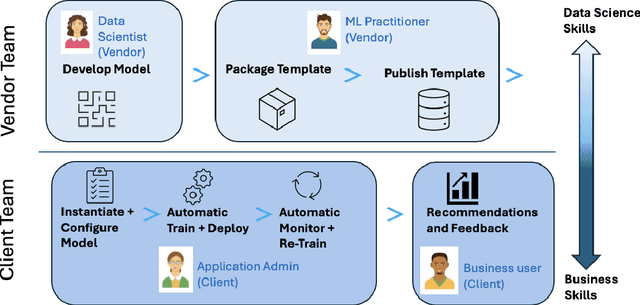
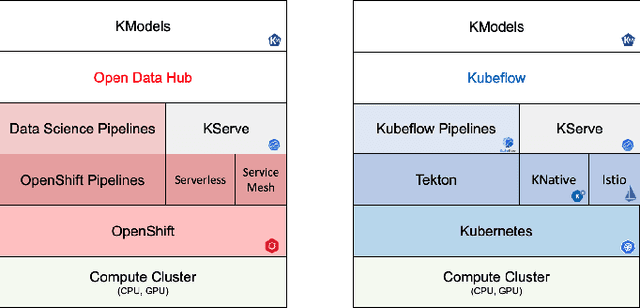
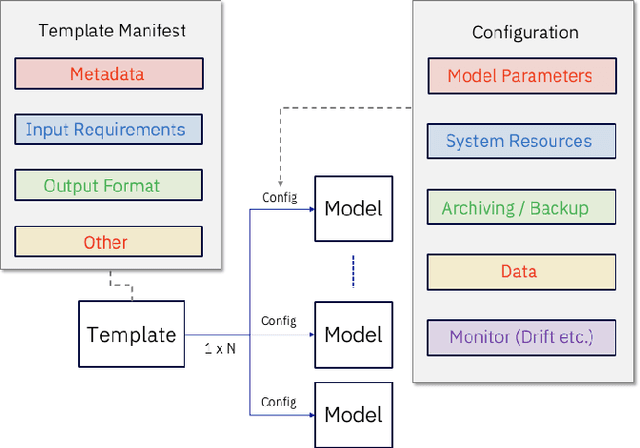
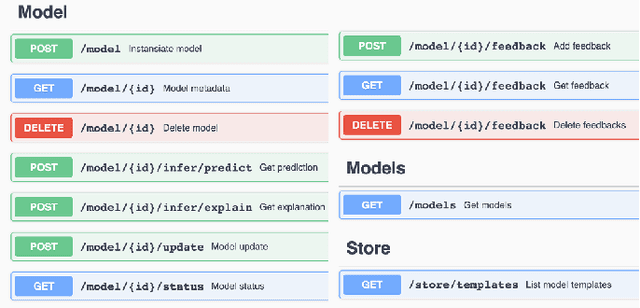
As artificial intelligence (AI) continues to rapidly advance, there is a growing demand to integrate AI capabilities into existing business applications. However, a significant gap exists between the rapid progress in AI and how slowly AI is being embedded into business environments. Deploying well-performing lab models into production settings, especially in on-premise environments, often entails specialized expertise and imposes a heavy burden of model management, creating significant barriers to implementing AI models in real-world applications. KModels leverages proven libraries and platforms (Kubeflow Pipelines, KServe) to streamline AI adoption by supporting both AI developers and consumers. It allows model developers to focus solely on model development and share models as transportable units (Templates), abstracting away complex production deployment concerns. KModels enables AI consumers to eliminate the need for a dedicated data scientist, as the templates encapsulate most data science considerations while providing business-oriented control. This paper presents the architecture of KModels and the key decisions that shape it. We outline KModels' main components as well as its interfaces. Furthermore, we explain how KModels is highly suited for on-premise deployment but can also be used in cloud environments. The efficacy of KModels is demonstrated through the successful deployment of three AI models within an existing Work Order Management system. These models operate in a client's data center and are trained on local data, without data scientist intervention. One model improved the accuracy of Failure Code specification for work orders from 46% to 83%, showcasing the substantial benefit of accessible and localized AI solutions.