 Add to Chrome
 Add to Firefox
 Add to Edge
Domain-Specialized Object Detection via Model-Level Mixtures of Experts
Apr 20, 2026
Mixture-of-Experts (MoE) models provide a structured approach to combining specialized neural networks and offer greater interpretability than conventional ensembles. While MoEs have been successfully applied to image classification and semantic segmentation, their use in object detection remains limited due to challenges in merging dense and structured predictions. In this work, we investigate model-level mixtures of object detectors and analyze their suitability for improving performance and interpretability in object detection. We propose an MoE architecture that combines YOLO-based detectors trained on semantically disjoint data subsets, with a learned gating network that dynamically weights expert contributions. We study different strategies for fusing detection outputs and for training the gating mechanism, including balancing losses to prevent expert collapse. Experiments on the BDD100K dataset demonstrate that the proposed MoE consistently outperforms standard ensemble approaches and provides insights into expert specialization across domains, highlighting model-level MoEs as a viable alternative to traditional ensembling for object detection. Our code is available at https://github.com/KASTEL-MobilityLab/mixtures-of-experts/.

Extracting Uncertainty Estimates from Mixtures of Experts for Semantic Segmentation
Sep 05, 2025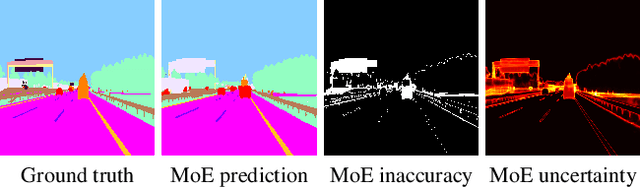
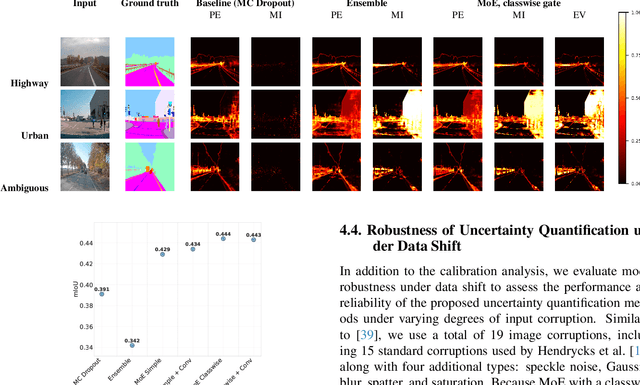
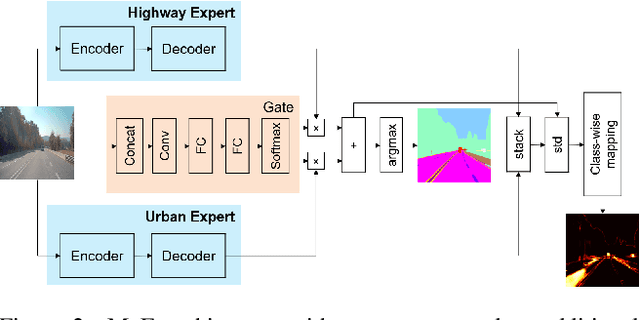
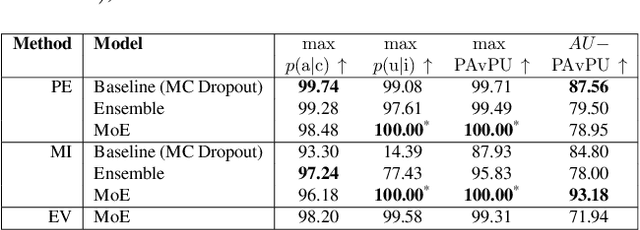
Estimating accurate and well-calibrated predictive uncertainty is important for enhancing the reliability of computer vision models, especially in safety-critical applications like traffic scene perception. While ensemble methods are commonly used to quantify uncertainty by combining multiple models, a mixture of experts (MoE) offers an efficient alternative by leveraging a gating network to dynamically weight expert predictions based on the input. Building on the promising use of MoEs for semantic segmentation in our previous works, we show that well-calibrated predictive uncertainty estimates can be extracted from MoEs without architectural modifications. We investigate three methods to extract predictive uncertainty estimates: predictive entropy, mutual information, and expert variance. We evaluate these methods for an MoE with two experts trained on a semantical split of the A2D2 dataset. Our results show that MoEs yield more reliable uncertainty estimates than ensembles in terms of conditional correctness metrics under out-of-distribution (OOD) data. Additionally, we evaluate routing uncertainty computed via gate entropy and find that simple gating mechanisms lead to better calibration of routing uncertainty estimates than more complex classwise gates. Finally, our experiments on the Cityscapes dataset suggest that increasing the number of experts can further enhance uncertainty calibration. Our code is available at https://github.com/KASTEL-MobilityLab/mixtures-of-experts/.