 Add to Chrome
 Add to Firefox
 Add to Edge
An Effective Context-Balanced Adaptation Approach for Long-Tailed Speech Recognition
Sep 10, 2024
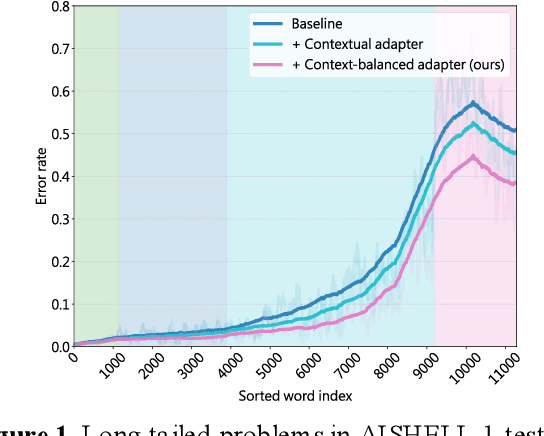
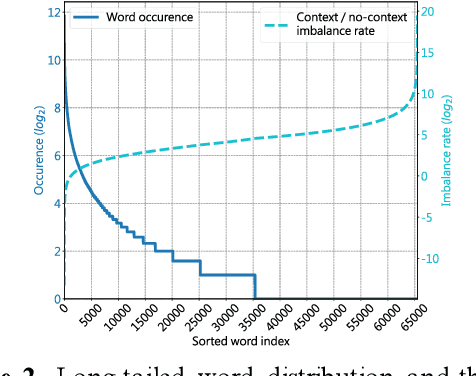
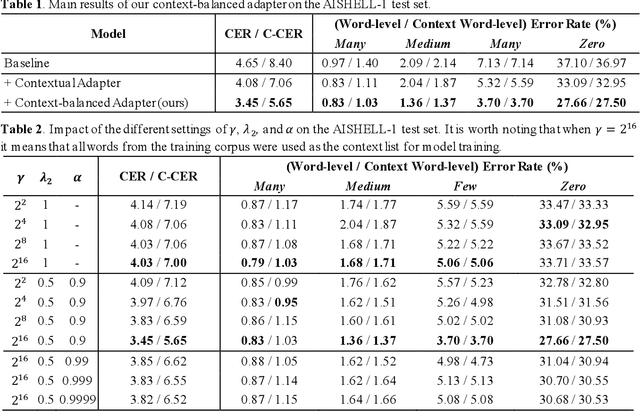

End-to-end (E2E) automatic speech recognition (ASR) models have become standard practice for various commercial applications. However, in real-world scenarios, the long-tailed nature of word distribution often leads E2E ASR models to perform well on common words but fall short in recognizing uncommon ones. Recently, the notion of a contextual adapter (CA) was proposed to infuse external knowledge represented by a context word list into E2E ASR models. Although CA can improve recognition performance on rare words, two crucial data imbalance problems remain. First, when using low-frequency words as context words during training, since these words rarely occur in the utterance, CA becomes prone to overfit on attending to the <no-context> token due to higher-frequency words not being present in the context list. Second, the long-tailed distribution within the context list itself still causes the model to perform poorly on low-frequency context words. In light of this, we explore in-depth the impact of altering the context list to have words with different frequency distributions on model performance, and meanwhile extend CA with a simple yet effective context-balanced learning objective. A series of experiments conducted on the AISHELL-1 benchmark dataset suggests that using all vocabulary words from the training corpus as the context list and pairing them with our balanced objective yields the best performance, demonstrating a significant reduction in character error rate (CER) by up to 1.21% and a more pronounced 9.44% reduction in the error rate of zero-shot words.

Effective Noise-aware Data Simulation for Domain-adaptive Speech Enhancement Leveraging Dynamic Stochastic Perturbation
Sep 03, 2024Cross-domain speech enhancement (SE) is often faced with severe challenges due to the scarcity of noise and background information in an unseen target domain, leading to a mismatch between training and test conditions. This study puts forward a novel data simulation method to address this issue, leveraging noise-extractive techniques and generative adversarial networks (GANs) with only limited target noisy speech data. Notably, our method employs a noise encoder to extract noise embeddings from target-domain data. These embeddings aptly guide the generator to synthesize utterances acoustically fitted to the target domain while authentically preserving the phonetic content of the input clean speech. Furthermore, we introduce the notion of dynamic stochastic perturbation, which can inject controlled perturbations into the noise embeddings during inference, thereby enabling the model to generalize well to unseen noise conditions. Experiments on the VoiceBank-DEMAND benchmark dataset demonstrate that our domain-adaptive SE method outperforms an existing strong baseline based on data simulation.
Optimizing Automatic Speech Assessment: W-RankSim Regularization and Hybrid Feature Fusion Strategies
Jun 16, 2024Automatic Speech Assessment (ASA) has seen notable advancements with the utilization of self-supervised features (SSL) in recent research. However, a key challenge in ASA lies in the imbalanced distribution of data, particularly evident in English test datasets. To address this challenge, we approach ASA as an ordinal classification task, introducing Weighted Vectors Ranking Similarity (W-RankSim) as a novel regularization technique. W-RankSim encourages closer proximity of weighted vectors in the output layer for similar classes, implying that feature vectors with similar labels would be gradually nudged closer to each other as they converge towards corresponding weighted vectors. Extensive experimental evaluations confirm the effectiveness of our approach in improving ordinal classification performance for ASA. Furthermore, we propose a hybrid model that combines SSL and handcrafted features, showcasing how the inclusion of handcrafted features enhances performance in an ASA system.
ConPCO: Preserving Phoneme Characteristics for Automatic Pronunciation Assessment Leveraging Contrastive Ordinal Regularization
Jun 05, 2024Automatic pronunciation assessment (APA) manages to evaluate the pronunciation proficiency of a second language (L2) learner in a target language. Existing efforts typically draw on regression models for proficiency score prediction, where the models are trained to estimate target values without explicitly accounting for phoneme-awareness in the feature space. In this paper, we propose a contrastive phonemic ordinal regularizer (ConPCO) tailored for regression-based APA models to generate more phoneme-discriminative features while considering the ordinal relationships among the regression targets. The proposed ConPCO first aligns the phoneme representations of an APA model and textual embeddings of phonetic transcriptions via contrastive learning. Afterward, the phoneme characteristics are retained by regulating the distances between inter- and intra-phoneme categories in the feature space while allowing for the ordinal relationships among the output targets. We further design and develop a hierarchical APA model to evaluate the effectiveness of our method. Extensive experiments conducted on the speechocean762 benchmark dataset suggest the feasibility and efficacy of our approach in relation to some cutting-edge baselines.
An Effective Automated Speaking Assessment Approach to Mitigating Data Scarcity and Imbalanced Distribution
Apr 12, 2024
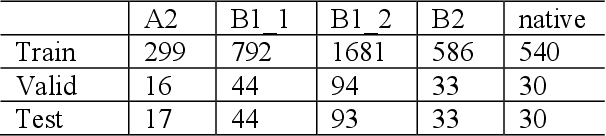

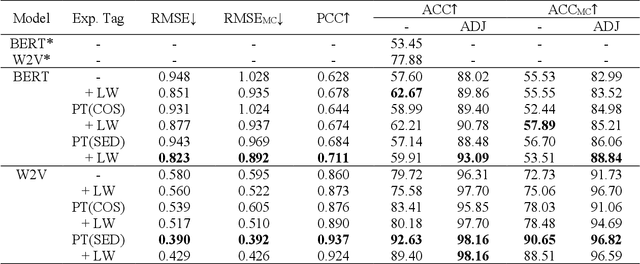
Automated speaking assessment (ASA) typically involves automatic speech recognition (ASR) and hand-crafted feature extraction from the ASR transcript of a learner's speech. Recently, self-supervised learning (SSL) has shown stellar performance compared to traditional methods. However, SSL-based ASA systems are faced with at least three data-related challenges: limited annotated data, uneven distribution of learner proficiency levels and non-uniform score intervals between different CEFR proficiency levels. To address these challenges, we explore the use of two novel modeling strategies: metric-based classification and loss reweighting, leveraging distinct SSL-based embedding features. Extensive experimental results on the ICNALE benchmark dataset suggest that our approach can outperform existing strong baselines by a sizable margin, achieving a significant improvement of more than 10% in CEFR prediction accuracy.
DANCER: Entity Description Augmented Named Entity Corrector for Automatic Speech Recognition
Apr 11, 2024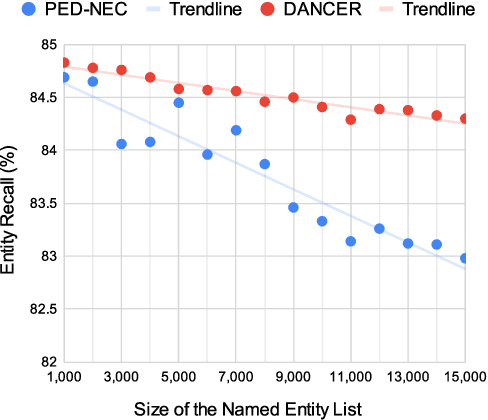
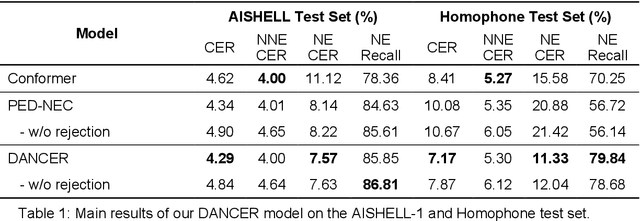
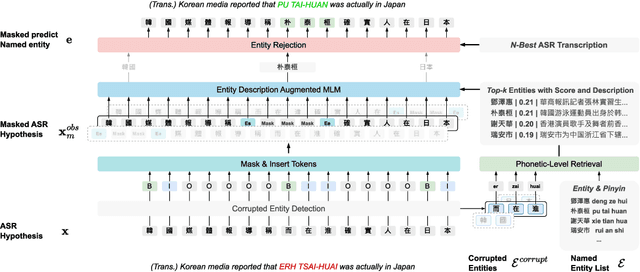
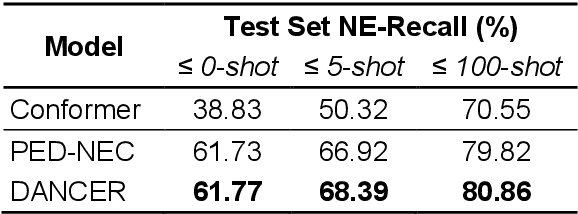
End-to-end automatic speech recognition (E2E ASR) systems often suffer from mistranscription of domain-specific phrases, such as named entities, sometimes leading to catastrophic failures in downstream tasks. A family of fast and lightweight named entity correction (NEC) models for ASR have recently been proposed, which normally build on phonetic-level edit distance algorithms and have shown impressive NEC performance. However, as the named entity (NE) list grows, the problems of phonetic confusion in the NE list are exacerbated; for example, homophone ambiguities increase substantially. In view of this, we proposed a novel Description Augmented Named entity CorrEctoR (dubbed DANCER), which leverages entity descriptions to provide additional information to facilitate mitigation of phonetic confusion for NEC on ASR transcription. To this end, an efficient entity description augmented masked language model (EDA-MLM) comprised of a dense retrieval model is introduced, enabling MLM to adapt swiftly to domain-specific entities for the NEC task. A series of experiments conducted on the AISHELL-1 and Homophone datasets confirm the effectiveness of our modeling approach. DANCER outperforms a strong baseline, the phonetic edit-distance-based NEC model (PED-NEC), by a character error rate (CER) reduction of about 7% relatively on AISHELL-1 for named entities. More notably, when tested on Homophone that contain named entities of high phonetic confusion, DANCER offers a more pronounced CER reduction of 46% relatively over PED-NEC for named entities.
Speech-Aware Neural Diarization with Encoder-Decoder Attractor Guided by Attention Constraints
Mar 21, 2024End-to-End Neural Diarization with Encoder-Decoder based Attractor (EEND-EDA) is an end-to-end neural model for automatic speaker segmentation and labeling. It achieves the capability to handle flexible number of speakers by estimating the number of attractors. EEND-EDA, however, struggles to accurately capture local speaker dynamics. This work proposes an auxiliary loss that aims to guide the Transformer encoders at the lower layer of EEND-EDA model to enhance the effect of self-attention modules using speaker activity information. The results evaluated on public dataset Mini LibriSpeech, demonstrates the effectiveness of the work, reducing Diarization Error Rate from 30.95% to 28.17%. We will release the source code on GitHub to allow further research and reproducibility.
What do neural networks listen to? Exploring the crucial bands in Speech Enhancement using Sinc-convolution
Mar 04, 2024This study introduces a reformed Sinc-convolution (Sincconv) framework tailored for the encoder component of deep networks for speech enhancement (SE). The reformed Sincconv, based on parametrized sinc functions as band-pass filters, offers notable advantages in terms of training efficiency, filter diversity, and interpretability. The reformed Sinc-conv is evaluated in conjunction with various SE models, showcasing its ability to boost SE performance. Furthermore, the reformed Sincconv provides valuable insights into the specific frequency components that are prioritized in an SE scenario. This opens up a new direction of SE research and improving our knowledge of their operating dynamics.
ConSep: a Noise- and Reverberation-Robust Speech Separation Framework by Magnitude Conditioning
Mar 04, 2024Speech separation has recently made significant progress thanks to the fine-grained vision used in time-domain methods. However, several studies have shown that adopting Short-Time Fourier Transform (STFT) for feature extraction could be beneficial when encountering harsher conditions, such as noise or reverberation. Therefore, we propose a magnitude-conditioned time-domain framework, ConSep, to inherit the beneficial characteristics. The experiment shows that ConSep promotes performance in anechoic, noisy, and reverberant settings compared to two celebrated methods, SepFormer and Bi-Sep. Furthermore, we visualize the components of ConSep to strengthen the advantages and cohere with the actualities we have found in preliminary studies.
An Effective Mixture-Of-Experts Approach For Code-Switching Speech Recognition Leveraging Encoder Disentanglement
Feb 27, 2024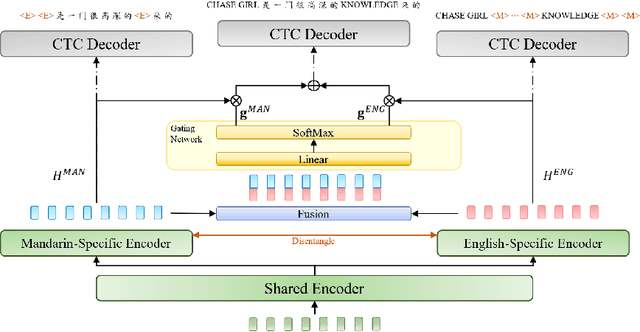
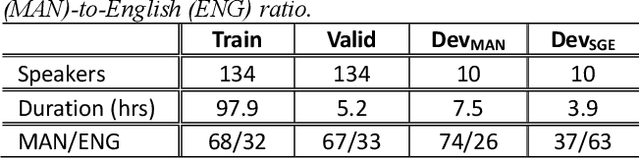
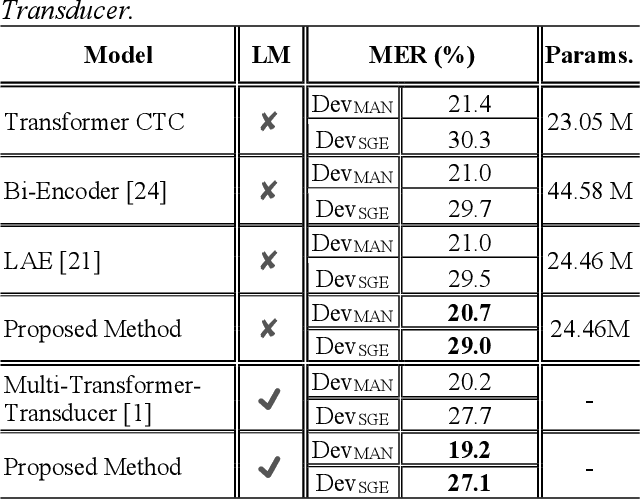
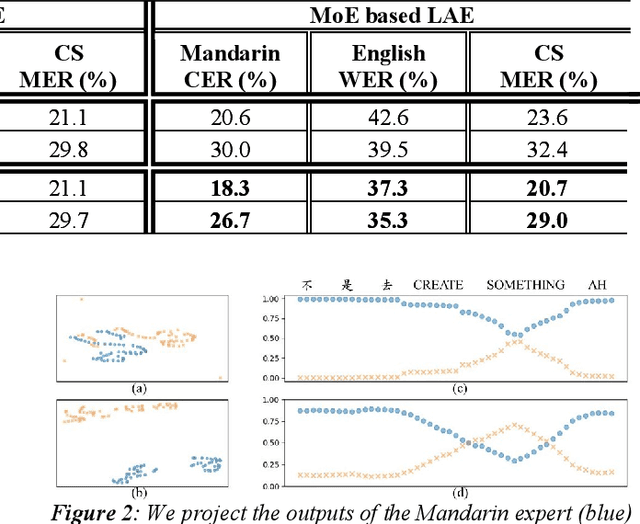
With the massive developments of end-to-end (E2E) neural networks, recent years have witnessed unprecedented breakthroughs in automatic speech recognition (ASR). However, the codeswitching phenomenon remains a major obstacle that hinders ASR from perfection, as the lack of labeled data and the variations between languages often lead to degradation of ASR performance. In this paper, we focus exclusively on improving the acoustic encoder of E2E ASR to tackle the challenge caused by the codeswitching phenomenon. Our main contributions are threefold: First, we introduce a novel disentanglement loss to enable the lower-layer of the encoder to capture inter-lingual acoustic information while mitigating linguistic confusion at the higher-layer of the encoder. Second, through comprehensive experiments, we verify that our proposed method outperforms the prior-art methods using pretrained dual-encoders, meanwhile having access only to the codeswitching corpus and consuming half of the parameterization. Third, the apparent differentiation of the encoders' output features also corroborates the complementarity between the disentanglement loss and the mixture-of-experts (MoE) architecture.