 Add to Chrome
 Add to Firefox
 Add to Edge
ECHOSAT: Estimating Canopy Height Over Space And Time
Feb 24, 2026
Forest monitoring is critical for climate change mitigation. However, existing global tree height maps provide only static snapshots and do not capture temporal forest dynamics, which are essential for accurate carbon accounting. We introduce ECHOSAT, a global and temporally consistent tree height map at 10 m resolution spanning multiple years. To this end, we resort to multi-sensor satellite data to train a specialized vision transformer model, which performs pixel-level temporal regression. A self-supervised growth loss regularizes the predictions to follow growth curves that are in line with natural tree development, including gradual height increases over time, but also abrupt declines due to forest loss events such as fires. Our experimental evaluation shows that our model improves state-of-the-art accuracies in the context of single-year predictions. We also provide the first global-scale height map that accurately quantifies tree growth and disturbances over time. We expect ECHOSAT to advance global efforts in carbon monitoring and disturbance assessment. The maps can be accessed at https://github.com/ai4forest/echosat.

Neural Concept Verifier: Scaling Prover-Verifier Games via Concept Encodings
Jul 10, 2025While Prover-Verifier Games (PVGs) offer a promising path toward verifiability in nonlinear classification models, they have not yet been applied to complex inputs such as high-dimensional images. Conversely, Concept Bottleneck Models (CBMs) effectively translate such data into interpretable concepts but are limited by their reliance on low-capacity linear predictors. In this work, we introduce the Neural Concept Verifier (NCV), a unified framework combining PVGs with concept encodings for interpretable, nonlinear classification in high-dimensional settings. NCV achieves this by utilizing recent minimally supervised concept discovery models to extract structured concept encodings from raw inputs. A prover then selects a subset of these encodings, which a verifier -- implemented as a nonlinear predictor -- uses exclusively for decision-making. Our evaluations show that NCV outperforms CBM and pixel-based PVG classifier baselines on high-dimensional, logically complex datasets and also helps mitigate shortcut behavior. Overall, we demonstrate NCV as a promising step toward performative, verifiable AI.
Capturing Temporal Dynamics in Large-Scale Canopy Tree Height Estimation
Jan 31, 2025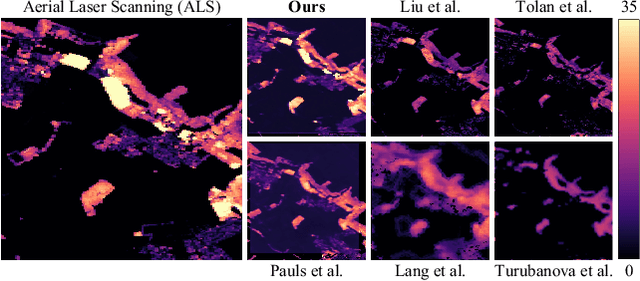
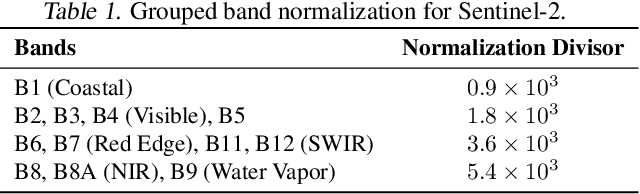

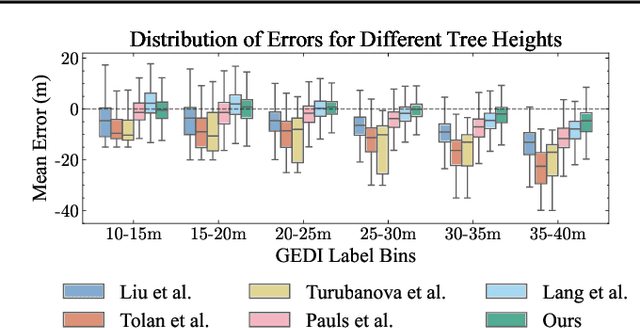
With the rise in global greenhouse gas emissions, accurate large-scale tree canopy height maps are essential for understanding forest structure, estimating above-ground biomass, and monitoring ecological disruptions. To this end, we present a novel approach to generate large-scale, high-resolution canopy height maps over time. Our model accurately predicts canopy height over multiple years given Sentinel-2 time series satellite data. Using GEDI LiDAR data as the ground truth for training the model, we present the first 10m resolution temporal canopy height map of the European continent for the period 2019-2022. As part of this product, we also offer a detailed canopy height map for 2020, providing more precise estimates than previous studies. Our pipeline and the resulting temporal height map are publicly available, enabling comprehensive large-scale monitoring of forests and, hence, facilitating future research and ecological analyses. For an interactive viewer, see https://europetreemap.projects.earthengine.app/view/temporalcanopyheight.
The Good, the Bad and the Ugly: Watermarks, Transferable Attacks and Adversarial Defenses
Oct 11, 2024We formalize and extend existing definitions of backdoor-based watermarks and adversarial defenses as interactive protocols between two players. The existence of these schemes is inherently tied to the learning tasks for which they are designed. Our main result shows that for almost every discriminative learning task, at least one of the two -- a watermark or an adversarial defense -- exists. The term "almost every" indicates that we also identify a third, counterintuitive but necessary option, i.e., a scheme we call a transferable attack. By transferable attack, we refer to an efficient algorithm computing queries that look indistinguishable from the data distribution and fool all efficient defenders. To this end, we prove the necessity of a transferable attack via a construction that uses a cryptographic tool called homomorphic encryption. Furthermore, we show that any task that satisfies our notion of a transferable attack implies a cryptographic primitive, thus requiring the underlying task to be computationally complex. These two facts imply an "equivalence" between the existence of transferable attacks and cryptography. Finally, we show that the class of tasks of bounded VC-dimension has an adversarial defense, and a subclass of them has a watermark.