 Add to Chrome
 Add to Firefox
 Add to Edge
Measuring and Aligning Abstraction in Vision-Language Models with Medical Taxonomies
Jan 21, 2026
Vision-Language Models show strong zero-shot performance for chest X-ray classification, but standard flat metrics fail to distinguish between clinically minor and severe errors. This work investigates how to quantify and mitigate abstraction errors by leveraging medical taxonomies. We benchmark several state-of-the-art VLMs using hierarchical metrics and introduce Catastrophic Abstraction Errors to capture cross-branch mistakes. Our results reveal substantial misalignment of VLMs with clinical taxonomies despite high flat performance. To address this, we propose risk-constrained thresholding and taxonomy-aware fine-tuning with radial embeddings, which reduce severe abstraction errors to below 2 per cent while maintaining competitive performance. These findings highlight the importance of hierarchical evaluation and representation-level alignment for safer and more clinically meaningful deployment of VLMs.

Towards Interpretable Summary Evaluation via Allocation of Contextual Embeddings to Reference Text Topics
Oct 25, 2022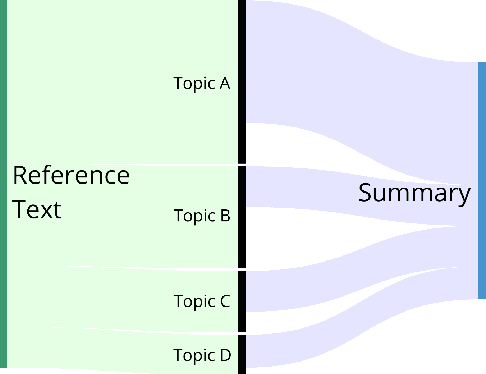
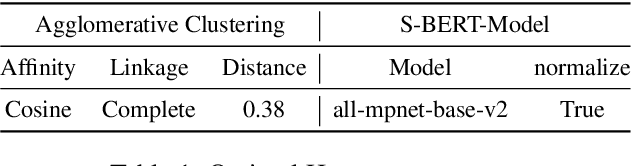

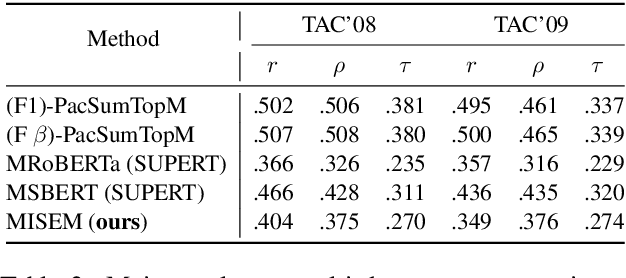
Despite extensive recent advances in summary generation models, evaluation of auto-generated summaries still widely relies on single-score systems insufficient for transparent assessment and in-depth qualitative analysis. Towards bridging this gap, we propose the multifaceted interpretable summary evaluation method (MISEM), which is based on allocation of a summary's contextual token embeddings to semantic topics identified in the reference text. We further contribute an interpretability toolbox for automated summary evaluation and interactive visual analysis of summary scoring, topic identification, and token-topic allocation. MISEM achieves a promising .404 Pearson correlation with human judgment on the TAC'08 dataset.