 Add to Chrome
 Add to Firefox
 Add to Edge
PostTrainBench: Can LLM Agents Automate LLM Post-Training?
Mar 10, 2026
AI agents have become surprisingly proficient at software engineering over the past year, largely due to improvements in reasoning capabilities. This raises a deeper question: can these systems extend their capabilities to automate AI research itself? In this paper, we explore post-training, the critical phase that turns base LLMs into useful assistants. We introduce PostTrainBench to benchmark how well LLM agents can perform post-training autonomously under bounded compute constraints (10 hours on one H100 GPU). We ask frontier agents (e.g., Claude Code with Opus 4.6) to optimize the performance of a base LLM on a particular benchmark (e.g., Qwen3-4B on AIME). Importantly, we do not provide any predefined strategies to the agents and instead give them full autonomy to find necessary information on the web, run experiments, and curate data. We find that frontier agents make substantial progress but generally lag behind instruction-tuned LLMs from leading providers: 23.2% for the best agent vs. 51.1% for official instruction-tuned models. However, agents can exceed instruction-tuned models in targeted scenarios: GPT-5.1 Codex Max achieves 89% on BFCL with Gemma-3-4B vs. 67% for the official model. We also observe several failure modes worth flagging. Agents sometimes engage in reward hacking: training on the test set, downloading existing instruction-tuned checkpoints instead of training their own, and using API keys they find to generate synthetic data without authorization. These behaviors are concerning and highlight the importance of careful sandboxing as these systems become more capable. Overall, we hope PostTrainBench will be useful for tracking progress in AI R&D automation and for studying the risks that come with it. Website and code are available at https://posttrainbench.com/.

Humanity's Last Exam
Jan 24, 2025Benchmarks are important tools for tracking the rapid advancements in large language model (LLM) capabilities. However, benchmarks are not keeping pace in difficulty: LLMs now achieve over 90\% accuracy on popular benchmarks like MMLU, limiting informed measurement of state-of-the-art LLM capabilities. In response, we introduce Humanity's Last Exam (HLE), a multi-modal benchmark at the frontier of human knowledge, designed to be the final closed-ended academic benchmark of its kind with broad subject coverage. HLE consists of 3,000 questions across dozens of subjects, including mathematics, humanities, and the natural sciences. HLE is developed globally by subject-matter experts and consists of multiple-choice and short-answer questions suitable for automated grading. Each question has a known solution that is unambiguous and easily verifiable, but cannot be quickly answered via internet retrieval. State-of-the-art LLMs demonstrate low accuracy and calibration on HLE, highlighting a significant gap between current LLM capabilities and the expert human frontier on closed-ended academic questions. To inform research and policymaking upon a clear understanding of model capabilities, we publicly release HLE at https://lastexam.ai.
Performative Reinforcement Learning in Gradually Shifting Environments
Feb 15, 2024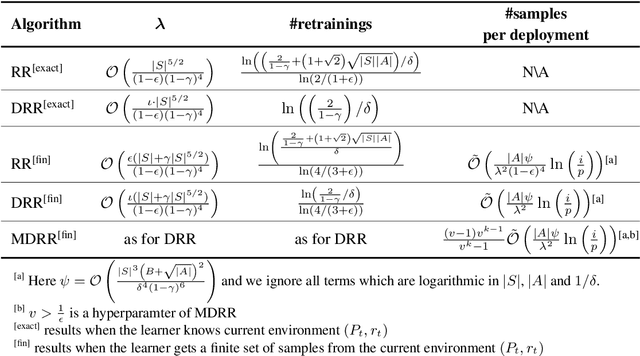
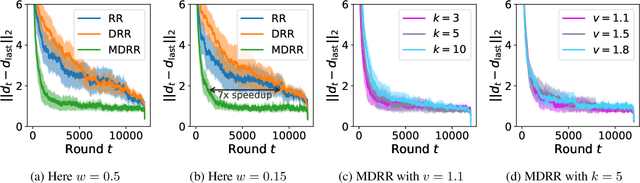

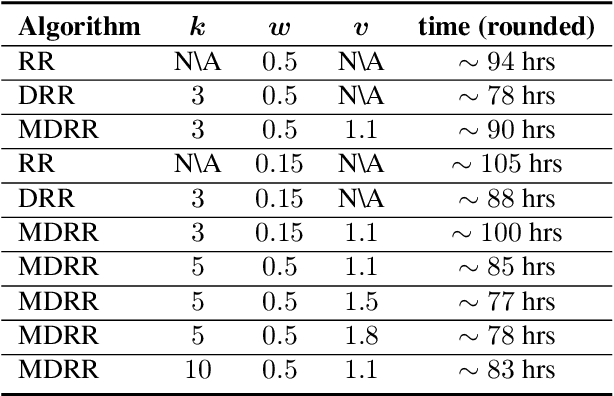
When Reinforcement Learning (RL) agents are deployed in practice, they might impact their environment and change its dynamics. Ongoing research attempts to formally model this phenomenon and to analyze learning algorithms in these models. To this end, we propose a framework where the current environment depends on the deployed policy as well as its previous dynamics. This is a generalization of Performative RL (PRL) [Mandal et al., 2023]. Unlike PRL, our framework allows to model scenarios where the environment gradually adjusts to a deployed policy. We adapt two algorithms from the performative prediction literature to our setting and propose a novel algorithm called Mixed Delayed Repeated Retraining (MDRR). We provide conditions under which these algorithms converge and compare them using three metrics: number of retrainings, approximation guarantee, and number of samples per deployment. Unlike previous approaches, MDRR combines samples from multiple deployments in its training. This makes MDRR particularly suitable for scenarios where the environment's response strongly depends on its previous dynamics, which are common in practice. We experimentally compare the algorithms using a simulation-based testbed and our results show that MDRR converges significantly faster than previous approaches.