 Add to Chrome
 Add to Firefox
 Add to Edge
GameEngineBench: Evaluating Coding Agents on Real C++ Runtime Environments
Jul 03, 2026
Game engines provide real-time simulation, rendering, physics, interaction, networking, and asset pipelines, making them valuable not only for games but also for 3D applications in healthcare, robotics, architecture, manufacturing, and related domains. Because game development is where these systems are most mature and publicly available, it offers a practical testbed for evaluating coding agents that must modify C++ code within stateful, interactive, real-time systems. We present GameEngineBench, a benchmark for evaluating coding agents on scoped C++ implementation tasks inside Unreal Engine 5 projects, built from nine real-world game repositories. The evaluation set consists of 110 tasks spanning gameplay mechanics, multiplayer behavior, AI and world orchestration, animation and movement, UI and session code, loading behavior, online-service integration, persistence, data serialization, XR behavior, and rendering-oriented plugins. These tasks require models to make native C++ changes that compile and satisfy behavioral tests within executable Unreal Engine projects. Across twelve evaluated configurations, the strongest model reaches 55.5\% pass@1, while 31 tasks remain unsolved by every configuration. Our results demonstrate that frontier coding agents continue to struggle with deeply integrated C++ development for real-time interactive software, highlighting game-engine benchmarks as a valuable complement to existing software engineering evaluations.

eViper: A Scalable Platform for Untethered Modular Soft Robots
Mar 03, 2023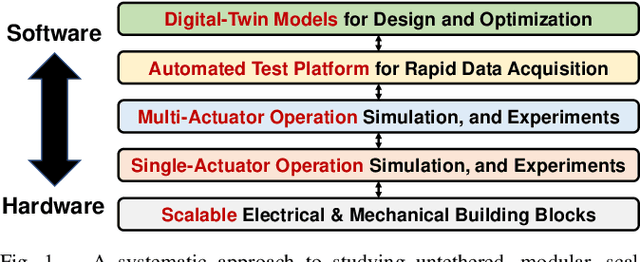
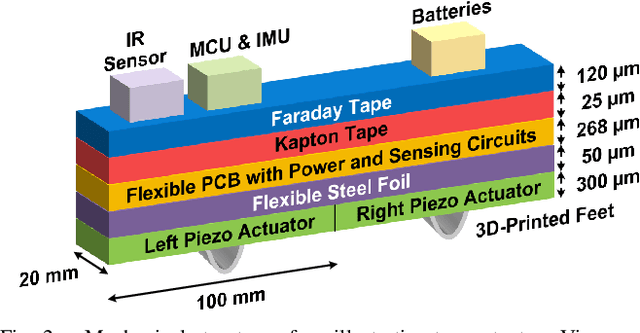
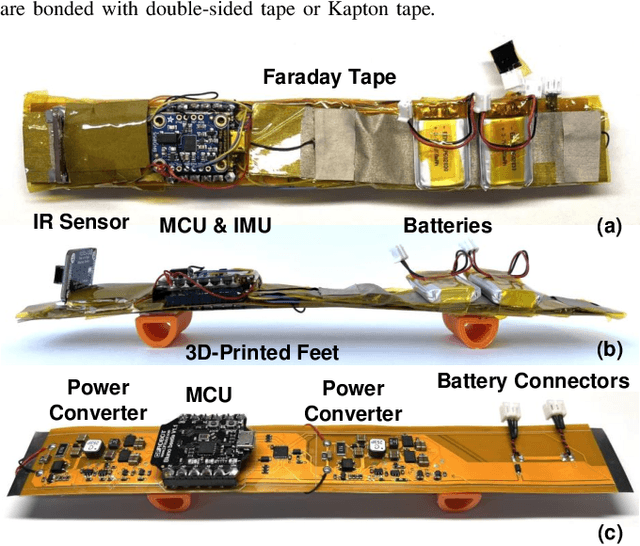

Soft robots present unique capabilities, but have been limited by the lack of scalable technologies for construction and the complexity of algorithms for efficient control and motion, which depend on soft-body dynamics, high-dimensional actuation patterns, and external/on-board forces. This paper presents scalable methods and platforms to study the impact of weight distribution and actuation patterns on fully untethered modular soft robots. An extendable Vibrating Intelligent Piezo-Electric Robot (eViper), together with an open-source Simulation Framework for Electroactive Robotic Sheet (SFERS) implemented in PyBullet, was developed as a platform to study the sophisticated weight-locomotion interaction. By integrating the power electronics, sensors, actuators, and batteries on-board, the eViper platform enables rapid design iteration and evaluation of different weight distribution and control strategies for the actuator arrays, supporting both physics-based modeling and data-driven modeling via on-board automatic data-acquisition capabilities. We show that SFERS can provide useful guidelines for optimizing the weight distribution and actuation patterns of the eViper to achieve the maximum speed or minimum cost-of-transportation (COT).