 Add to Chrome
 Add to Firefox
 Add to Edge
GameEngineBench: Evaluating Coding Agents on Real C++ Runtime Environments
Jul 03, 2026
Game engines provide real-time simulation, rendering, physics, interaction, networking, and asset pipelines, making them valuable not only for games but also for 3D applications in healthcare, robotics, architecture, manufacturing, and related domains. Because game development is where these systems are most mature and publicly available, it offers a practical testbed for evaluating coding agents that must modify C++ code within stateful, interactive, real-time systems. We present GameEngineBench, a benchmark for evaluating coding agents on scoped C++ implementation tasks inside Unreal Engine 5 projects, built from nine real-world game repositories. The evaluation set consists of 110 tasks spanning gameplay mechanics, multiplayer behavior, AI and world orchestration, animation and movement, UI and session code, loading behavior, online-service integration, persistence, data serialization, XR behavior, and rendering-oriented plugins. These tasks require models to make native C++ changes that compile and satisfy behavioral tests within executable Unreal Engine projects. Across twelve evaluated configurations, the strongest model reaches 55.5\% pass@1, while 31 tasks remain unsolved by every configuration. Our results demonstrate that frontier coding agents continue to struggle with deeply integrated C++ development for real-time interactive software, highlighting game-engine benchmarks as a valuable complement to existing software engineering evaluations.

Interpretable Neural ODEs for Gene Regulatory Network Discovery under Perturbations
Jan 05, 2025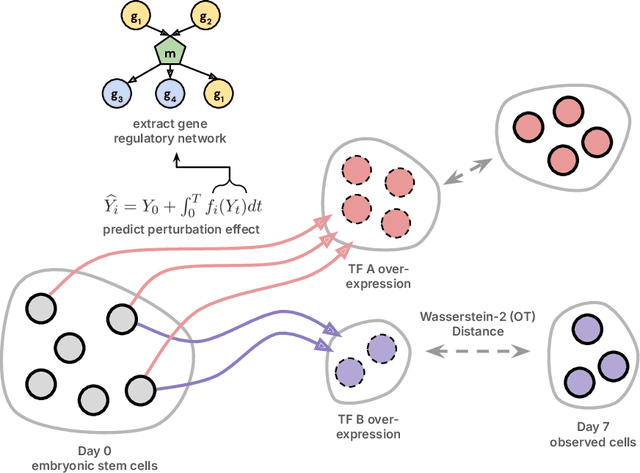

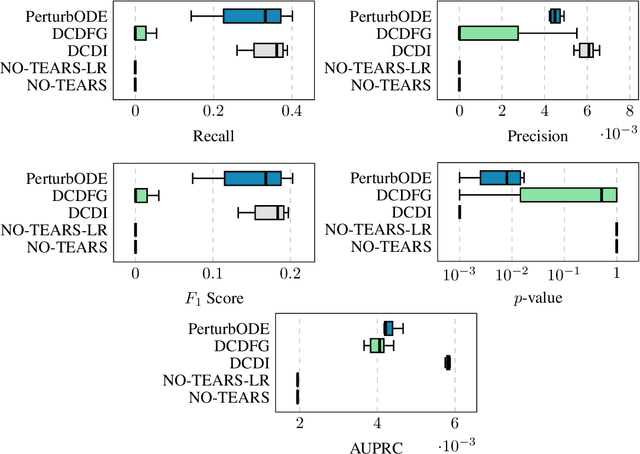

Modern high-throughput biological datasets with thousands of perturbations provide the opportunity for large-scale discovery of causal graphs that represent the regulatory interactions between genes. Numerous methods have been proposed to infer a directed acyclic graph (DAG) corresponding to the underlying gene regulatory network (GRN) that captures causal gene relationships. However, existing models have restrictive assumptions (e.g. linearity, acyclicity), limited scalability, and/or fail to address the dynamic nature of biological processes such as cellular differentiation. We propose PerturbODE, a novel framework that incorporates biologically informative neural ordinary differential equations (neural ODEs) to model cell state trajectories under perturbations and derive the causal GRN from the neural ODE's parameters. We demonstrate PerturbODE's efficacy in trajectory prediction and GRN inference across simulated and real over-expression datasets.