 Add to Chrome
 Add to Firefox
 Add to Edge
Learning ground state observables from quantum computing experiments
Jun 14, 2026
Recent theoretical progress has established conditions under which machine learning models can efficiently predict ground-state properties of gapped local Hamiltonians when trained on quantum-generated data. Previous experimental demonstrations in this paradigm, however, have largely been limited to small systems or highly structured states, due to the difficulty of preparing many-body ground states on quantum processors. In this work, we demonstrate learning from experimental quantum data generated from approximate ground states of the two-dimensional Heisenberg XXZ model with system sizes up to 115 qubits. We construct a dataset of single-site expectation values, two-point correlations, and 12-body loop correlations across the antiferromagnetic phase. We then train neural networks on this data and show that they can accurately predict spatially resolved observables for previously unseen Hamiltonian parameters, both within the training distribution and in an out-of-distribution regime approaching the phase boundary. Our results demonstrate the practical realization of learning from quantum data for an interacting two-dimensional many-body system at scale, motivating a path toward regimes where quantum processors could provide training data beyond the reach of classical approximation methods.

Let Quantum Neural Networks Choose Their Own Frequencies
Sep 06, 2023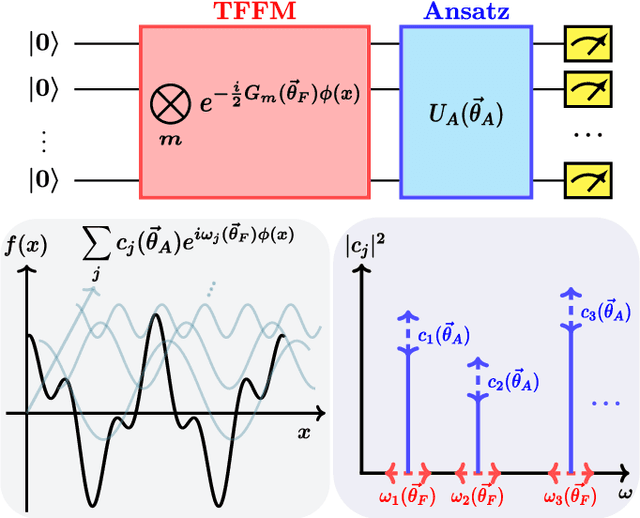
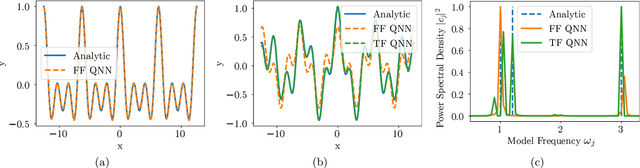
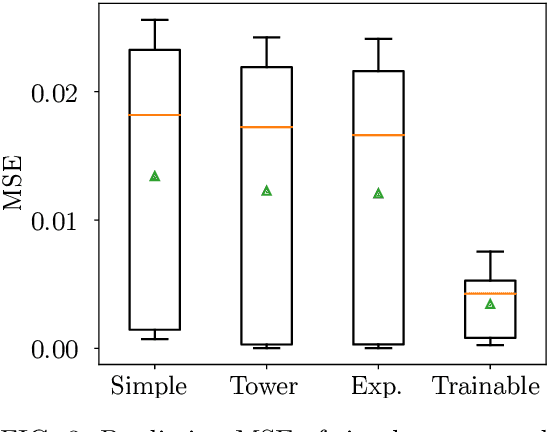
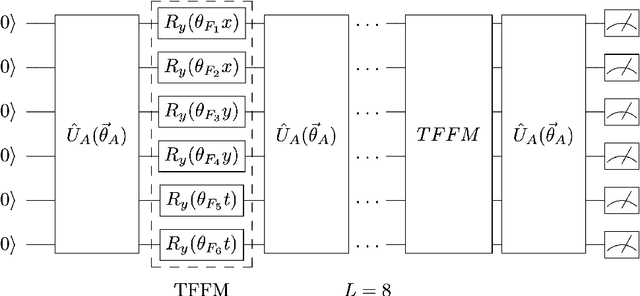
Parameterized quantum circuits as machine learning models are typically well described by their representation as a partial Fourier series of the input features, with frequencies uniquely determined by the feature map's generator Hamiltonians. Ordinarily, these data-encoding generators are chosen in advance, fixing the space of functions that can be represented. In this work we consider a generalization of quantum models to include a set of trainable parameters in the generator, leading to a trainable frequency (TF) quantum model. We numerically demonstrate how TF models can learn generators with desirable properties for solving the task at hand, including non-regularly spaced frequencies in their spectra and flexible spectral richness. Finally, we showcase the real-world effectiveness of our approach, demonstrating an improved accuracy in solving the Navier-Stokes equations using a TF model with only a single parameter added to each encoding operation. Since TF models encompass conventional fixed frequency models, they may offer a sensible default choice for variational quantum machine learning.
Quantum Self-Supervised Learning
Mar 26, 2021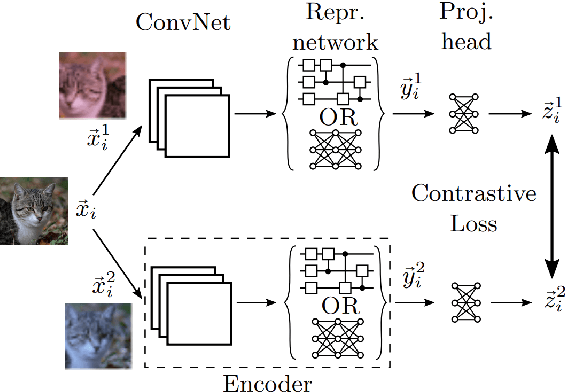
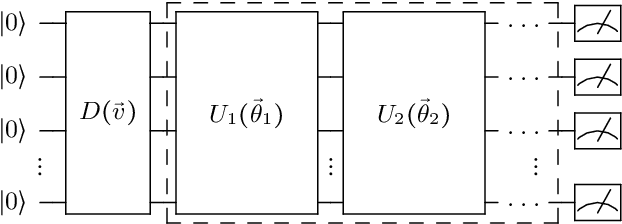
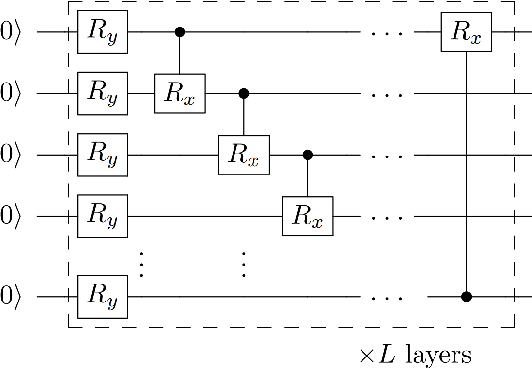
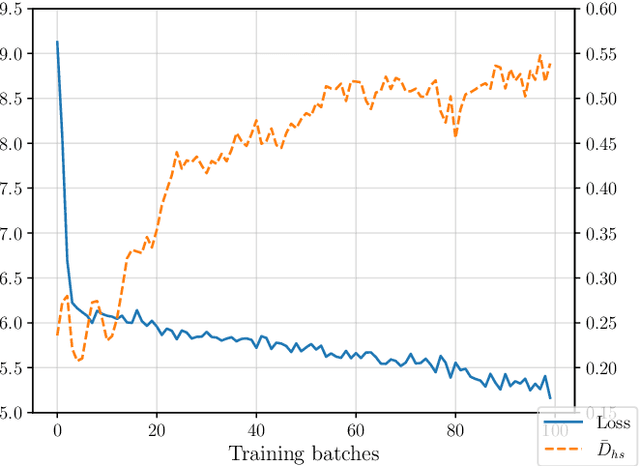
The popularisation of neural networks has seen incredible advances in pattern recognition, driven by the supervised learning of human annotations. However, this approach is unsustainable in relation to the dramatically increasing size of real-world datasets. This has led to a resurgence in self-supervised learning, a paradigm whereby the model generates its own supervisory signal from the data. Here we propose a hybrid quantum-classical neural network architecture for contrastive self-supervised learning and test its effectiveness in proof-of-principle experiments. Interestingly, we observe a numerical advantage for the learning of visual representations using small-scale quantum neural networks over equivalently structured classical networks, even when the quantum circuits are sampled with only 100 shots. Furthermore, we apply our best quantum model to classify unseen images on the ibmq_paris quantum computer and find that current noisy devices can already achieve equal accuracy to the equivalent classical model on downstream tasks.