 Add to Chrome
 Add to Firefox
 Add to Edge
LLM-Powered Automatic Translation and Urgency in Crisis Scenarios
Feb 13, 2026
Large language models (LLMs) are increasingly proposed for crisis preparedness and response, particularly for multilingual communication. However, their suitability for high-stakes crisis contexts remains insufficiently evaluated. This work examines the performance of state-of-the-art LLMs and machine translation systems in crisis-domain translation, with a focus on preserving urgency, which is a critical property for effective crisis communication and triaging. Using multilingual crisis data and a newly introduced urgency-annotated dataset covering over 32 languages, we show that both dedicated translation models and LLMs exhibit substantial performance degradation and instability. Crucially, even linguistically adequate translations can distort perceived urgency, and LLM-based urgency classifications vary widely depending on the language of the prompt and input. These findings highlight significant risks in deploying general-purpose language technologies for crisis communication and underscore the need for crisis-aware evaluation frameworks.

What Do We Mean by 'Pilot Study': Early Findings from a Meta-Review of Pilot Study Reporting at CHI
Feb 13, 2026Pilot studies (PS) are ubiquitous in HCI research. CHI papers routinely reference 'pilot studies', 'pilot tests', or 'preliminary studies' to justify design decisions, verify procedures, or motivate methodological choices. Yet despite their frequency, the role of pilot studies in HCI remains conceptually vague and empirically underexamined. Unlike fields such as medicine, nursing, and education, where pilot and feasibility studies have well-established definitions, guidelines, reporting standards and even a dedicated research journal, the CHI community lacks a shared understanding of what constitutes a pilot study, why they are conducted, and how they should be reported. Many papers reference pilots 'in passing', without details about design, outcomes, or how the pilot informed the main study. This variability suggests a methodological blind spot in our community.
Indigenous Languages Spoken in Argentina: A Survey of NLP and Speech Resources
Jan 17, 2025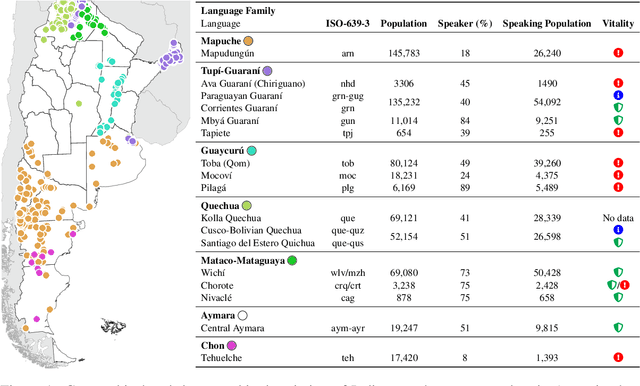
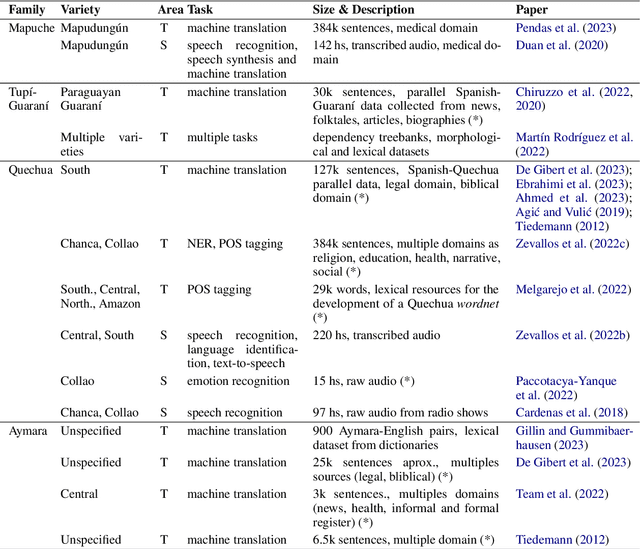
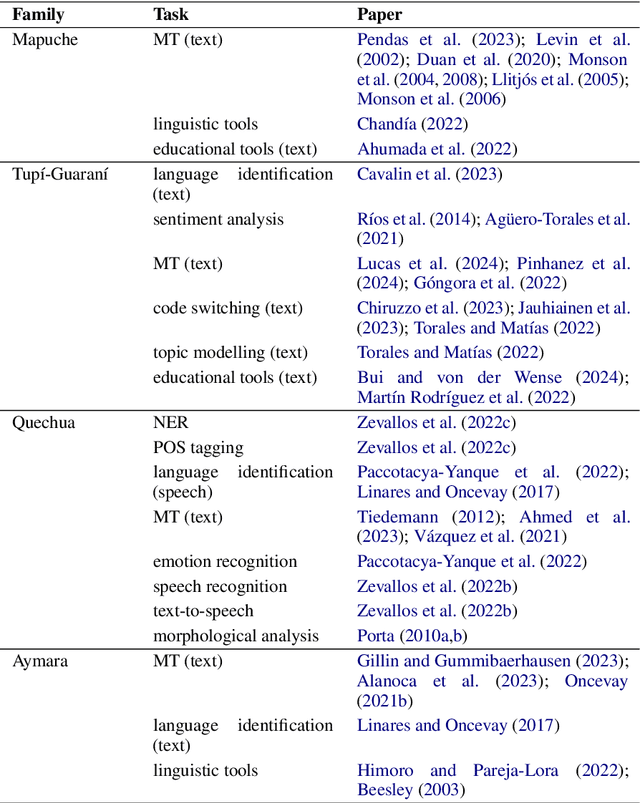
Argentina has a diverse, yet little-known, Indigenous language heritage. Most of these languages are at risk of disappearing, resulting in a significant loss of world heritage and cultural knowledge. Currently, no unified information on speakers and computational tools is available for these languages. In this work, we present a systematization of the Indigenous languages spoken in Argentina, along with national demographic data on the country's Indigenous population. The languages are classified into seven families: Mapuche, Tup\'i-Guaran\'i, Guaycur\'u, Quechua, Mataco-Mataguaya, Aymara, and Chon. We also provide an introductory survey of the computational resources available for these languages, whether or not they are specifically developed for Argentine varieties.