 Add to Chrome
 Add to Firefox
 Add to Edge
Agentic AI for Remote Sensing: Technical Challenges and Research Directions
Apr 27, 2026
Earth Observation (EO) is moving beyond static prediction toward multi-step analytical workflows that require coordinated reasoning over data, tools, and geospatial state. While foundation models and vision-language models have expanded representation learning and language-grounded interaction for remote sensing, and agentic AI has demonstrated long-horizon reasoning and external tool use, EO is not a straightforward extension of generic agentic AI. EO workflows operate over georeferenced, multi-modal, and temporally structured data, where operations such as reprojection, resampling, compositing, and aggregation actively transform the underlying state and can constrain subsequent analysis. As a result, errors may propagate silently across steps, and correctness depends not only on internal coherence, but also on geospatial consistency, temporally valid comparisons, and physical validity. This position paper argues that these challenges are structural rather than incidental. We identify the implicit assumptions commonly made in generic agentic models, analyze how they break in geospatial workflows, and characterize the resulting failure modes in multi-step EO pipelines. We then outline design principles for EO-native agents centered on structured geospatial state, tool-aware reasoning, verifier-guided execution, and learning objectives aligned with geospatial and physical validity. Finally, we present research directions spanning EO-specific benchmarks, hybrid supervised and reinforcement learning, constrained self-improvement, and trajectory-level evaluation beyond final-answer accuracy. Building reliable geospatial agents therefore requires rethinking agent design around the physical, geospatial, and workflow constraints that govern EO analysis.

A Novel Uncertainty-aware Collaborative Learning Method for Remote Sensing Image Classification Under Multi-Label Noise
May 12, 2021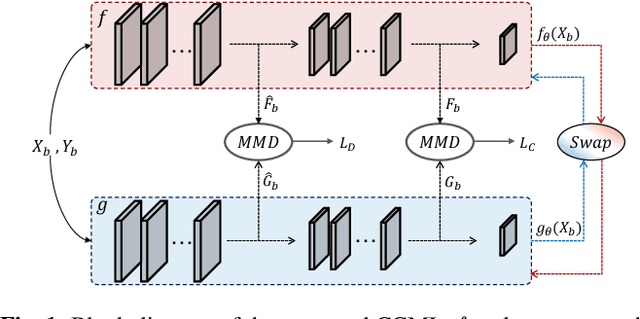
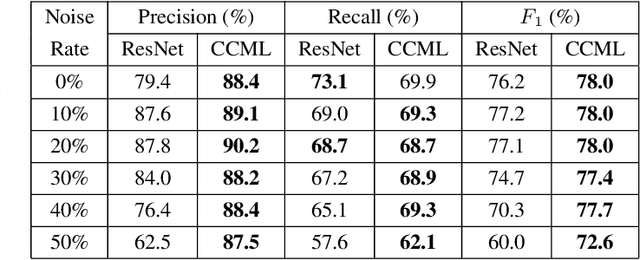
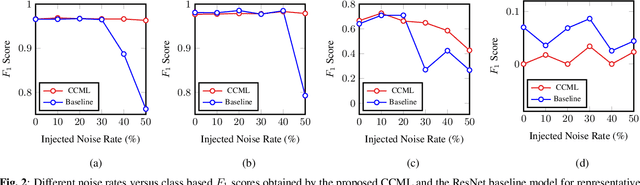
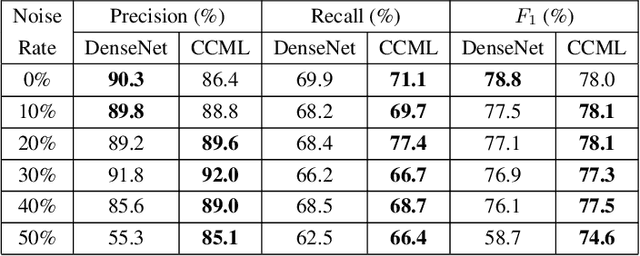
In remote sensing (RS), collecting a large number of reliable training images annotated by multiple land-cover class labels for multi-label classification (MLC) is time-consuming and costly. To address this problem, the publicly available thematic products are often used for annotating RS images with zero-labeling cost. However, in this case the training set can include noisy multi-labels that distort the learning process, resulting in inaccurate predictions. This paper proposes an architect-independent Consensual Collaborative Multi-Label Learning (CCML) method to train deep classifiers under input-dependent (heteroscedastic) multi-label noise in the MLC problems. The proposed CCML identifies, ranks, and corrects noisy multi-label images through four main modules: 1) group lasso module; 2) discrepancy module; 3) flipping module; and 4) swap module. The group lasso module detects the potentially noisy labels by estimating the label uncertainty based on the aggregation of two collaborative networks. The discrepancy module ensures that the two networks learn diverse features, while obtaining the same predictions. The flipping module corrects the identified noisy labels, and the swap module exchanges the ranking information between the two networks. The experiments conducted on the multi-label RS image archive IR-BigEarthNet confirm the robustness of the proposed CCML under extreme multi-label noise rates.
CCML: A Novel Collaborative Learning Model for Classification of Remote Sensing Images with Noisy Multi-Labels
Dec 27, 2020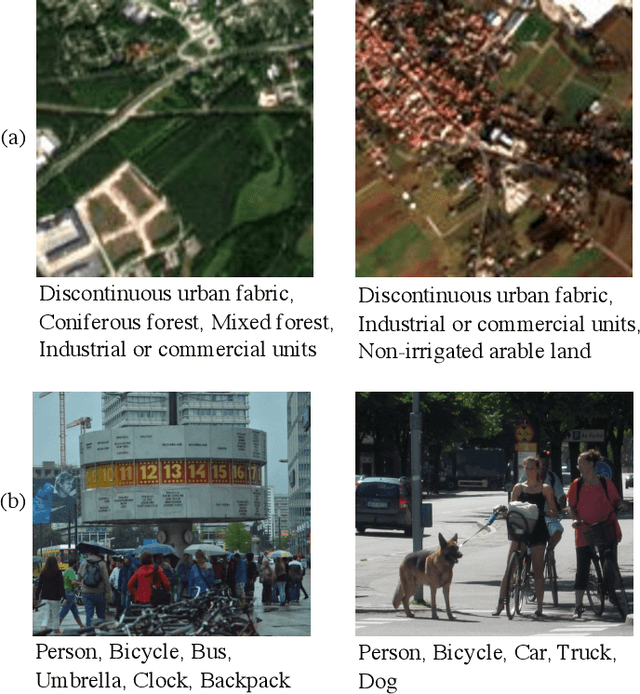
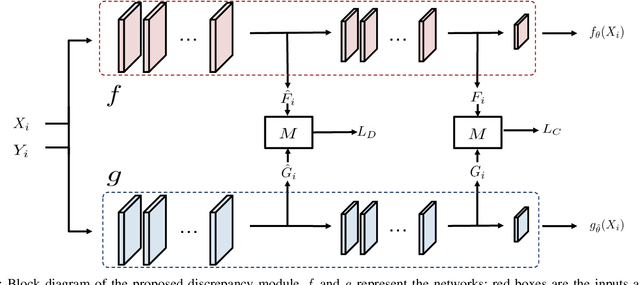
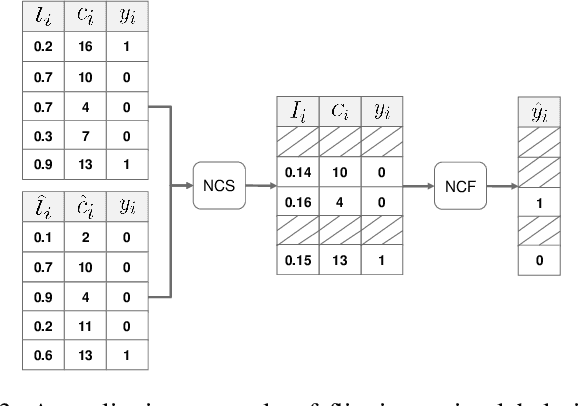
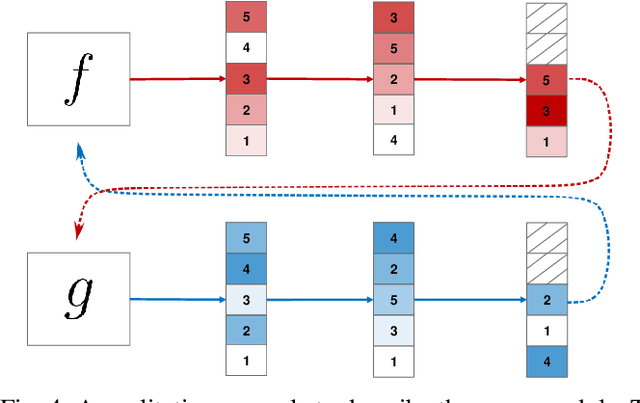
The development of accurate methods for multi-label classification (MLC) of remote sensing (RS) images is one of the most important research topics in RS. Deep Convolutional Neural Networks (CNNs) based methods have triggered substantial performance gains in RS MLC problems, requiring a large number of reliable training images annotated by multiple land-cover class labels. Collecting such data is time-consuming and costly. To address this problem, the publicly available thematic products, which can include noisy labels, can be used for annotating RS images with zero-labeling cost. However, multi-label noise (which can be associated with wrong as well as missing label annotations) can distort the learning process of the MLC algorithm, resulting in inaccurate predictions. The detection and correction of label noise are challenging tasks, especially in a multi-label scenario, where each image can be associated with more than one label. To address this problem, we propose a novel Consensual Collaborative Multi-Label Learning (CCML) method to alleviate the adverse effects of multi-label noise during the training phase of the CNN model. CCML identifies, ranks, and corrects noisy multi-labels in RS images based on four main modules: 1) group lasso module; 2) discrepancy module; 3) flipping module; and 4) swap module. The task of the group lasso module is to detect the potentially noisy labels assigned to the multi-labeled training images, and the discrepancy module ensures that the two collaborative networks learn diverse features, while obtaining the same predictions. The flipping module is designed to correct the identified noisy multi-labels, while the swap module task is devoted to exchanging the ranking information between two networks. Our code is publicly available online: http://www.noisy-labels-in-rs.org