 Add to Chrome
 Add to Firefox
 Add to Edge
Hard Rules, Soft Preferences: Bridging Reasoning, Learning, and Optimization for Personalized Packing Checklist Generation
Jul 17, 2026
Packing for air travel is recurring and error-prone: the checklist must be personal and context-aware, yet feasible under safety rules, item dependencies, and luggage limits. Existing packing assistants are template-driven and generic, or recommendation-driven but unconstrained, leaving users to manually patch regulatory and capacity violations. We propose a reasoning-guided learning framework with three stages: (1) a symbolic engine that generates a regulation-aware seed checklist with explicit dependency structure, (2) a two-stage preference learner that estimates inclusion and priority utilities from user add and remove actions while mitigating survivorship bias, and (3) a CP-SAT optimizer that selects a compact, compliant subset. The architecture instantiates a general pattern for constrained personalization, applicable wherever hard feasibility coexists with sparse preference signals. On 604 labeled trip scenarios, comprising 29K inclusion labels and 343K pairwise comparisons, the symbolic engine attains 99.7% recall and 0.96 rubric validity, compared with 0.78 to 0.81 for frontier LLMs. Gradient-boosted trees and LambdaMART reach an AUC-ROC of 0.943 and an NDCG@5 of 0.923. CP-SAT attains 100% constraint satisfaction, compared with 28% for greedy selection and 10% for random selection. Deployment in FlyEnJoy, a production iOS travel app, doubled checklist completions and reduced editing and completion time.

From Feasibility to Desirability: Plan, Learn, Adapt (PLA) Framework for Personalized On-Device Itinerary Generation
Jul 17, 2026Generating personalized trip itineraries is a complex planning task and involves a tension between hard combinatorial feasibility and soft latent desirability. Classical optimization enforces constraints but fails to capture subjective traveler preferences. While learning-based approaches model preferences, they cannot guarantee feasibility. Mobile deployment imposes additional resource constraints on both. To address this, we propose Plan, Learn, Adapt (PLA), a three-stage framework for personalized on-device itinerary generation. The Plan stage builds a heterogeneous ensemble of lightweight planners that produces structurally diverse feasible candidates. From pairwise itinerary comparisons, Learn fits a compact Bradley-Terry reward model that captures emergent schedule properties such as pacing, geographic coherence, and day balance, which per-POI signals miss. Finally, Adapt applies feasibility-preserving local refinement within a device-aware compute budget; every intermediate state is feasible by construction. On 2,519 pairwise human comparisons across more than 100 U.S. cities, the reward-guided ensemble achieves a 67.8% win rate, 11.2 percentage points above the best single planner, with 100% feasibility. Three frontier LLMs, GPT-5, Claude Opus 4.5, and Gemini 3 Pro, achieve 0% feasibility under the same constraints. The reward model generalizes across held-out cities, with a 67.6% mean leave-one-city-out accuracy. In production deployment within FlyEnJoy, PLA increased itinerary completion rates by 91%, with 109.9 ms average on-device latency.
Profiling US Restaurants from Billions of Payment Card Transactions
Sep 05, 2020
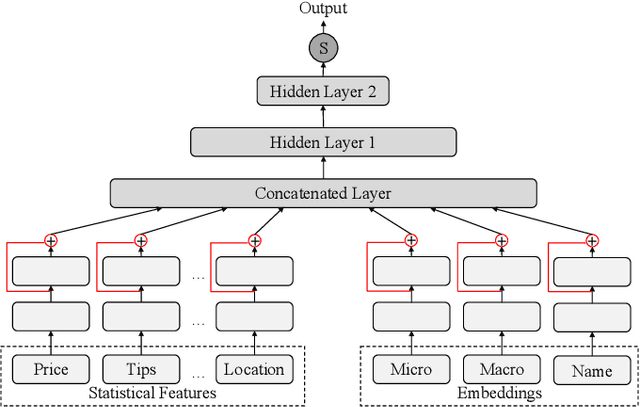
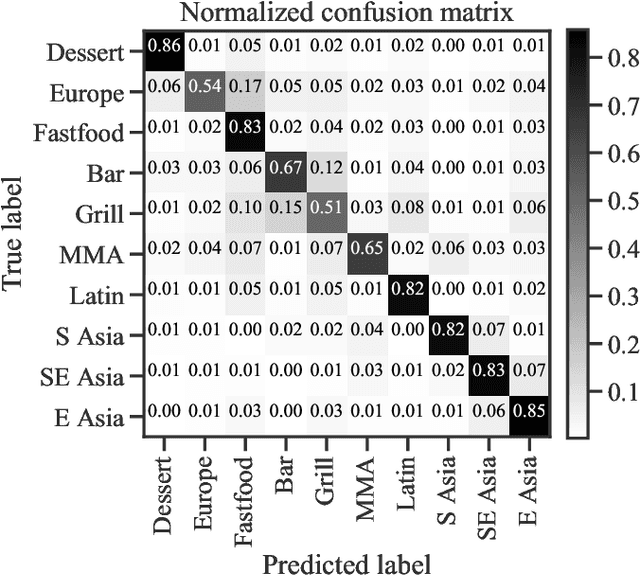
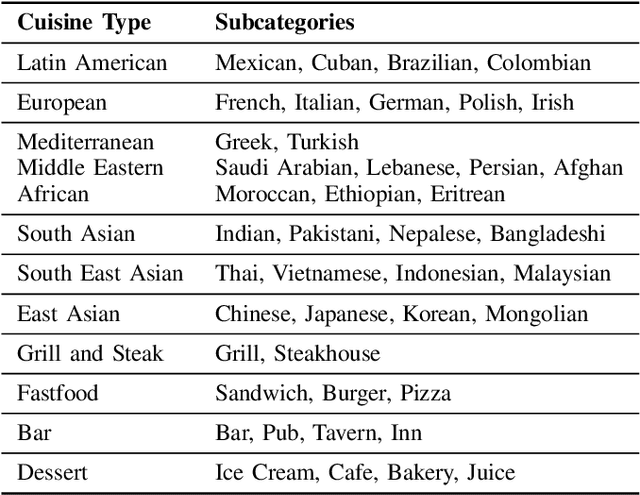
A payment card (such as debit or credit) is one of the most convenient payment methods for purchasing goods and services. Hundreds of millions of card transactions take place across the globe every day, generating a massive volume of transaction data. The data render a holistic view of cardholder-merchant interactions, containing insights that can benefit various applications, such as payment fraud detection and merchant recommendation. However, utilizing these insights often requires additional information about merchants missing from the data owner's (i.e., payment company's) perspective. For example, payment companies do not know the exact type of product a merchant serves. Collecting merchant attributes from external sources for commercial purposes can be expensive. Motivated by this limitation, we aim to infer latent merchant attributes from transaction data. As proof of concept, we concentrate on restaurants and infer the cuisine types of restaurants from transactions. To this end, we present a framework for inferring the cuisine types of restaurants from transaction data. Our proposed framework consists of three steps. In the first step, we generate cuisine labels for a limited number of restaurants via weak supervision. In the second step, we extract a wide variety of statistical features and neural embeddings from the restaurant transactions. In the third step, we use deep neural networks (DNNs) to infer the remaining restaurants' cuisine types. The proposed framework achieved a 76.2% accuracy in classifying the US restaurants. To the best of our knowledge, this is the first framework to infer the cuisine types of restaurants by analyzing transaction data as the only source.