 Add to Chrome
 Add to Firefox
 Add to Edge
CTRAG: An In-Context Retrieval-based Framework for Automated Compliance Checking using LLMs
Aug 03, 2026
Trust is fundamental in modern regulatory ecosystems, and compliance checking plays a critical role in fostering that trust. Regulatory compliance verification is essential for businesses operating in highly controlled environments, as it ensures alignment with sector-specific guidelines across domains such as financial reporting, data privacy, and cybersecurity. Manual compliance testing, however, is often time-intensive and prone to inconsistencies, particularly when compliance depends indirectly on third-party services such as cloud providers, where vendors rely on external providers to meet regulatory standards. In this paper, we present CTRAG, a novel Retrieval-Augmented Generation (RAG) pipeline designed for automated compliance checking. CTRAG employs advanced strategies, including adaptive chunking, dynamic retrieval configurations, and in-context learning, to improve the precision and relevance of compliance assessments. By extracting control questions from regulatory texts and cross-referencing them with unstructured company documentation, CTRAG achieves highly accurate, document-informed compliance verification, even in cases of indirect compliance through third-party services. Empirical evaluations demonstrate significant improvements, with CTRAG achieving an F1-score of 78% and a recall of 85% in the final deployed configuration, ensuring minimal missed non-compliance cases while reducing manual reviewer effort in a real-world deployment. To validate CTRAG value, we developed and deployed a POC within a Big Four professional services firm, applying it to real-world cases and cross-checking results against manual compliance reports. These findings highlight CTRAG potential to streamline compliance workflows, mitigate risks, and enhance regulatory trust in complex, high-stakes environments.

TBSG-Net: Temporal Bipartite Scene Graph Network for Fine-Grained Video Moment Retrieval
Aug 03, 2026Recent advances in proposal-free Video Moment Retrieval (VMR) have highlighted the effectiveness of Static Scene Graphs (SSGs). By modeling objects and their relations at the frame level, SSGs enrich retrieval-oriented video representations. However, integrating SSGs into VMR remains constrained by two inherent limitations: (1) Lack of Temporal Dynamics. SSGs fail to model how objects and their relationships evolve over time, leading to the loss of essential temporal dependencies in video representation; and (2) Lack of Explicit Temporal Span Encoding. SSGs do not explicitly encode the duration of relationships, making precise localization challenging. To address these limitations, we propose Temporal Bipartite Scene Graph Network (TBSG-Net)---to the best of our knowledge, the first Dynamic Scene Graph (DSG) based proposal-free VMR model. Specifically, TBSG-Net leverages DSGs to extract event-centric graph representations of the input video, enabling the modeling of object interactions over time and thus addressing limitation (1). These DSGs are then processed by a novel Dynamic Scene Graph Embedding (DSG-E) module to capture both Temporal Span and spatio-temporal information. First, DSG-E utilizes a TBSG Constructor to transform DSGs into TBSGs, explicitly encoding objects, relationships, and time spans to tackle limitation (2). Second, the resultant TBSGs are passed into a hybrid TBSG Encoder that integrates a Transformer variant for global event modeling and a Graph Convolutional Network for detailed relational reasoning, ultimately producing a more comprehensive spatio-temporal representation. Our experiments demonstrate substantial improvements of TBSG-Net over all baselines.
A Systematic Literature Review of Retrieval-Augmented Generation: Techniques, Metrics, and Challenges
Aug 08, 2025This systematic review of the research literature on retrieval-augmented generation (RAG) provides a focused analysis of the most highly cited studies published between 2020 and May 2025. A total of 128 articles met our inclusion criteria. The records were retrieved from ACM Digital Library, IEEE Xplore, Scopus, ScienceDirect, and the Digital Bibliography and Library Project (DBLP). RAG couples a neural retriever with a generative language model, grounding output in up-to-date, non-parametric memory while retaining the semantic generalisation stored in model weights. Guided by the PRISMA 2020 framework, we (i) specify explicit inclusion and exclusion criteria based on citation count and research questions, (ii) catalogue datasets, architectures, and evaluation practices, and (iii) synthesise empirical evidence on the effectiveness and limitations of RAG. To mitigate citation-lag bias, we applied a lower citation-count threshold to papers published in 2025 so that emerging breakthroughs with naturally fewer citations were still captured. This review clarifies the current research landscape, highlights methodological gaps, and charts priority directions for future research.
SynFinTabs: A Dataset of Synthetic Financial Tables for Information and Table Extraction
Dec 05, 2024Table extraction from document images is a challenging AI problem, and labelled data for many content domains is difficult to come by. Existing table extraction datasets often focus on scientific tables due to the vast amount of academic articles that are readily available, along with their source code. However, there are significant layout and typographical differences between tables found across scientific, financial, and other domains. Current datasets often lack the words, and their positions, contained within the tables, instead relying on unreliable OCR to extract these features for training modern machine learning models on natural language processing tasks. Therefore, there is a need for a more general method of obtaining labelled data. We present SynFinTabs, a large-scale, labelled dataset of synthetic financial tables. Our hope is that our method of generating these synthetic tables is transferable to other domains. To demonstrate the effectiveness of our dataset in training models to extract information from table images, we create FinTabQA, a layout large language model trained on an extractive question-answering task. We test our model using real-world financial tables and compare it to a state-of-the-art generative model and discuss the results. We make the dataset, model, and dataset generation code publicly available.
QUB-Cirdan at "Discharge Me!": Zero shot discharge letter generation by open-source LLM
May 27, 2024
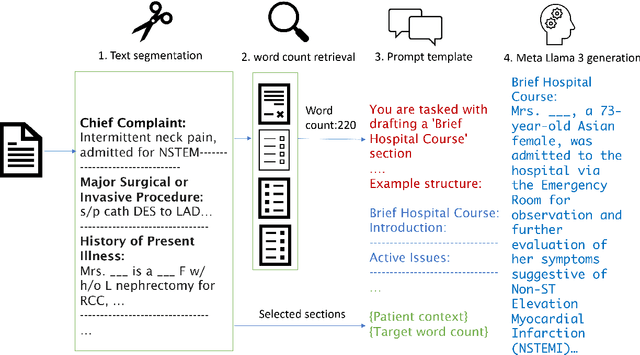
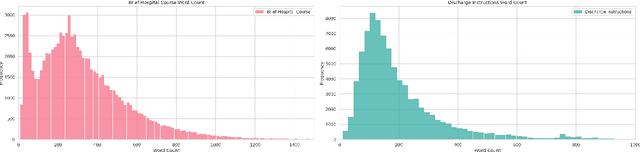

The BioNLP ACL'24 Shared Task on Streamlining Discharge Documentation aims to reduce the administrative burden on clinicians by automating the creation of critical sections of patient discharge letters. This paper presents our approach using the Llama3 8B quantized model to generate the "Brief Hospital Course" and "Discharge Instructions" sections. We employ a zero-shot method combined with Retrieval-Augmented Generation (RAG) to produce concise, contextually accurate summaries. Our contributions include the development of a curated template-based approach to ensure reliability and consistency, as well as the integration of RAG for word count prediction. We also describe several unsuccessful experiments to provide insights into our pathway for the competition. Our results demonstrate the effectiveness and efficiency of our approach, achieving high scores across multiple evaluation metrics.
Feature2Vec: Distributional semantic modelling of human property knowledge
Aug 29, 2019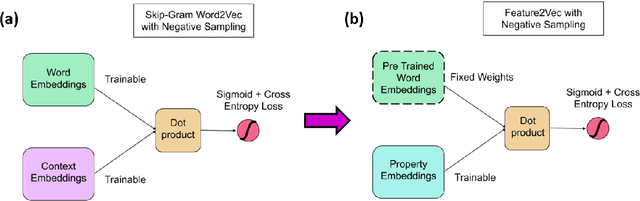
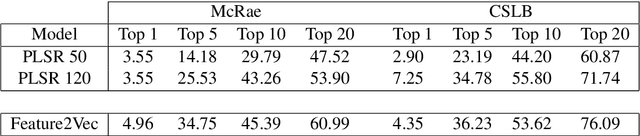
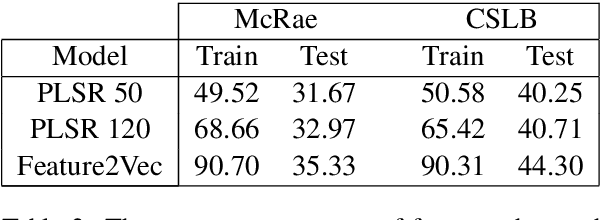
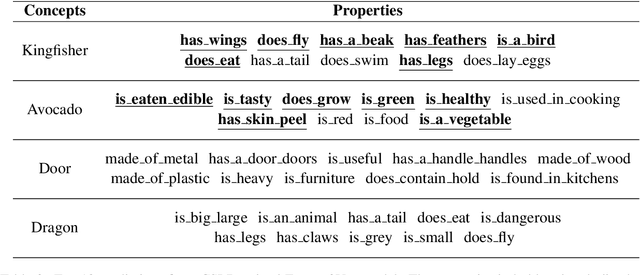
Feature norm datasets of human conceptual knowledge, collected in surveys of human volunteers, yield highly interpretable models of word meaning and play an important role in neurolinguistic research on semantic cognition. However, these datasets are limited in size due to practical obstacles associated with exhaustively listing properties for a large number of words. In contrast, the development of distributional modelling techniques and the availability of vast text corpora have allowed researchers to construct effective vector space models of word meaning over large lexicons. However, this comes at the cost of interpretable, human-like information about word meaning. We propose a method for mapping human property knowledge onto a distributional semantic space, which adapts the word2vec architecture to the task of modelling concept features. Our approach gives a measure of concept and feature affinity in a single semantic space, which makes for easy and efficient ranking of candidate human-derived semantic properties for arbitrary words. We compare our model with a previous approach, and show that it performs better on several evaluation tasks. Finally, we discuss how our method could be used to develop efficient sampling techniques to extend existing feature norm datasets in a reliable way.
* 7 pages, Proceedings of the 2019 Conference on Empirical Methods in Natural Language Processing (EMNLP 2019)
Using Sparse Semantic Embeddings Learned from Multimodal Text and Image Data to Model Human Conceptual Knowledge
Sep 18, 2018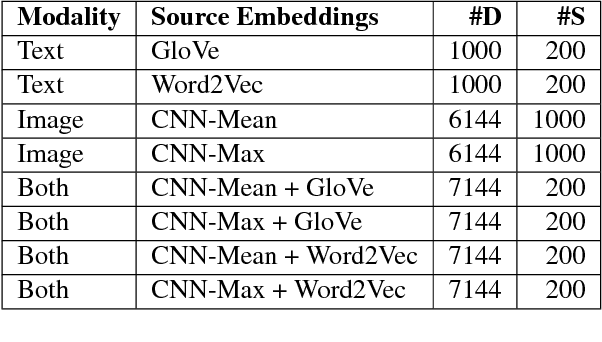
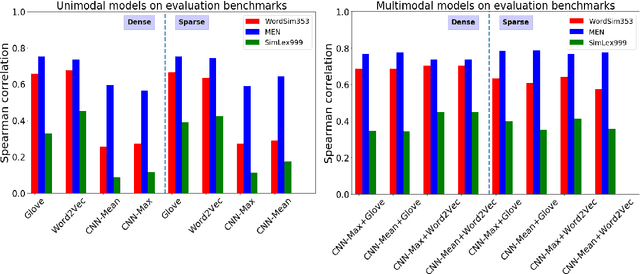
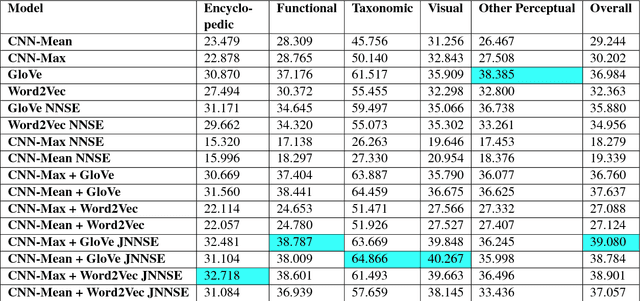
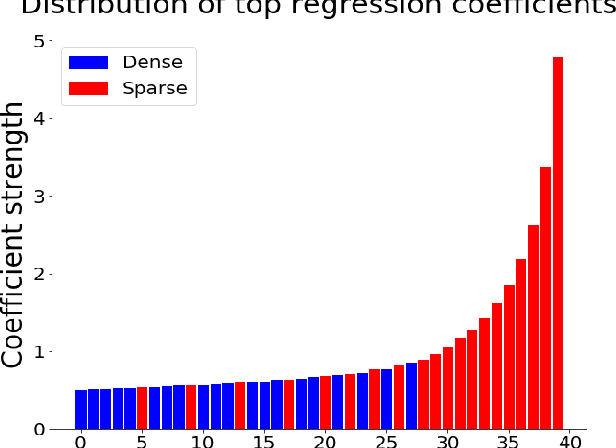
Distributional models provide a convenient way to model semantics using dense embedding spaces derived from unsupervised learning algorithms. However, the dimensions of dense embedding spaces are not designed to resemble human semantic knowledge. Moreover, embeddings are often built from a single source of information (typically text data), even though neurocognitive research suggests that semantics is deeply linked to both language and perception. In this paper, we combine multimodal information from both text and image-based representations derived from state-of-the-art distributional models to produce sparse, interpretable vectors using Joint Non-Negative Sparse Embedding. Through in-depth analyses comparing these sparse models to human-derived behavioural and neuroimaging data, we demonstrate their ability to predict interpretable linguistic descriptions of human ground-truth semantic knowledge.