 Add to Chrome
 Add to Firefox
 Add to Edge
Deep Unrolled Networks in Representation Space Applied to MRI Reconstruction
Jun 19, 2026
Deep unrolled networks (DUNs) integrate physical forward models with learned regularization in cascaded network architectures, achieving exceptional performance in inverse problems while maintaining interpretability. While most DUNs operate in the object domain (e.g., image space), recent variants explored representation spaces for improved information flow. However, these methods rely on heuristic methods for data consistency (DC), sacrificing fidelity with measurements. In this work, we introduce DUNE (Deep Unrolled Networks in rEpresentation space), a framework that maintains exact adherence to physical measurements while operating in learned representation spaces. By deriving the DC gradient via the chain rule and implementing it through the Vector-Jacobian Product (VJP), we enable exact backpropagation of measurement residuals into the representation space. This formulation supports diverse architectural backbones, including pre-trained encoders to guide the iterative process. We assess DUNE against state-of-the-art baselines on accelerated MRI reconstruction tasks, demonstrating that exact VJP-based gradients yield superior reconstruction quality and structural fidelity across both single-channel portable low-field and multi-channel clinical high-field MRI acquisitions. The code will be available upon publication at https://github.com/EfeIlicak/DUNE.

Brain-Shift: Unsupervised Pseudo-Healthy Brain Synthesis for Novel Biomarker Extraction in Chronic Subdural Hematoma
Mar 28, 2024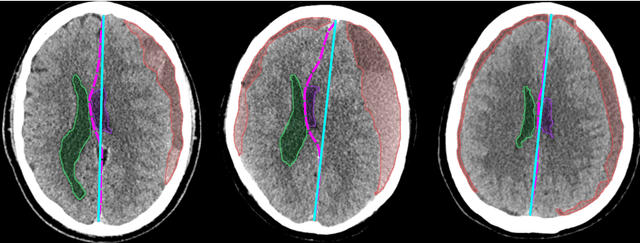
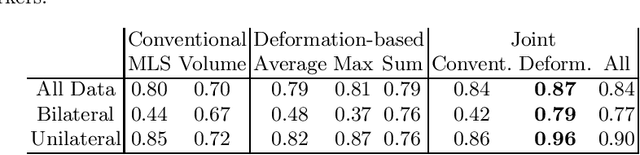
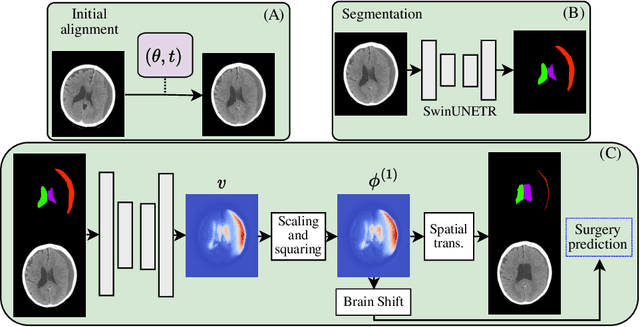
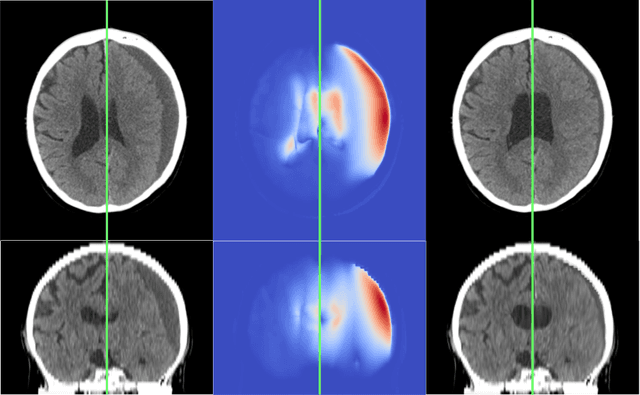
Chronic subdural hematoma (cSDH) is a common neurological condition characterized by the accumulation of blood between the brain and the dura mater. This accumulation of blood can exert pressure on the brain, potentially leading to fatal outcomes. Treatment options for cSDH are limited to invasive surgery or non-invasive management. Traditionally, the midline shift, hand-measured by experts from an ideal sagittal plane, and the hematoma volume have been the primary metrics for quantifying and analyzing cSDH. However, these approaches do not quantify the local 3D brain deformation caused by cSDH. We propose a novel method using anatomy-aware unsupervised diffeomorphic pseudo-healthy synthesis to generate brain deformation fields. The deformation fields derived from this process are utilized to extract biomarkers that quantify the shift in the brain due to cSDH. We use CT scans of 121 patients for training and validation of our method and find that our metrics allow the identification of patients who require surgery. Our results indicate that automatically obtained brain deformation fields might contain prognostic value for personalized cSDH treatment. Our implementation is available on: github.com/Barisimre/brain-morphing
LaB-GATr: geometric algebra transformers for large biomedical surface and volume meshes
Mar 12, 2024Many anatomical structures can be described by surface or volume meshes. Machine learning is a promising tool to extract information from these 3D models. However, high-fidelity meshes often contain hundreds of thousands of vertices, which creates unique challenges in building deep neural network architectures. Furthermore, patient-specific meshes may not be canonically aligned which limits the generalisation of machine learning algorithms. We propose LaB-GATr, a transfomer neural network with geometric tokenisation that can effectively learn with large-scale (bio-)medical surface and volume meshes through sequence compression and interpolation. Our method extends the recently proposed geometric algebra transformer (GATr) and thus respects all Euclidean symmetries, i.e. rotation, translation and reflection, effectively mitigating the problem of canonical alignment between patients. LaB-GATr achieves state-of-the-art results on three tasks in cardiovascular hemodynamics modelling and neurodevelopmental phenotype prediction, featuring meshes of up to 200,000 vertices. Our results demonstrate that LaB-GATr is a powerful architecture for learning with high-fidelity meshes which has the potential to enable interesting downstream applications. Our implementation is publicly available.