 Add to Chrome
 Add to Firefox
 Add to Edge
Sobolev Approximation by Fixed-Size Neural Networks with Arbitrary Accuracy
Jun 15, 2026
In this work, we investigate new activation functions for achieving arbitrary-accuracy Sobolev approximation by fixed-size neural networks. We first show that any function in $W^{2,\infty}((a,b)^d)$ can be approximated with arbitrary accuracy, measured in the $W^{1,\infty}$-norm, by a fixed-size neural network using the Elementary Universal Activation Function ($\mathrm{EUAF}$). To extend this result to $W^{s,\infty}((a,b)^d)$ for $s\in\mathbb{N}$, we introduce a smooth activation $\mathrm{DUAF}_{\infty}$ from the family of Differentiable Universal Activation Functions ($\mathrm{DUAF}_n$). We prove that any function in $W^{s,\infty}((a,b)^d)$ can be approximated with arbitrary accuracy in the $W^{s-1,\infty}$-norm by a fixed-size $\mathrm{DUAF}_{\infty}$-activated network. We further construct sigmoidal variants $\widetilde{\mathrm{DUAF}}_n$ and show that, for every $1\leq s\leq n$, fixed-size $\widetilde{\mathrm{DUAF}}_n$-activated networks still approximate any $f\in W^{s,\infty}((a,b)^d)$ with arbitrary accuracy in the $W^{s-1,\infty}$-norm. In all these results, the width and depth bounds are computed explicitly, and the proposed activations are elementary.

MV-SAM3D: Adaptive Multi-View Fusion for Layout-Aware 3D Generation
Mar 12, 2026Recent unified 3D generation models have made remarkable progress in producing high-quality 3D assets from a single image. Notably, layout-aware approaches such as SAM3D can reconstruct multiple objects while preserving their spatial arrangement, opening the door to practical scene-level 3D generation. However, current methods are limited to single-view input and cannot leverage complementary multi-view observations, while independently estimated object poses often lead to physically implausible layouts such as interpenetration and floating artifacts. We present MV-SAM3D, a training-free framework that extends layout-aware 3D generation with multi-view consistency and physical plausibility. We formulate multi-view fusion as a Multi-Diffusion process in 3D latent space and propose two adaptive weighting strategies -- attention-entropy weighting and visibility weighting -- that enable confidence-aware fusion, ensuring each viewpoint contributes according to its local observation reliability. For multi-object composition, we introduce physics-aware optimization that injects collision and contact constraints both during and after generation, yielding physically plausible object arrangements. Experiments on standard benchmarks and real-world multi-object scenes demonstrate significant improvements in reconstruction fidelity and layout plausibility, all without any additional training. Code is available at https://github.com/devinli123/MV-SAM3D.
Reflection-Based Task Adaptation for Self-Improving VLA
Oct 14, 2025Pre-trained Vision-Language-Action (VLA) models represent a major leap towards general-purpose robots, yet efficiently adapting them to novel, specific tasks in-situ remains a significant hurdle. While reinforcement learning (RL) is a promising avenue for such adaptation, the process often suffers from low efficiency, hindering rapid task mastery. We introduce Reflective Self-Adaptation, a framework for rapid, autonomous task adaptation without human intervention. Our framework establishes a self-improving loop where the agent learns from its own experience to enhance both strategy and execution. The core of our framework is a dual-pathway architecture that addresses the full adaptation lifecycle. First, a Failure-Driven Reflective RL pathway enables rapid learning by using the VLM's causal reasoning to automatically synthesize a targeted, dense reward function from failure analysis. This provides a focused learning signal that significantly accelerates policy exploration. However, optimizing such proxy rewards introduces a potential risk of "reward hacking," where the agent masters the reward function but fails the actual task. To counteract this, our second pathway, Success-Driven Quality-Guided SFT, grounds the policy in holistic success. It identifies and selectively imitates high-quality successful trajectories, ensuring the agent remains aligned with the ultimate task goal. This pathway is strengthened by a conditional curriculum mechanism to aid initial exploration. We conduct experiments in challenging manipulation tasks. The results demonstrate that our framework achieves faster convergence and higher final success rates compared to representative baselines. Our work presents a robust solution for creating self-improving agents that can efficiently and reliably adapt to new environments.
Learn to Memorize and to Forget: A Continual Learning Perspective of Dynamic SLAM
Jul 18, 2024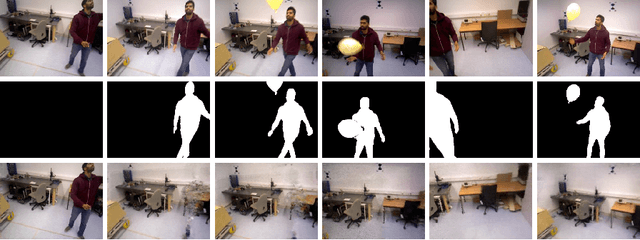
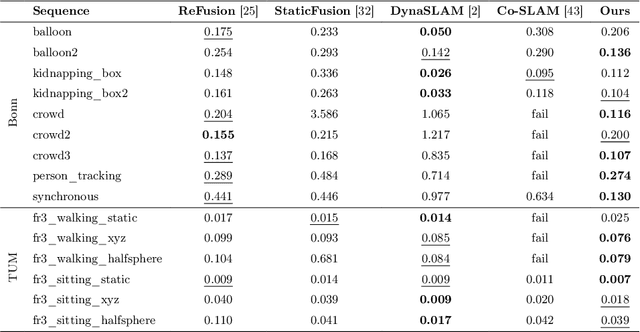
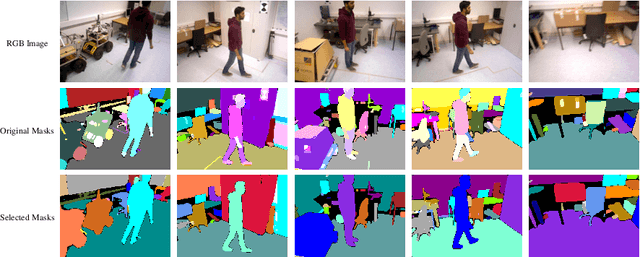
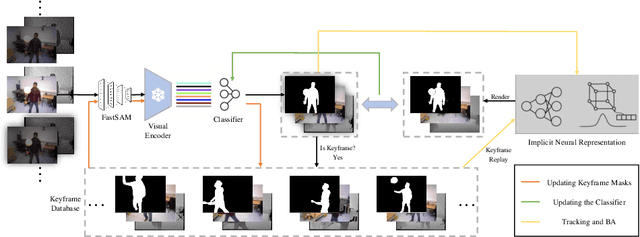
Simultaneous localization and mapping (SLAM) with implicit neural representations has received extensive attention due to the expressive representation power and the innovative paradigm of continual learning. However, deploying such a system within a dynamic environment has not been well-studied. Such challenges are intractable even for conventional algorithms since observations from different views with dynamic objects involved break the geometric and photometric consistency, whereas the consistency lays the foundation for joint optimizing the camera pose and the map parameters. In this paper, we best exploit the characteristics of continual learning and propose a novel SLAM framework for dynamic environments. While past efforts have been made to avoid catastrophic forgetting by exploiting an experience replay strategy, we view forgetting as a desirable characteristic. By adaptively controlling the replayed buffer, the ambiguity caused by moving objects can be easily alleviated through forgetting. We restrain the replay of the dynamic objects by introducing a continually-learned classifier for dynamic object identification. The iterative optimization of the neural map and the classifier notably improves the robustness of the SLAM system under a dynamic environment. Experiments on challenging datasets verify the effectiveness of the proposed framework.