 Add to Chrome
 Add to Firefox
 Add to Edge
A Neural Network Based Teleoperation for Remote Controlled Vehicles
Aug 11, 2026
Direct teleoperation of vehicles faces critical technical bottlenecks: communication latency and the operator's inability to physically perceive unmodeled environmental disturbances (e.g., aerodynamic drag, bank angles) coupled with highly nonlinear tire-road dynamics. To address these challenges, we propose a tailored unilateral teleoperation framework. The system integrates the Wave Variable (WV) approach to passively guarantee stability under stochastic delays, and an adaptive Radial Basis Function Network (RBFN) to actively compensate for vehicle-specific uncertainties. Unlike existing WV-neural network architectures designed for bilateral robotic arms, our framework features decoupled adaptive laws specifically designed for vehicle longitudinal and lateral dynamics. Furthermore, compared to model-heavy predictive controllers, the model-free RBFN offers rapid online adaptation without heavy computational overhead. Building upon our preliminary theoretical formulation, this brief paper presents comprehensive comparative analyses and real-world hardware validations. Simulation benchmarks against PID, LQR, MPC, and NMPC demonstrate that the RBFN achieves superior robustness against unmodeled disturbances while requiring orders of magnitude less execution time than MPC and NMPC, making it ideal for resource-constrained vehicle edge computing. Finally, hardware-in-the-loop experiments using a 1/10th scale vehicle over a 4G network validate the system's practical feasibility, safety, and robust trajectory tracking under physical road uncertainties.

SimBEV2X: A Large-Scale Dataset and Data Generation Tool for Multi-Task Vehicle-to-Everything Cooperative Perception
Jul 27, 2026Cooperative perception through vehicle-to-everything (V2X) communication can overcome the inherent physical limitations of individual autonomous vehicles, such as occlusions and limited sensor range. However, the development of robust V2X algorithms, particularly those relying on unified spatial representations like bird's-eye view (BEV) representation, is hampered by the lack of large-scale, multi-modal, multi-task datasets. Moreover, collecting and annotating a large set of synchronized, real-world multi-agent data is prohibitively expensive. This has resulted in a landscape where existing V2X datasets are notably limited in both size and scope. To overcome this, we introduce SimBEV2X, an advanced synthetic data generation tool built on the CARLA simulator. SimBEV2X automatically creates randomized driving scenarios to collect multi-modal sensor data alongside various types of ground truth including 3D bounding boxes with unique track IDs, HD map information, BEV segmentation maps, and semantic occupancy voxel grids from both vehicles and RSUs. We also present the SimBEV2X dataset, the largest V2X perception dataset to date. The dataset comprises 258 scenes, each involving up to 8 connected vehicles and up to 4 RSUs across a variety of road networks. The SimBEV2X dataset is an order of magnitude larger than existing V2X datasets and contains 102,200 frames, 588,520 lidar point clouds, more than 3 million images, over 27 million bounding boxes, and a comprehensive set of other annotations. Finally, we establish a strong baseline on the SimBEV2X dataset using CoopDet3D and propose CoBEVFusion, a novel architecture that combines CoopDet3D with fused axial attention (FAX) for context-aware multi-agent feature aggregation, resulting in superior performance. SimBEV2X, the SimBEV2X dataset, and CoBEVFusion are available at https://simbev2x.org and https://github.com/GoodarzMehr/SimBEV2X.
Physics-Informed Reinforcement Learning of Spatial Density Velocity Potentials for Map-Free Racing
Apr 10, 2026Autonomous racing without prebuilt maps is a grand challenge for embedded robotics that requires kinodynamic planning from instantaneous sensor data at the acceleration and tire friction limits. Out-Of-Distribution (OOD) generalization to various racetrack configurations utilizes Machine Learning (ML) to encode the mathematical relation between sensor data and vehicle actuation for end-to-end control, with implicit localization. These comprise Behavioral Cloning (BC) that is capped to human reaction times and Deep Reinforcement Learning (DRL) which requires large-scale collisions for comprehensive training that can be infeasible without simulation but is arduous to transfer to reality, thus exhibiting greater performance than BC in simulation, but actuation instability on hardware. This paper presents a DRL method that parameterizes nonlinear vehicle dynamics from the spectral distribution of depth measurements with a non-geometric, physics-informed reward, to infer vehicle time-optimal and overtaking racing controls with an Artificial Neural Network (ANN) that utilizes less than 1% of the computation of BC and model-based DRL. Slaloming from simulation to reality transfer and variance-induced conservatism are eliminated with the combination of a physics engine exploit-aware reward and the replacement of an explicit collision penalty with an implicit truncation of the value horizon. The policy outperforms human demonstrations by 12% in OOD tracks on proportionally scaled hardware, by maximizing the friction circle with tire dynamics that resemble an empirical Pacejka tire model. System identification illuminates a functional bifurcation where the first layer compresses spatial observations to extract digitized track features with higher resolution in corner apexes, and the second encodes nonlinear dynamics.
SimBEV: A Synthetic Multi-Task Multi-Sensor Driving Data Generation Tool and Dataset
Feb 04, 2025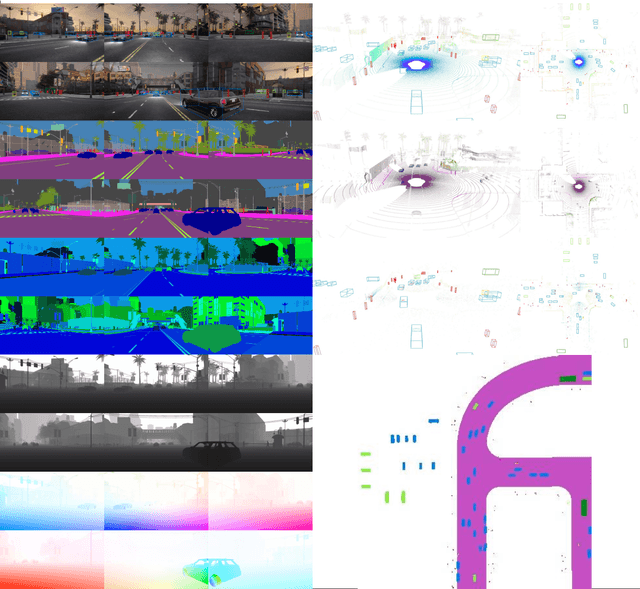
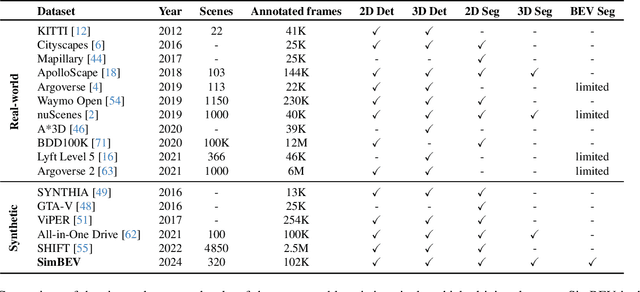
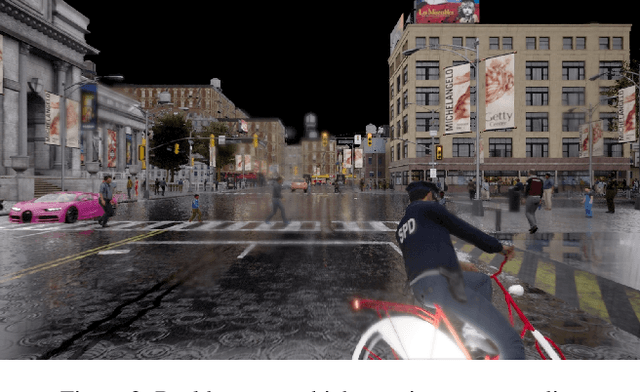
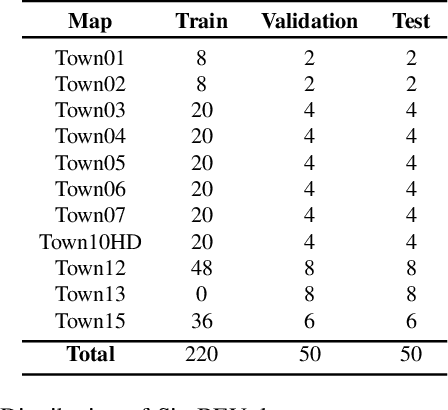
Bird's-eye view (BEV) perception for autonomous driving has garnered significant attention in recent years, in part because BEV representation facilitates the fusion of multi-sensor data. This enables a variety of perception tasks including BEV segmentation, a concise view of the environment that can be used to plan a vehicle's trajectory. However, this representation is not fully supported by existing datasets, and creation of new datasets can be a time-consuming endeavor. To address this problem, in this paper we introduce SimBEV, an extensively configurable and scalable randomized synthetic data generation tool that incorporates information from multiple sources to capture accurate BEV ground truth data, supports a comprehensive array of sensors, and enables a variety of perception tasks including BEV segmentation and 3D object detection. We use SimBEV to create the SimBEV dataset, a large collection of annotated perception data from diverse driving scenarios.
Image-Guided Outdoor LiDAR Perception Quality Assessment for Autonomous Driving
Jun 25, 2024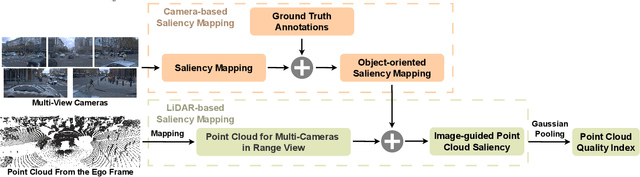
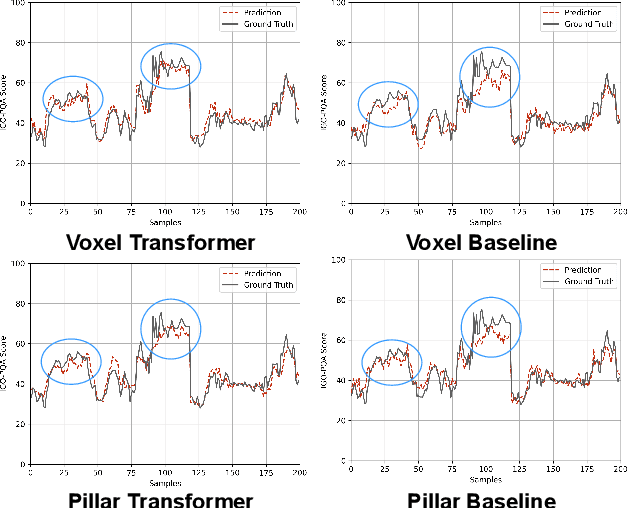
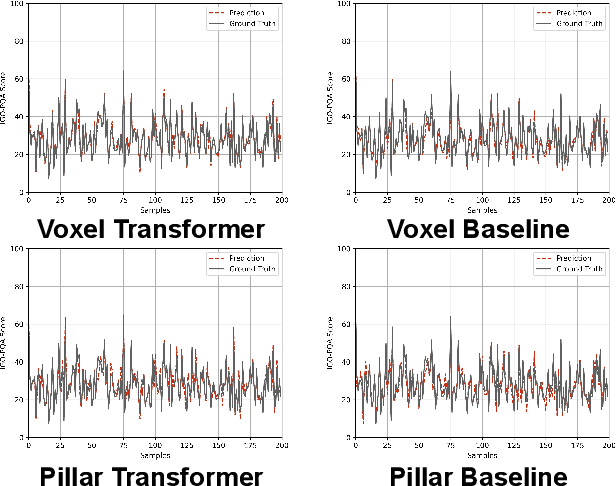

LiDAR is one of the most crucial sensors for autonomous vehicle perception. However, current LiDAR-based point cloud perception algorithms lack comprehensive and rigorous LiDAR quality assessment methods, leading to uncertainty in detection performance. Additionally, existing point cloud quality assessment algorithms are predominantly designed for indoor environments or single-object scenarios. In this paper, we introduce a novel image-guided point cloud quality assessment algorithm for outdoor autonomous driving environments, named the Image-Guided Outdoor Point Cloud Quality Assessment (IGO-PQA) algorithm. Our proposed algorithm comprises two main components. The first component is the IGO-PQA generation algorithm, which leverages point cloud data, corresponding RGB surrounding view images, and agent objects' ground truth annotations to generate an overall quality score for a single-frame LiDAR-based point cloud. The second component is a transformer-based IGO-PQA regression algorithm for no-reference outdoor point cloud quality assessment. This regression algorithm allows for the direct prediction of IGO-PQA scores in an online manner, without requiring image data and object ground truth annotations. We evaluate our proposed algorithm using the nuScenes and Waymo open datasets. The IGO-PQA generation algorithm provides consistent and reasonable perception quality indices. Furthermore, our proposed IGO-PQA regression algorithm achieves a Pearson Linear Correlation Coefficient (PLCC) of 0.86 on the nuScenes dataset and 0.97 on the Waymo dataset.
Exploration Without Maps via Zero-Shot Out-of-Distribution Deep Reinforcement Learning
Feb 07, 2024Operation of Autonomous Mobile Robots (AMRs) of all forms that include wheeled ground vehicles, quadrupeds and humanoids in dynamically changing GPS denied environments without a-priori maps, exclusively using onboard sensors, is an unsolved problem that has potential to transform the economy, and vastly improve humanity's capabilities with improvements to agriculture, manufacturing, disaster response, military and space exploration. Conventional AMR automation approaches are modularized into perception, motion planning and control which is computationally inefficient, and requires explicit feature extraction and engineering, that inhibits generalization, and deployment at scale. Few works have focused on real-world end-to-end approaches that directly map sensor inputs to control outputs due to the large amount of well curated training data required for supervised Deep Learning (DL) which is time consuming and labor intensive to collect and label, and sample inefficiency and challenges to bridging the simulation to reality gap using Deep Reinforcement Learning (DRL). This paper presents a novel method to efficiently train DRL for robust end-to-end AMR exploration, in a constrained environment at physical limits in simulation, transferred zero-shot to the real-world. The representation learned in a compact parameter space with 2 fully connected layers with 64 nodes each is demonstrated to exhibit emergent behavior for out-of-distribution generalization to navigation in new environments that include unstructured terrain without maps, and dynamic obstacle avoidance. The learned policy outperforms conventional navigation algorithms while consuming a fraction of the computation resources, enabling execution on a range of AMR forms with varying embedded computer payloads.
Cooperative Probabilistic Trajectory Forecasting under Occlusion
Dec 06, 2023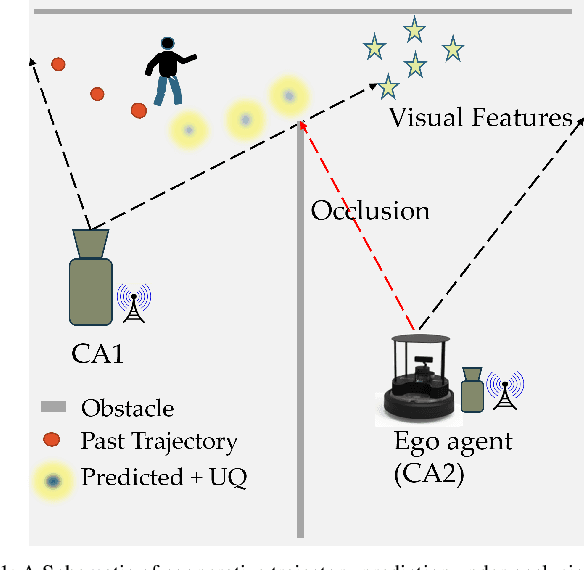
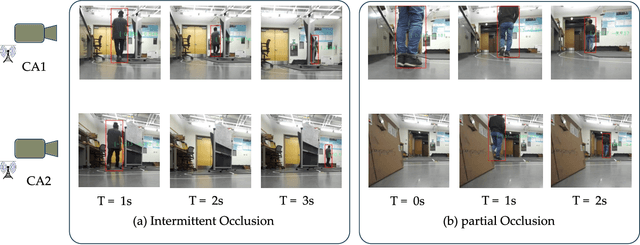
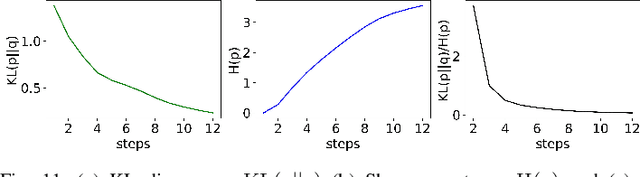
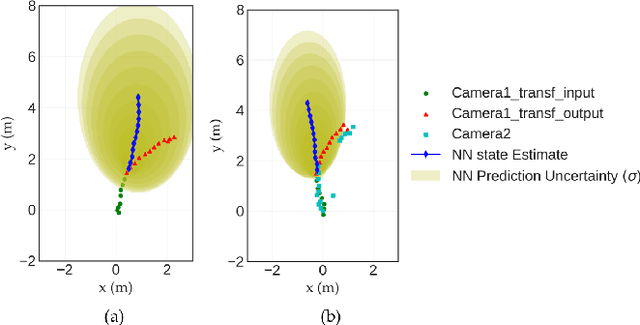
Perception and planning under occlusion is essential for safety-critical tasks. Occlusion-aware planning often requires communicating the information of the occluded object to the ego agent for safe navigation. However, communicating rich sensor information under adverse conditions during communication loss and limited bandwidth may not be always feasible. Further, in GPS denied environments and indoor navigation, localizing and sharing of occluded objects can be challenging. To overcome this, relative pose estimation between connected agents sharing a common field of view can be a computationally effective way of communicating information about surrounding objects. In this paper, we design an end-to-end network that cooperatively estimates the current states of occluded pedestrian in the reference frame of ego agent and then predicts the trajectory with safety guarantees. Experimentally, we show that the uncertainty-aware trajectory prediction of occluded pedestrian by the ego agent is almost similar to the ground truth trajectory assuming no occlusion. The current research holds promise for uncertainty-aware navigation among multiple connected agents under occlusion.
The Impact of Different Backbone Architecture on Autonomous Vehicle Dataset
Sep 15, 2023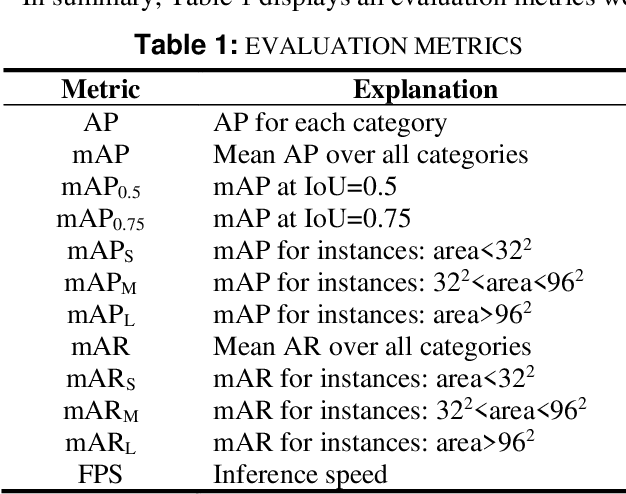
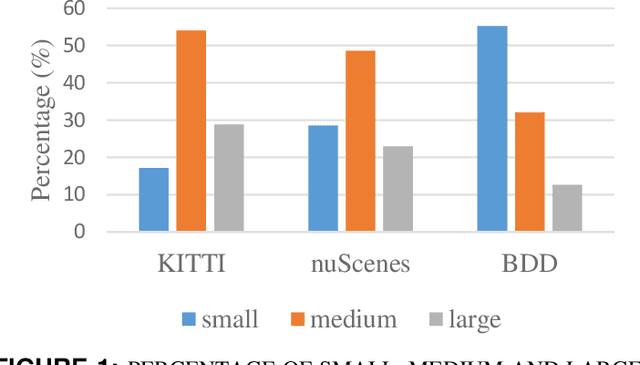
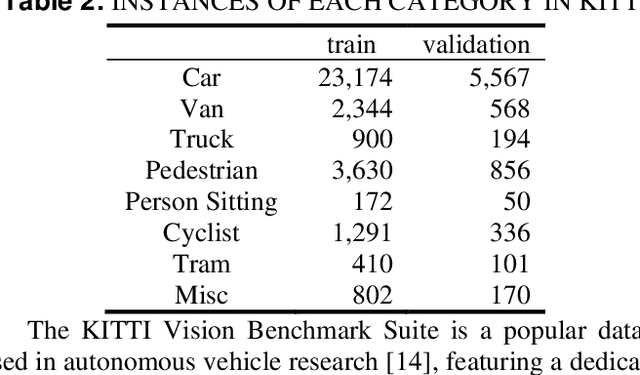

Object detection is a crucial component of autonomous driving, and many detection applications have been developed to address this task. These applications often rely on backbone architectures, which extract representation features from inputs to perform the object detection task. The quality of the features extracted by the backbone architecture can have a significant impact on the overall detection performance. Many researchers have focused on developing new and improved backbone architectures to enhance the efficiency and accuracy of object detection applications. While these backbone architectures have shown state-of-the-art performance on generic object detection datasets like MS-COCO and PASCAL-VOC, evaluating their performance under an autonomous driving environment has not been previously explored. To address this, our study evaluates three well-known autonomous vehicle datasets, namely KITTI, NuScenes, and BDD, to compare the performance of different backbone architectures on object detection tasks.
Pedestrian Trajectory Forecasting Using Deep Ensembles Under Sensing Uncertainty
May 26, 2023One of the fundamental challenges in the prediction of dynamic agents is robustness. Usually, most predictions are deterministic estimates of future states which are over-confident and prone to error. Recently, few works have addressed capturing uncertainty during forecasting of future states. However, these probabilistic estimation methods fail to account for the upstream noise in perception data during tracking. Sensors always have noise and state estimation becomes even more difficult under adverse weather conditions and occlusion. Traditionally, Bayes filters have been used to fuse information from noisy sensors to update states with associated belief. But, they fail to address non-linearities and long-term predictions. Therefore, we propose an end-to-end estimator that can take noisy sensor measurements and make robust future state predictions with uncertainty bounds while simultaneously taking into consideration the upstream perceptual uncertainty. For the current research, we consider an encoder-decoder based deep ensemble network for capturing both perception and predictive uncertainty simultaneously. We compared the current model to other approximate Bayesian inference methods. Overall, deep ensembles provided more robust predictions and the consideration of upstream uncertainty further increased the estimation accuracy for the model.
Probabilistic RRT Connect with intermediate goal selection for online planning of autonomous vehicles
May 14, 2023Rapidly Exploring Random Trees (RRT) is one of the most widely used algorithms for motion planning in the field of robotics. To reduce the exploration time, RRT-Connect was introduced where two trees are simultaneously formed and eventually connected. Probabilistic RRT used the concept of position probability map to introduce goal biasing for faster convergence. In this paper, we propose a modified method to combine the pRRT and RRT-Connect techniques and obtain a feasible trajectory around the obstacles quickly. Instead of forming a single tree from the start point to the destination point, intermediate goal points are selected around the obstacles. Multiple trees are formed to connect the start, destination, and intermediate goal points. These partial trees are eventually connected to form an overall safe path around the obstacles. The obtained path is tracked using an MPC + Stanley controller which results in a trajectory with control commands at each time step. The trajectories generated by the proposed methods are more optimal and in accordance with human intuition. The algorithm is compared with the standard RRT and pRRT for studying its relative performance.