 Add to Chrome
 Add to Firefox
 Add to Edge
Signed Compression Progress on a Sealed Audit is Goodhart-Resistant
Jun 09, 2026
Compression progress is a long-standing proposal for intrinsic motivation: reward an agent when its world model becomes better at predicting or compressing experience. The folk claim is that this reward is "credible" because it is paid only for learning. We make this precise and prove it. If intrinsic reward is the signed decrease of a fixed sealed-audit loss, r_t = E(theta_{t-1}) - E(theta_t), then cumulative reward telescopes exactly to endpoint audit improvement, so no policy can push reward up indefinitely while true audit performance stagnates or degrades. For finite audit panels the same result holds with a sharp false-positive budget: cumulative empirical reward is at most true audit improvement plus 2 Delta_n(F, delta), the uniform audit deviation of the model class. This is horizon-free: adaptivity over time costs nothing once the sealed panel uniformly controls the class. The theorem also identifies the failure modes: the guarantee disappears if progress is clipped, scored on the agent's own stream, exposed to a high-capacity model on a reusable panel, or applied to a neural class that makes Delta_n vacuous. We give a Lean 4 mechanization of the structural core (telescoping, the finite-audit bound, finite Gibbs, and the entropy floor) and an experiment suite on ARC-TGI grid-transformation generators with adaptive holdout attacks. Experiments confirm the theory: finite-audit deviation scales as n^{-0.527}; signed progress resists clip-farming, stream leakage, and noisy-TV curiosity; naive reusable audits are exploitable by black-box scalar feedback, while standard release defenses keep the attack below the 2 Delta_n threshold. Signed compression progress on a sealed audit is an accounting signal of genuine improvement.

Multilevel profiling of situation and dialogue-based deep networks for movie genre classification using movie trailers
Sep 14, 2021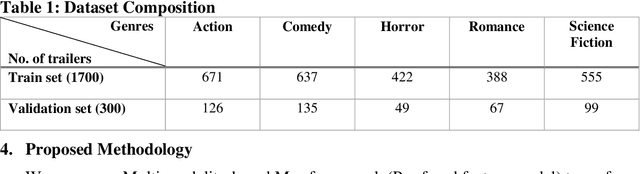
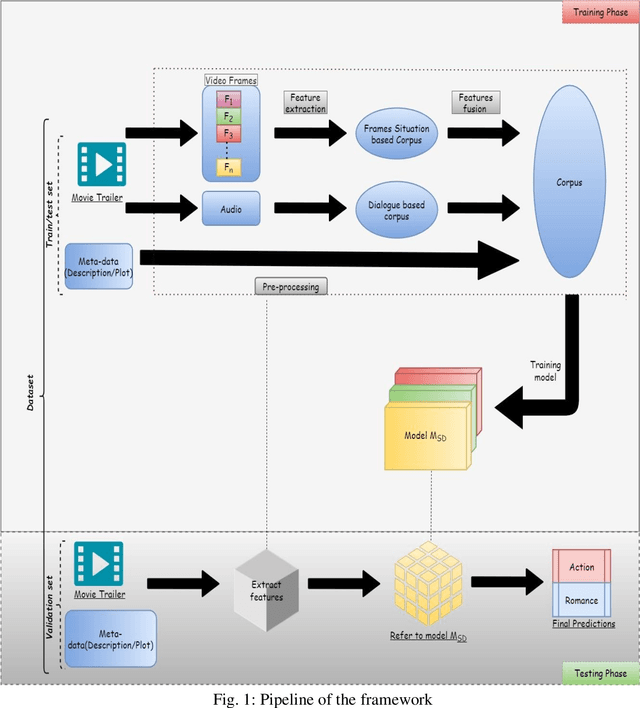
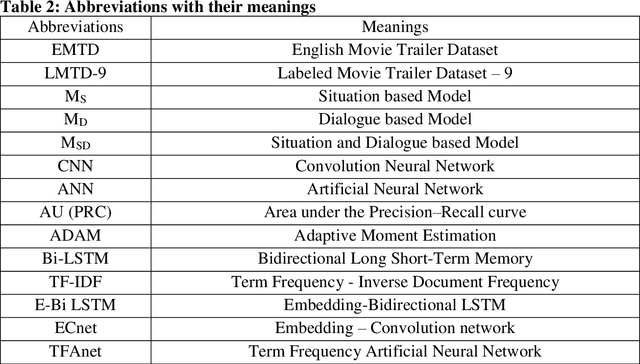
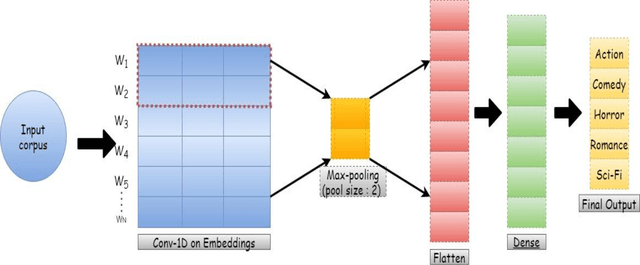
Automated movie genre classification has emerged as an active and essential area of research and exploration. Short duration movie trailers provide useful insights about the movie as video content consists of the cognitive and the affective level features. Previous approaches were focused upon either cognitive or affective content analysis. In this paper, we propose a novel multi-modality: situation, dialogue, and metadata-based movie genre classification framework that takes both cognition and affect-based features into consideration. A pre-features fusion-based framework that takes into account: situation-based features from a regular snapshot of a trailer that includes nouns and verbs providing the useful affect-based mapping with the corresponding genres, dialogue (speech) based feature from audio, metadata which together provides the relevant information for cognitive and affect based video analysis. We also develop the English movie trailer dataset (EMTD), which contains 2000 Hollywood movie trailers belonging to five popular genres: Action, Romance, Comedy, Horror, and Science Fiction, and perform cross-validation on the standard LMTD-9 dataset for validating the proposed framework. The results demonstrate that the proposed methodology for movie genre classification has performed excellently as depicted by the F1 scores, precision, recall, and area under the precision-recall curves.
Unsupervised Domain Adaptation in the Wild: Dealing with Asymmetric Label Sets
Mar 26, 2016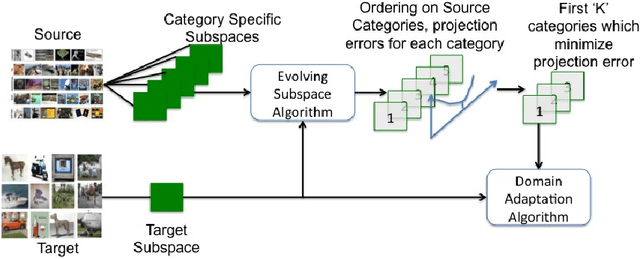
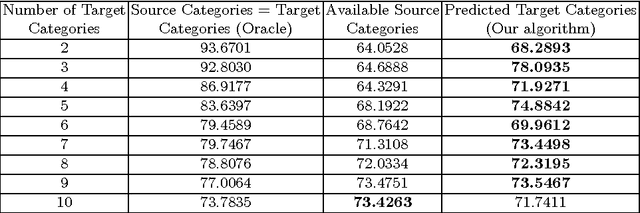
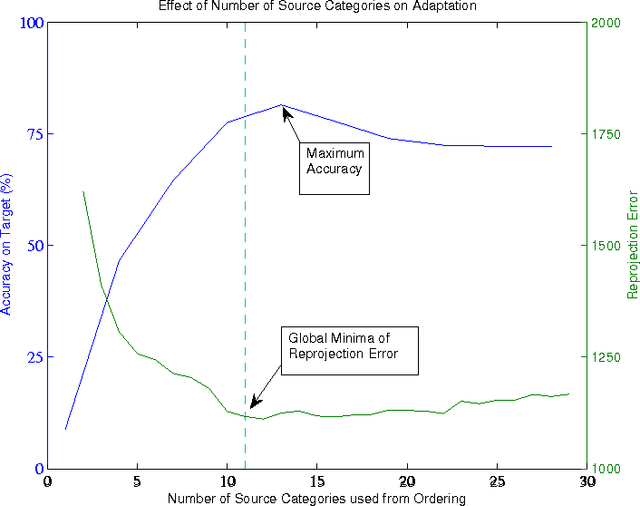

The goal of domain adaptation is to adapt models learned on a source domain to a particular target domain. Most methods for unsupervised domain adaptation proposed in the literature to date, assume that the set of classes present in the target domain is identical to the set of classes present in the source domain. This is a restrictive assumption that limits the practical applicability of unsupervised domain adaptation techniques in real world settings ("in the wild"). Therefore, we relax this constraint and propose a technique that allows the set of target classes to be a subset of the source classes. This way, large publicly available annotated datasets with a wide variety of classes can be used as source, even if the actual set of classes in target can be more limited and, maybe most importantly, unknown beforehand. To this end, we propose an algorithm that orders a set of source subspaces that are relevant to the target classification problem. Our method then chooses a restricted set from this ordered set of source subspaces. As an extension, even starting from multiple source datasets with varied sets of categories, this method automatically selects an appropriate subset of source categories relevant to a target dataset. Empirical analysis on a number of source and target domain datasets shows that restricting the source subspace to only a subset of categories does indeed substantially improve the eventual target classification accuracy over the baseline that considers all source classes.