 Add to Chrome
 Add to Firefox
 Add to Edge
Grammar of the Wave: Towards Explainable Multivariate Time Series Event Detection via Neuro-Symbolic VLM Agents
Mar 12, 2026
Time Series Event Detection (TSED) has long been an important task with critical applications across many high-stakes domains. Unlike statistical anomalies, events are defined by semantics with complex internal structures, which are difficult to learn inductively from scarce labeled data in real-world settings. In light of this, we introduce Knowledge-Guided TSED, a new setting where a model is given a natural-language event description and must ground it to intervals in multivariate signals with little or no training data. To tackle this challenge, we introduce Event Logic Tree (ELT), a novel knowledge representation framework to bridge linguistic descriptions and physical time series data via modeling the intrinsic temporal-logic structures of events. Based on ELT, we present a neuro-symbolic VLM agent framework that iteratively instantiates primitives from signal visualizations and composes them under ELT constraints, producing both detected intervals and faithful explanations in the form of instantiated trees. To validate the effectiveness of our approach, we release a benchmark based on real-world time series data with expert knowledge and annotations. Experiments and human evaluation demonstrate the superiority of our method compared to supervised fine-tuning baselines and existing zero-shot time series reasoning frameworks based on LLMs/VLMs. We also show that ELT is critical in mitigating VLMs' inherent hallucination in matching signal morphology with event semantics.

Forecasting Electric Vehicle Charging Station Occupancy: Smarter Mobility Data Challenge
Jun 09, 2023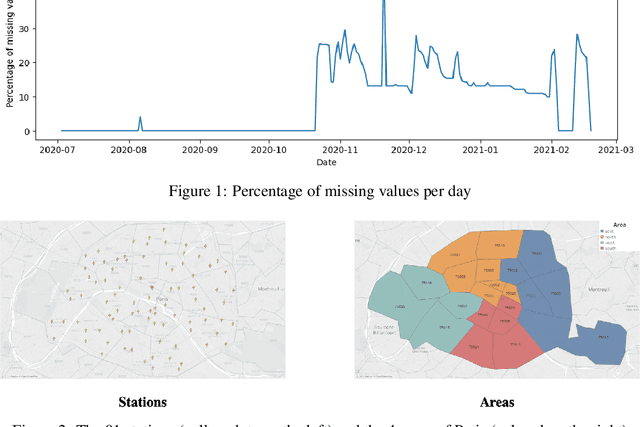


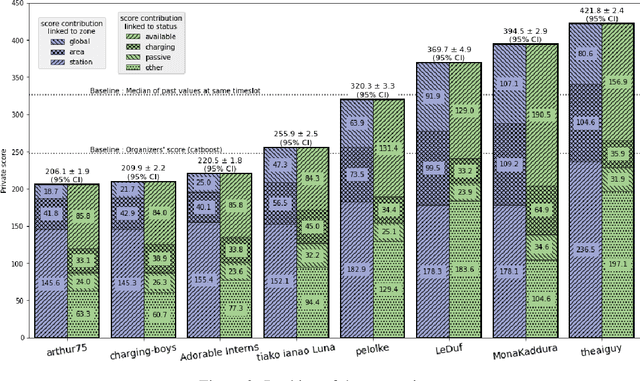
The transport sector is a major contributor to greenhouse gas emissions in Europe. Shifting to electric vehicles (EVs) powered by a low-carbon energy mix would reduce carbon emissions. However, to support the development of electric mobility, a better understanding of EV charging behaviours and more accurate forecasting models are needed. To fill that gap, the Smarter Mobility Data Challenge has focused on the development of forecasting models to predict EV charging station occupancy. This challenge involved analysing a dataset of 91 charging stations across four geographical areas over seven months in 2020-2021. The forecasts were evaluated at three levels of aggregation (individual stations, areas and global) to capture the inherent hierarchical structure of the data. The results highlight the potential of hierarchical forecasting approaches to accurately predict EV charging station occupancy, providing valuable insights for energy providers and EV users alike. This open dataset addresses many real-world challenges associated with time series, such as missing values, non-stationarity and spatio-temporal correlations. Access to the dataset, code and benchmarks are available at https://gitlab.com/smarter-mobility-data-challenge/tutorials to foster future research.