 Add to Chrome
 Add to Firefox
 Add to Edge
Grammar of the Wave: Towards Explainable Multivariate Time Series Event Detection via Neuro-Symbolic VLM Agents
Mar 12, 2026
Time Series Event Detection (TSED) has long been an important task with critical applications across many high-stakes domains. Unlike statistical anomalies, events are defined by semantics with complex internal structures, which are difficult to learn inductively from scarce labeled data in real-world settings. In light of this, we introduce Knowledge-Guided TSED, a new setting where a model is given a natural-language event description and must ground it to intervals in multivariate signals with little or no training data. To tackle this challenge, we introduce Event Logic Tree (ELT), a novel knowledge representation framework to bridge linguistic descriptions and physical time series data via modeling the intrinsic temporal-logic structures of events. Based on ELT, we present a neuro-symbolic VLM agent framework that iteratively instantiates primitives from signal visualizations and composes them under ELT constraints, producing both detected intervals and faithful explanations in the form of instantiated trees. To validate the effectiveness of our approach, we release a benchmark based on real-world time series data with expert knowledge and annotations. Experiments and human evaluation demonstrate the superiority of our method compared to supervised fine-tuning baselines and existing zero-shot time series reasoning frameworks based on LLMs/VLMs. We also show that ELT is critical in mitigating VLMs' inherent hallucination in matching signal morphology with event semantics.

Mining customer product reviews for product development: A summarization process
Jan 13, 2020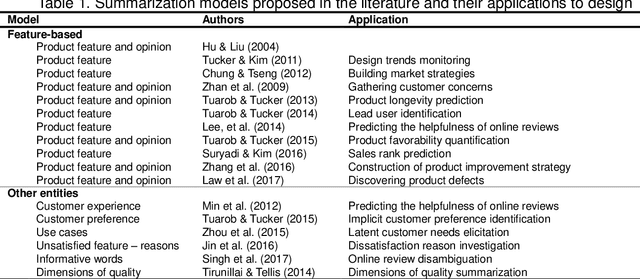
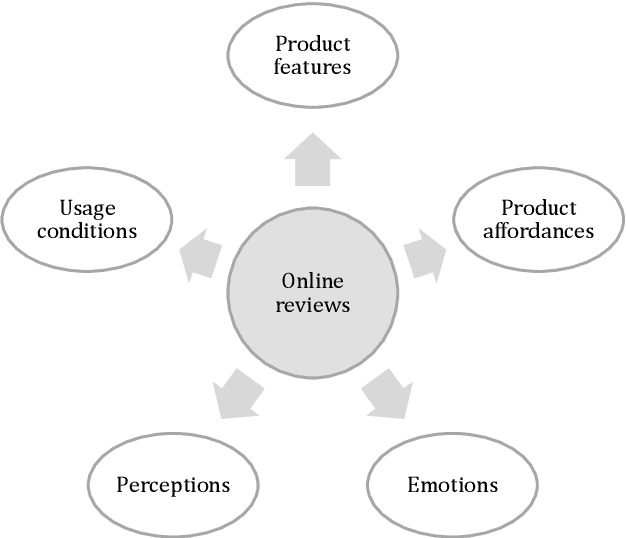
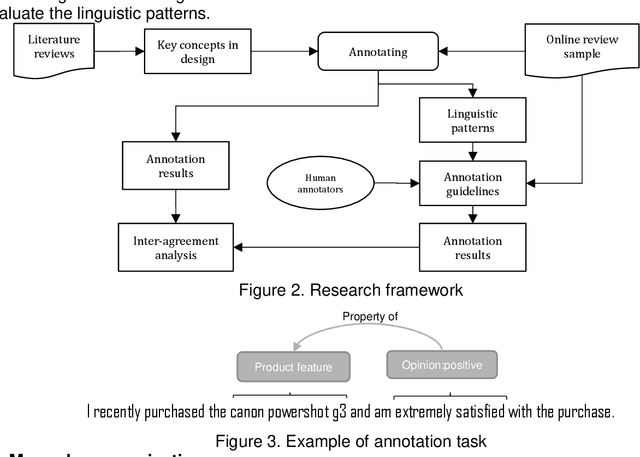
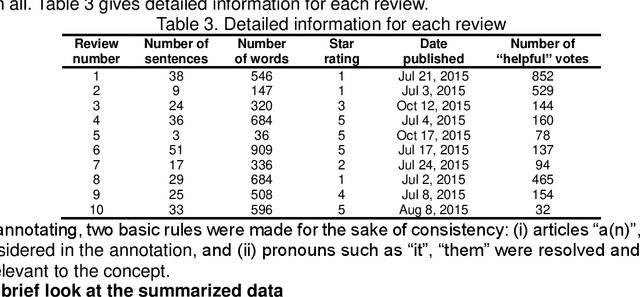
This research set out to identify and structure from online reviews the words and expressions related to customers' likes and dislikes to guide product development. Previous methods were mainly focused on product features. However, reviewers express their preference not only on product features. In this paper, based on an extensive literature review in design science, the authors propose a summarization model containing multiples aspects of user preference, such as product affordances, emotions, usage conditions. Meanwhile, the linguistic patterns describing these aspects of preference are discovered and drafted as annotation guidelines. A case study demonstrates that with the proposed model and the annotation guidelines, human annotators can structure the online reviews with high inter-agreement. As high inter-agreement human annotation results are essential for automatizing the online review summarization process with the natural language processing, this study provides materials for the future study of automatization.
Mining Changes in User Expectation Over Time From Online Reviews
Jan 13, 2020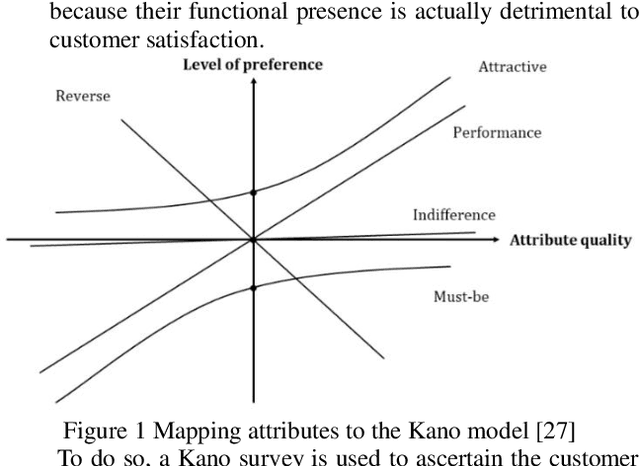
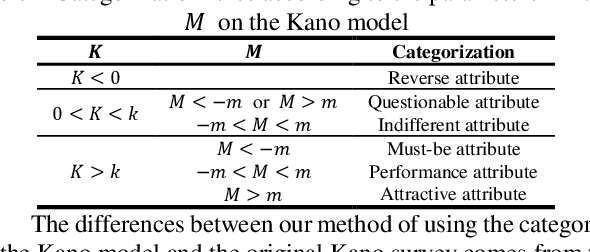
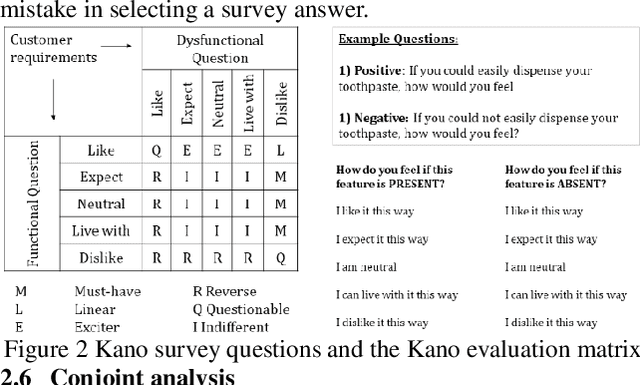
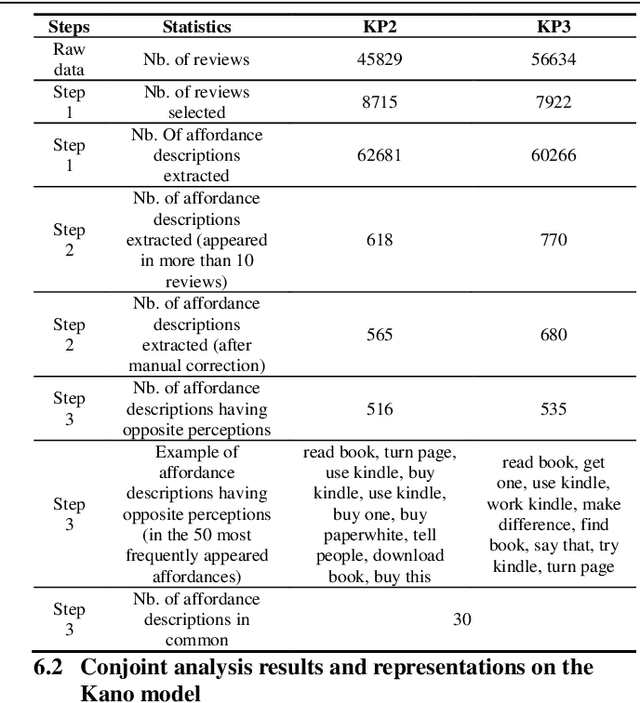
Customers post online reviews at any time. With the timestamp of online reviews, they can be regarded as a flow of information. With this characteristic, designers can capture the changes in customer feedback to help set up product improvement strategies. Here we propose an approach for capturing changes of user expectation on product affordances based on the online reviews for two generations of products. First, the approach uses a rule-based natural language processing method to automatically identify and structure product affordances from review text. Then, inspired by the Kano model which classifies preferences of product attributes in five categories, conjoint analysis is used to quantitatively categorize the structured affordances. Finally, changes of user expectation can be found by applying the conjoint analysis on the online reviews posted for two successive generations of products. A case study based on the online reviews of Kindle e-readers downloaded from amazon.com shows that designers can use our proposed approach to evaluate their product improvement strategies for previous products and develop new product improvement strategies for future products.